
By Josh Lederman and Sahil Kapur
WASHINGTON — As the coronavirus crisis ravages the U.S. economy, millions of Americans are about to receive help from Congress in the form of direct cash payments.
President Donald Trump signed into law a massive $2 trillion emergency economic package on Friday that includes direct cash payments and unemployment benefits, among other provisions, for people across the country.
But who’s eligible to get a check or direct deposit, and for how much? Here are some questions and answers about who qualifies for cash from the federal government:
Q: How much will I get?
Depends on how much you make.
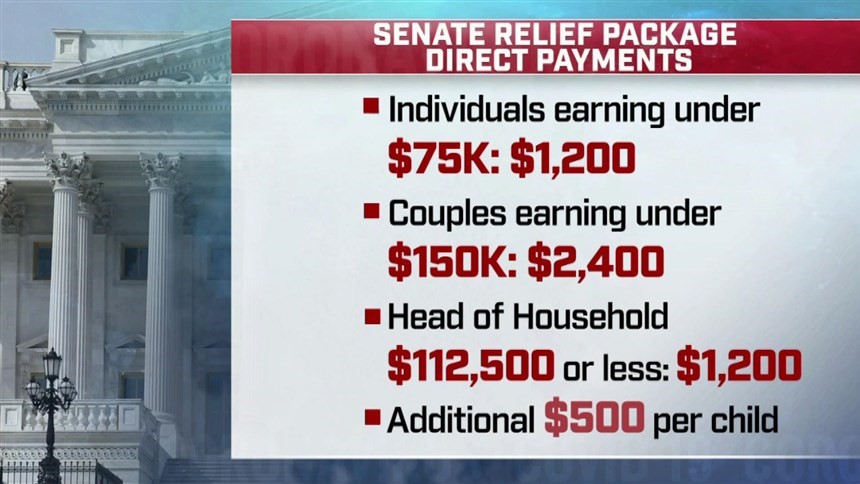
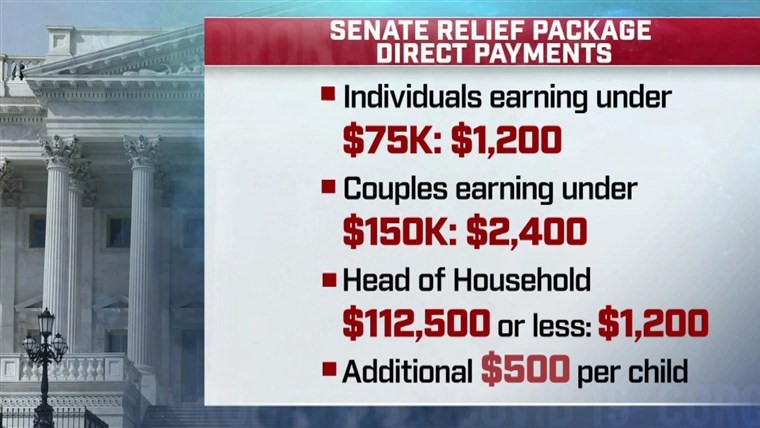
If you made less than $75,000 in 2019, you will be eligible for the full payment of $1,200. Couples who filed jointly and made less than $150,000 will get $2,400. An individual who filed as “head of household” and earned $112,500 or less gets $1,200.
Who qualifies to receive money from the Senate coronavirus relief plan?
March 26, 202004:32
For every child in the household, you will receive an additional $500.
If you made more than $75,000, your payment will be reduced by $5 for every $100 of income that exceeds the limits. So if you made $80,000 in 2019, you will receive $950. The payment decreases to zero for an individual making $99,000 or more or a couple making $198,000 or more.
If you’re a family of four, you’ll be eligible for a maximum of $3,400.
Q: When is the money coming?
Treasury Secretary Steven Mnuchin said Wednesday the checks will be sent out “within three weeks” to people for whom the IRS has information. You don’t need to sign up or fill out a form to receive a payment if you’ve been working and paying taxes since 2018.
The Treasury Department will also run a “public awareness campaign” with information about the program, including for people who didn’t file a tax return for 2018 or 2019.
Q: Will there be multiple payments?
No, this legislation only authorizes one-time payments. But House Speaker Nancy Pelosi suggested on CNN that Congress could revisit the issue: “We think we’ll get more direct payments in another bill.”
Q: Where do I sign up?
You don’t. There’s no sign up. The payments will be automatic for people who have filed a tax return or gotten Social Security benefits recently. The IRS asks people not to call with questions, but to keep checking this website where they will post updates about the program once they are available.
Q: How will the money be sent?
If you’ve gotten a tax refund in the last two years by direct deposit, that’s where the money will be sent. If not, the IRS can mail a check to your “last known address,” and it has 15 days to notify you of the method and amount of the payment. They’ll send a phone number and appropriate point of contact so you can tell them if you didn’t receive it.
If you’ve moved recently, it may be a good idea to notify the IRS as soon as possible. The IRS also suggests that if you haven’t yet filed a tax return for 2018 or 2019, do it as soon as you can, so that the government has your up-to-date information on file.
Q: How does the gov’t calculate how much I earned?
Have you filed your taxes for 2019 already? If so, the checks will automatically be based on your 2019 return. Look for your “adjusted gross income” (Line 7 on your Form 1040 tax return in 2018, or line 8B on a 2019 return.) If you haven’t filed your 2019 taxes yet, it’ll be based on your 2018 return.
Q: I’m on Social Security, or don’t make enough to file a tax return. Will I get a check?
Yes. Even if you didn’t file a tax return for 2018 or 2019 or pay taxes in those years, you will be eligible if you received a Form SSA-1099 for the year 2019. That’s a form that the Social Security Administration sends each year to people who receive Social Security benefits, including retirement and disability.
Q: I’m a disabled vet but don’t pay taxes. Do I qualify?
Yes, although some of the details still need to be worked out. The IRS is expected to set up a system so that disabled veterans don’t fall through the cracks.
Q: I’m a college student. Do I get a check?
If your parents claim you as a dependent on their taxes, you’re ineligible. But if you’ve been working and filing taxes independently in recent years, you may qualify.
Q: I made too much money in 2019 to qualify. But now I’ve been laid off. Am I out of luck?
Not necessarily, but you’ll have to wait.
If you made too much to qualify in your last tax filing, you probably won’t be eligible for the cash benefit immediately. But you can apply for it when you file your 2020 tax return if your income drops below below $99,000 threshold for individuals (which doubles for couples) this year.
The IRS is expected to create a system to ensure help for people who fall into this category.
Q: I’m not an American citizen. Do I qualify?
Yes — as long as you’re living and working in the U.S. with a valid Social Security number. That includes green card holders, and it generally includes those on work visas, such as an H-1B and H-2A. But it generally excludes visitors and people who are in the U.S. illegally.
Q: Are the cash payments taxable?
Nope.
Q: Do I have to pay the money back?
No. The money isn’t a loan, but a credit. You are not required to pay the government back.
Q: I live in Puerto Rico or another U.S. territory. Is that a problem?
Not at all. There’s a special provision ensuring that people living in U.S. territories, even ones that have a different tax system, are still eligible.
Q: What if I’m homeless or recently got out of prison? Will I get help?
As long as you have a Social Security number, you should be eligible to apply for the relief payments under the new system created by the IRS.
Q: I owe back taxes. Will the IRS snatch my check?
No, your payment won’t be affected if you owe past due taxes to federal or state governments.
Q: I’m behind on child support payments. Does that affect me?
Yes, that’s a problem. The IRS may reduce the amount you receive if you have past due child support payments that have been reported by states to the Treasury Department.

My 38 year old Homeless Grandson has had no income for 5-6 years. Therefore, he has not needed to file a tax return. The only way he has to receive mail is by having it delivered to our place. He also lost his ID, but does have a social security card. Would he qualify for the 2020 Stimulus check?
Probably. He should go to IRS.gov and input his banking information
My Grandson is homeless and he has not had any income. Would he qualify for the 2020 Stimulus check?