
The Louisiana Insurance Tax — Part 2 of 5 | By Jeff Thomas
| TL;DR — THE SHORT VERSION A senator from West Monroe — nearly 400 miles from New Orleans — just voted to eliminate a New Orleans official’s elected position before he could be sworn in. That same legislature is doing nothing about the insurance industry extracting hundreds of dollars a year from poor Louisiana families of every race. One senator from New Orleans, Royce Duplessis, is fighting both fights at the same time. This article shows you how the machine works, who it hits, and why the same system robbing Black neighborhoods in New Orleans East is also robbing white families in Beauregard, Winn, and Sabine parishes. |
| KEY POINTS A senator from Ouachita Parish decided Orleans Parish’s business: Sen. Jay Morris of West Monroe filed three bills to restructure New Orleans courts — without consulting a single Orleans judge. On April 8, the Senate voted 25-11 along party lines to pass SB 256, eliminating the position of Calvin Duncan before he could be sworn in. Duplessis called it what it was: On the Senate floor,Sen Royce Duplessis invoked John Willis Menard — a Black man elected to Congress in 1868 who was never allowed to be seated. “This will be recorded a century from now,” Duplessis said. “What side are you on?” Meanwhile at the insurance committee: Senator Duplessis’s Senate Bill 267 — which bans credit scores and ZIP codes from auto and home insurance pricing — moves quietly, without the firepower the court bills command. The LBJ playbook: Lyndon Johnson once said that convincing a poor white man he’s better than a Black man keeps him from noticing his pocket is being picked. That observation fits Baton Rouge in 2026 precisely. This hits white Louisiana too: Louisiana’s white poverty rate is 11.8%. A poor credit score — from a medical bill, a layoff, or a hurricane — adds up to 60% more on your premium regardless of how you drive. The deadline is June 1: The 2026 legislative session ends June 1. SB 267 is alive. The insurance lobby is working hard to kill it. The time to act is now. |
The Oldest Trick in American Politics
Lyndon Johnson said it plainly, back when plain-talking was still something men in power occasionally did.
“If you can convince the lowest white man he’s better than the best colored man, he won’t notice you’re picking his pocket. Hell, give him somebody to look down on and he’ll empty his pockets for you.” — President Lyndon B. Johnson, 1960
Johnson was describing a strategy, not endorsing one. Sixty-six years later, however, that strategy runs on all cylinders inside the Louisiana State Capitol.
A Senator From West Monroe Decided New Orleans’s Business
Senator Jay Morris represents Ouachita Parish — in the northeastern corner of Louisiana, nearly 400 miles from New Orleans. He filed three bills to dramatically restructure the Orleans Parish court system.
Morris did not consult a single Orleans judge before filing. No efficiency study was commissioned. He and the House sponsor, Rep. Dixon McMakin of Baton Rouge, both referred to Orleans Parish as ‘low-hanging fruit.’ Governor Landry called it ‘right-sizing.’
Together, Morris’s bills would cut 11 judgeships across Orleans Parish and eliminate the position of Calvin Duncan — a man who was wrongly convicted of murder, spent 28 years in Angola, was eventually exonerated, ran for clerk of Orleans Parish Criminal District Court, and won with 68% of the vote in December.
On April 8, the Senate voted 25-11 to pass SB 256, eliminating Duncan’s position. The vote was straight party lines. Not one New Orleans-based senator voted for it.
Morris even amended the bill to make it effective immediately — specifically timed, he admitted, to eliminate Duncan’s position before he could be sworn in on May 4.
Even Duncan’s predecessor, outgoing clerk Darren Lombard — the man Duncan defeated — publicly urged legislators to reject the bills. “I respect the will of the voters above all,” Lombard wrote. “SB 256 attempts to undo that decision.”
What Duplessis Said on the Senate Floor
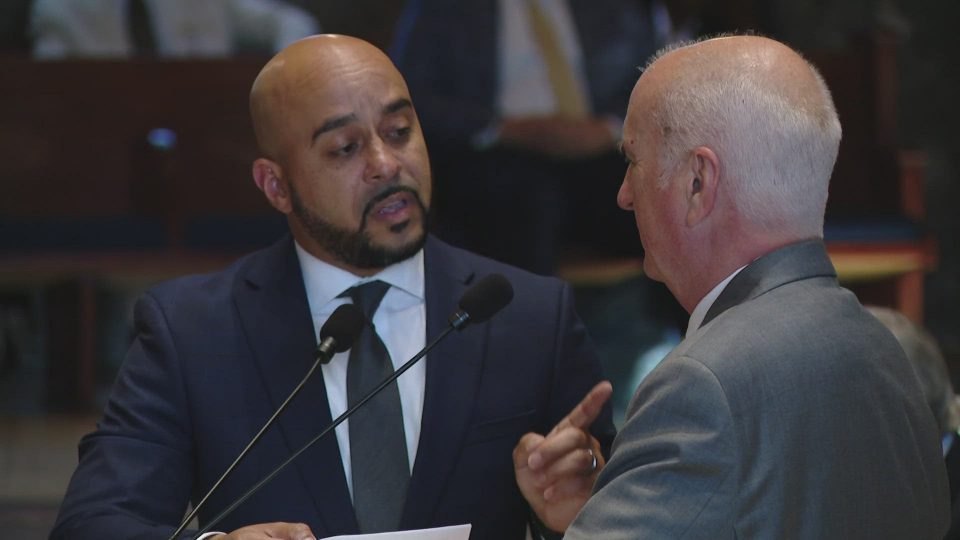
Senator Royce Duplessis of New Orleans was the most vocal critic throughout the process. When the clerk consolidation bill came to the floor on April 8, he invoked a piece of history most Louisiana legislators had never considered.
John Willis Menard was a Black man elected to represent Louisiana’s 2nd congressional district in 1868. His election was challenged. Despite winning, he was never seated. He became the first Black man to address Congress — pleading his own case — and still lost.
Standing at the lectern, Duplessis drew the line directly.
“This will be recorded a century from now, two centuries from now. What side are you on?” — Senator Royce Duplessis, Louisiana Senate floor, April 8, 2026
The Senate rejected his amendments. The bill passed anyway, 25-11.
Now Look at What the Supermajority Is Not Doing
That same governing bloc — 28 Republicans to 11 Democrats in the Senate, 73 to 32 in the House — is not using its overwhelming power to go after the insurance industry.
Every year, that industry extracts hundreds of dollars in excess premiums from poor and working-class Louisiana families. It hits Black neighborhoods hardest. But it also hits white families in Houma, Lake Charles, Shreveport, Sen Morris’ own West Monroe, and every rural parish in the state.
Instead of addressing that, the supermajority gives people somebody to look down on. Then it waits for them to empty their pockets.

The Senator Who Is Actually Fighting for Louisiana Families
Senate Bill 267 — The Core Reform
While Morris was filing bills to restructure New Orleans courts, Duplessis was filing Senate Bill 267 — legislation that would directly benefit Louisiana families of every race in every parish.
SB 267 is straightforward: it prohibits insurance companies from using your credit score or your ZIP code when pricing auto or home insurance policies in Louisiana.
Both. Auto and home. One bill.
Duplessis explained the problem in terms every Louisiana driver can understand. ‘People experience issues with credit,’ he said, ‘and it has nothing to do with their ability to drive.’
Then he sharpened it: ‘There’s evidence that someone who has a DUI but has a high credit score can actually get a lower premium than someone with a perfect driving record but has had some issues with their credit.’
Read that once more. A drunk driver with good credit can pay less than a safe driver with a damaged score. That is the current law of Louisiana. That is precisely what Senate Bill 267 would end.
What Texas Just Did — And What Louisiana Could Learn
Louisiana is not alone in grappling with this in 2026. In fact, Texas passed Senate Bill 1644, which took a more moderate approach than an outright ban.
Under that law, Texas now requires insurers who use credit scores to pull fresh data — no older than 90 days — update scores every 36 months, adjust premiums when credit improves, and notify consumers in writing whenever credit triggers a rate increase.
That is a viable middle path. If SB 267’s full ban faces resistance in committee, the Texas model gives Louisiana a meaningful fallback — one that still protects drivers who have recovered financially but haven’t seen their rates reflect it yet.
Either way, Duplessis is pointing in the right direction. The question now is whether his colleagues will follow — or whether they’re too busy attacking New Orleans courts to notice.
How the Machine Extracts Money From Everyone
The insurance industry does not think about race when it sets your premium. Instead, it runs four variables: your credit score, your ZIP code, your occupation, and your motor vehicle record.
Each variable does the work that writing ‘race’ or ‘income’ on the form would make illegal. Moreover, the industry’s own professional body — the Casualty Actuarial Society — confirmed this in published research. Their term for it is ‘proxy discrimination.’ It means using a neutral-looking variable to produce an outcome that would be forbidden if achieved directly.
Here is how each factor works — and who it hits.
Your Credit Score: A Record of What the System Did to You
A poor credit score adds up to 60% more to your auto insurance premium. By comparison, your actual driving record barely moves the needle.
Credit scores across America reflect decades of discriminatory lending. Black families were denied mortgages, blocked from credit, and targeted by predatory lenders for a century. Their scores reflect that history, not their character.
However, poor white Louisiana families carry damaged credit scores too. Medical debt is the leading cause of bad credit in America. So are job loss and hurricanes — and Louisiana has experienced all three, repeatedly, for twenty years.
Think of the single mother in Lake Charles who lost her job after Hurricane Laura. Or the oil worker in Houma whose hours got cut. Or the retired man in Natchitoches drowning in medical bills. Their scores went down. Their premiums went up. Not because they drive badly. Rather, because the system recorded their pain and sold it back to them as risk.
Notably, California banned credit scores as an insurance rating factor decades ago. The industry predicted catastrophe. Instead, the premium gap between neighborhoods narrowed. That is the data. Louisiana has chosen to ignore it.
Your ZIP Code: Geography as Punishment
In New Orleans, the gap between the most and least expensive ZIP codes for auto insurance reaches $891 per year. Furthermore, that gap tracks almost perfectly with the racial and economic makeup of each neighborhood.
However, ZIP code pricing does not only hurt Black neighborhoods. It hits every dense, lower-income ZIP code in Louisiana — including white working-class communities in Shreveport, Alexandria, and Lake Charles.
If you live in a high-density area with older infrastructure and more uninsured drivers, you pay more. The fact that you personally drive well and pay your bills on time does not matter to the algorithm.
Three states — California, Maryland, and Massachusetts — have already banned ZIP code pricing. Their insurance markets did not collapse. Their premium gaps narrowed. Louisiana, by contrast, has not moved.
Your Occupation: Your Job Title as a Rating Factor
Most Louisiana drivers have no idea this factor even exists.
Insurers charge different base rates based on what you do for work. Engineers and accountants pay less. Truck drivers, warehouse workers, and service employees pay more. The industry argues this reflects claims patterns. What it actually reflects, however, is the distribution of economic disadvantage.
Both Black and White men are hurt by this. Black men are overrepresented in the penalized job categories. But so are white men in rural Louisiana who work in oil fields, timber, and agriculture. The same factor that hits a Black construction worker in New Orleans East hits a white construction worker in Beauregard Parish. The machine does not notice the color. It only notices the job title.
Your Motor Vehicle Record: Citations From a Biased System
Traffic enforcement does not follow dangerous driving. Rather, it follows police patrol patterns.
The Stanford Open Policing Project analyzed over 100 million traffic stops nationwide and found that Black drivers face stops more often than white drivers — even after controlling for driving behavior. Significantly, the racial gap in stop rates shrinks at night, when officers can’t see the driver’s race as clearly.
Over-policing also hits poor white communities. Studies consistently show that low-income neighborhoods — regardless of racial composition — face heavier enforcement than wealthy ones.
Every citation from a patrol-heavy neighborhood becomes a permanent input in the insurer’s pricing model. The officer who wrote it is long gone. The premium increase, though, is forever.
| What This Costs Louisiana Families — By the Numbers $4,180/year — average Louisiana auto insurance premium, highest in the nation (Insure.com 2025) 60% more — what a poor credit score adds to your premium, regardless of driving record 20–40% more — what a high-density or high-claim ZIP code adds to your premium $891/year — the gap between most and least expensive ZIP codes in New Orleans alone (MoneyGeek 2024) 18.7% — Louisiana’s poverty rate in 2024, second highest in the nation 11.8% — Louisiana’s white poverty rate — hundreds of thousands of families hit by the same machine 50% — share of all Louisiana households below the ALICE threshold — above poverty but unable to afford basic necessities June 1 — the day the 2026 legislative session ends and the window for reform closes |
The Contrast That Should Embarrass Every Louisiana Legislator
What the Power Is Being Used For
The Republican supermajority has the votes to do almost anything it wants. A 28-11 Senate majority and a 73-32 House majority does not negotiate. It governs by force.
A senator from Ouachita Parish used that force to cut the legs out from under a New Orleans court system — without a study, without consulting the people who run those courts, and specifically timed to eliminate an elected Black official before he could begin his job.
Senator Morris told Duncan the bill was not personal. Then he amended it to take effect immediately — before Duncan’s swearing-in date of May 4.
That is the agenda.
What the Power Is Not Being Used For
Meanwhile, Senate Bill 267 — which would put real money back in the pockets of poor and working-class Louisiana families in every parish — sits quietly in committee.
The insurance lobby works every hallway in Baton Rouge. They know this bill by name. They are organized, well-funded, and experienced at killing consumer protections in this state.
By contrast, Senator Duplessis is one man with one bill and a hard deadline of June 1.
The Constituents Nobody Is Talking About
Legislators from Beauregard, Sabine, Winn, Caldwell, Ouachita, and every other rural white parish in Louisiana represent constituents paying the insurance tax every single month.
Those constituents are not paying it because of race. They pay because of credit scores damaged by medical debt, hurricanes and just living in the state of Louisiana which has fewer job opportunities. They pay because of ZIP codes in towns that never fully recovered. And they pay because their job titles fall into categories that actuarial models penalize — models their own legislators have never once questioned.
The playbook runs on distraction. Look at New Orleans. Look at the courts. Also look at a Black man who won an election by 68 points and still can’t take his seat.
Don’t look at the insurance renewal notice on your kitchen table.
“If you can convince the lowest white man he’s better than the best colored man, he won’t notice you’re picking his pocket. Hell, give him somebody to look down on and he’ll empty his pockets for you.” — President Lyndon B. Johnson, 1960
A Feature, Not a Bug
Johnson was not describing a conspiracy. Instead, he was describing a feature of American political life so durable and effective that it has outlasted every reform effort aimed at it.
The people running Baton Rouge right now may not be consciously coordinating with the insurance industry to distract their base. They may genuinely believe the court consolidation is good policy.
But the outcome is identical either way. The courts bill fills the headlines. The insurance bill dies quietly. And poor white Louisiana — the very people the supermajority claims to represent — keeps paying the same unfair tax, month after month, renewal after renewal.
“I have never seen something so barbaric. This will not improve efficiency. This will not improve outcomes. It will stall the work of the clerk’s office. What do you think you’re going to get?” — Senator Royce Duplessis, on SB 256, April 8, 2026
Duplessis has been fighting two battles at the same time this session. He fought to protect Calvin Duncan’s seat on the Senate floor. He is fighting to protect every Louisiana family’s wallet in the insurance committee.
Alas, he is losing the first fight, at least for now. The House still has to weigh in on the court bills. But the insurance fight is still open.
| What Every Louisiana Family Can Do Before June 1 Call your state senator and representative. Tell them you support Senate Bill 267. Ask them directly whether they plan to vote for it. Find your legislator at legis.la.gov. A phone call carries far more weight than any email. If you are in a rural white parish, this matters especially. Your legislator may not think insurance pricing is your issue. Show them this article. Show them the numbers. It is your issue. Share this article with someone outside New Orleans. The insurance tax hits every corner of Louisiana. Send it to family in Pineville, Bastrop, Houma, and Lake Charles. Get competing quotes before you renew. The premium gap between insurers for identical drivers is significant. Get at least three quotes every renewal. The savings can run hundreds of dollars per year. Pull your free credit report. Visit AnnualCreditReport.com. Dispute any errors. If your credit has improved since your last renewal, ask your insurer to re-rate your policy. Track SB 267 at legis.la.gov. When it reaches the floor, the vote will move fast. Your legislators need to hear from you before that happens. |
The Louisiana Insurance Tax is not a Black issue or a white issue. It crosses every racial line, every parish boundary, every income bracket. It is a Louisiana problem — and a working-class problem — and right now one senator from New Orleans is carrying that weight nearly alone.
Senator Duplessis does not need your applause. He needs your phone call to your legislator.
The session ends June 1. After that, the insurance industry wins again. And every Louisiana family — Black and white, rural and urban — keeps paying.
*This is Part 2 of The Louisiana Insurance Tax, a Black Source Media investigation. Part 3 examines homeowners insurance — how the same machine that overcharges drivers also overcharges homeowners, denies claims, and drives people out of Louisiana permanently.
Jeff Thomas is a contributor to Black Source Media covering New Orleans politics, civic affairs, and economic justice. Published every Sunday.
