
New Orleans Judicial Elections 2026: Here’s Who’s Actually on Your Ballot.
Part 1 of a Black Source Media judicial series on how New Orleans voters should evaluate the people asking to become judges.
Qualifying has closed for the New Orleans judicial elections 2026 cycle, set for November 3rd. The races on your ballot look different than they ever have before. Now we know exactly who’s running.
In June, Governor Jeff Landry signed Act 748 into law. It cut three judgeships from Orleans Parish Criminal District Court, dropping it from twelve judges to nine. The same legislative package also trimmed Orleans Parish Civil District Court and made cuts to Municipal, Traffic, and Juvenile Court.
Judge John Fuller sued. He argued the cuts needed a two-thirds supermajority vote in the legislature, not a simple majority. A Baton Rouge judge agreed with him in July and blocked the law. The state appealed.
On July 31st, the Louisiana Supreme Court reversed that ruling, 4-3. The justices found that a separate constitutional provision governing Orleans Parish’s unique court structure overrode the supermajority requirement. Fuller’s seat, along with those held by Judges Simone Levine and Rhonda Goode-Douglas, was gone.
The Ballot Has Changed Since This Story First Broke
Here’s what’s different now that qualifying has closed:
Fuller is out. He said on social media in July that he wouldn’t run again after the court ruled against him. He didn’t qualify for any seat. His time on the bench ends when his term does.
Levine is in a real fight. She qualified to challenge Judge Kimya Holmes in Section D. That’s an incumbent against an incumbent — a race New Orleans hasn’t seen much of.
Goode-Douglas changed course. Back in June, she announced plans to challenge Judge Leon Roche, whose Section I seat had been spared in a last-minute legislative swap that cost her hers. But when qualifying closed, she filed for Section I — and drew no opponent. She’s in.
Roche went a different direction. Instead of facing Goode-Douglas, he’s running against Judge Camille Buras in Section H.
Supporters of the judgeship cuts call them fiscally responsible. Critics — including members of New Orleans’ own legislative delegation and the Metropolitan Crime Commission — warn that fewer judges means slower courts, and that Baton Rouge overrode what New Orleans voters had already decided for themselves. Reasonable people disagree about who’s right in that fight.
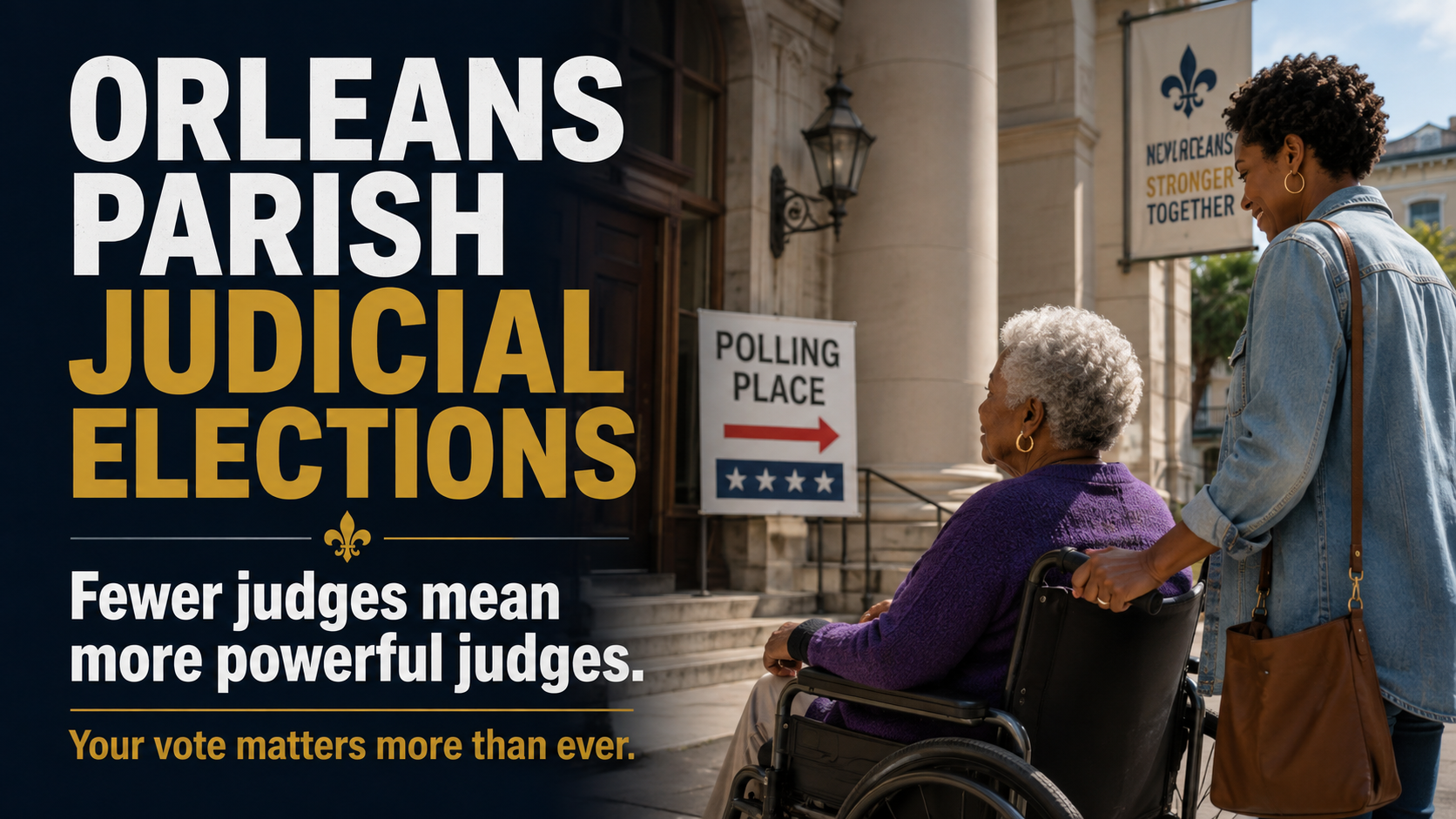
Almost nobody disputes this: there are fewer seats on the bench now, and more power concentrated in each one. Every judge elected this fall will carry a heavier caseload and a wider reach into more people’s lives than the judges who came before them.
- Act 748 cut Orleans Parish Criminal District Court from 12 judges to 9, effective January 1, 2027.
- The Louisiana Supreme Court upheld the law 4-3 on July 31, dismissing Judge Fuller’s lawsuit.
- Qualifying closed August 7. Fuller did not seek reelection.
- Levine faces Holmes in Section D; Goode-Douglas is unopposed in Section I; Roche faces Buras in Section H.
- Civil District Court, Municipal, Traffic, and Juvenile Court also lost seats under the same legislative package.
Most People Never Think About Judges — Until They’re Standing in Front of One
Almost nobody pays attention to judicial races until they have no choice. You don’t think about your criminal court judge until you, or someone you love, sits in that courtroom. You don’t think about your civil court judge until you’re fighting an eviction, a custody dispute, an insurance company that won’t pay. By then, it’s too late to have done your homework. The judge is already assigned.
That’s the part of civic life we get backwards. We treat judicial races like the bottom of the ballot — names we skip because we don’t recognize them. In reality, judges hold more direct, personal power over ordinary people’s lives than almost anyone else we elect. A mayor sets policy. A judge decides your case, your sentence, your custody arrangement, your claim.
Being a Good Judge Takes More Than Knowing the Law
Legal knowledge is the floor, not the ceiling. Every day, judges listen to two conflicting accounts of what happened and decide which one is credible. That judgment call is shaped by more than legal training. It’s shaped by whether the judge understands the community standing in front of them.
A judge who has never spent real time in the neighborhoods and everyday realities of the people who appear before them is working with a blind spot. That blind spot can turn honest testimony into something that reads as evasive. This isn’t a knock on any one person’s character. It’s a structural risk any time the person on the bench doesn’t understand the community they were elected to serve.
What the New Orleans Judicial Elections 2026 Mean for November
With fewer judgeships on the Orleans Parish bench, the judges elected this fall will hold more consolidated power over more cases affecting more of your neighbors. That makes this the wrong year to skip past the judicial section of your ballot.
Over the coming weeks, this series will walk through how to actually evaluate the candidates running in the New Orleans judicial elections 2026 — what to ask, what a candidate’s background can tell you, where to find independent information like the New Orleans Bar Association’s Judicial Poll, and how to tell a well-connected candidate from one who’s actually prepared to sit in judgment over your neighbors.
The text governing all of this sits in Article V of the Louisiana Constitution, which spells out how the legislature can and can’t change the number of judges in a district — the same provision at the center of Fuller’s now-dismissed lawsuit.
The bench just got smaller. The stakes didn’t.
Next in this series: How to research a judicial candidate before you vote — and the questions most voters never think to ask.

Great Read!!!