
Artificial intelligence is becoming part of everyday American work and life, and Black America is already there — 49% of Black adults now use AI chatbots, nearly matching the national average. But using a technology and benefiting from it aren’t the same thing. We were some of the most influential users of the internet, smartphones and social media, and we still didn’t end up owning much of the wealth those platforms created. AI is another shot at that same test. GetFenix.ai was built to help Black America pass it this time — not just as consumers, but as builders, business owners and owners of the technology itself.
- 49% of Black adults now use AI chatbots — about 24% use them daily.
- AI can help people work faster, learn faster and run businesses more efficiently, without requiring anyone to become a programmer.
- Black-owned businesses, which chronically run understaffed, stand to gain the most from AI-assisted productivity.
- Only 23% of Black adults 65 and older use AI chatbots, versus 66% of those 18-29 — a real generational gap.
- Black students need AI literacy alongside traditional digital literacy, not a ban on the technology.
- The next step isn’t just using AI. It’s building with it, and owning pieces of it.
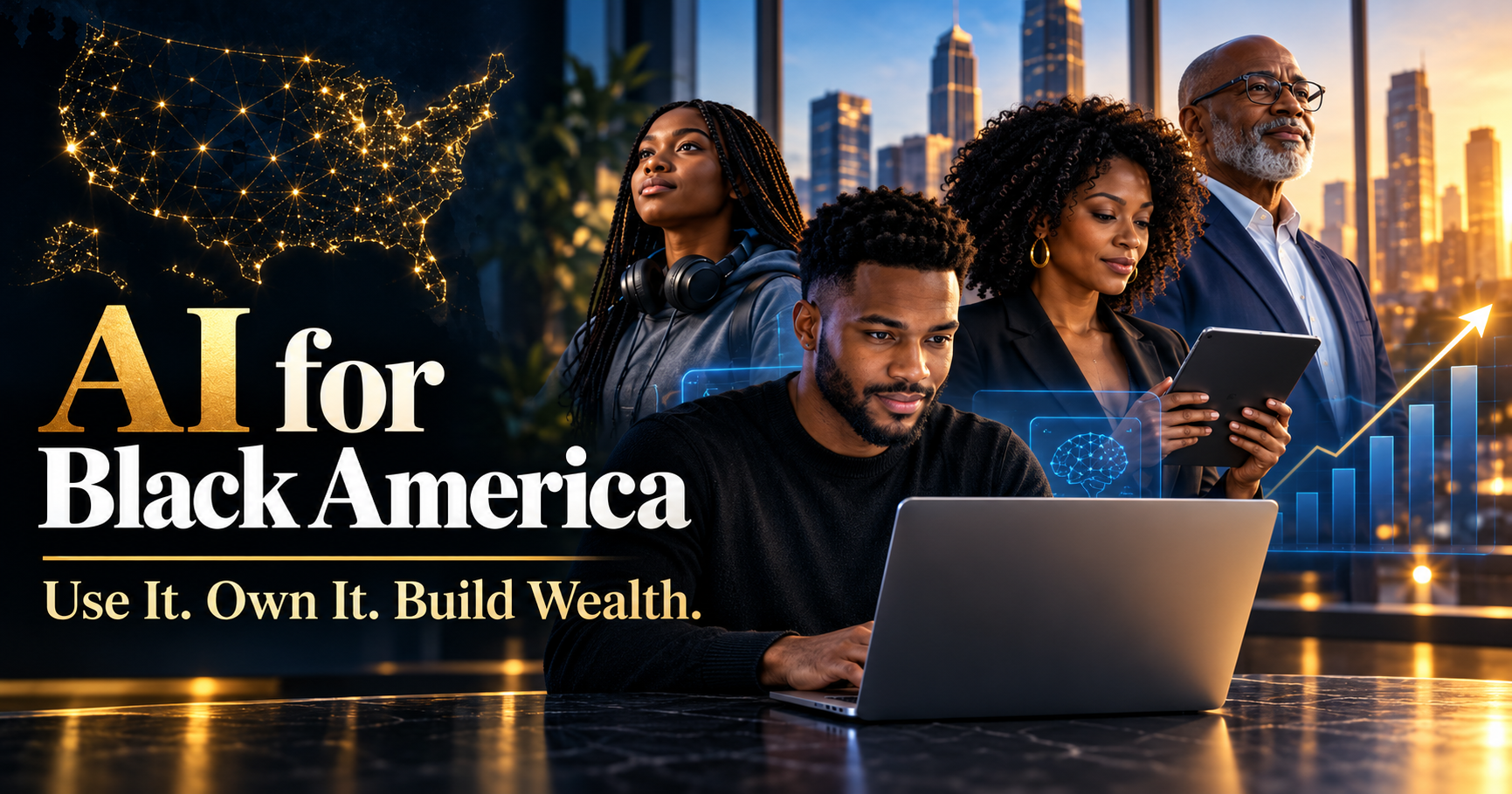
Artificial intelligence may become the biggest economic transformation of our lifetime. Black America has seen this movie before.
The internet changed business. Smartphones changed communication. Social media changed culture. Black people became some of the most influential users of every one of those technologies. But influence did not always produce ownership. We helped build the audiences, the trends, the language and the culture that made those platforms valuable — and other people mostly built the companies and captured the wealth.
Artificial intelligence gives us another opportunity. This time, we need to do more than participate. We need to use it. Build with it. Make money with it. And own part of it.
That is why I created GetFenix.ai. And that is why Black Source Media is making AI literacy a major part of our work.
Black People Are Already Using AI
Let’s start with something that might surprise you. Black people are not sitting out artificial intelligence.
Pew Research Center reported in June 2026 that 49% of Black adults use AI chatbots — essentially matching the national average. Twenty-four percent use them daily. We aren’t just playing with the technology, either: 42% of Black adults use chatbots to search for information, and among those who are employed, 36% use them for work tasks. Black adults also turn to AI for health information, news, entertainment and personal advice.
So the question isn’t “will Black people use AI?” We already are. The real question is bigger than that.
Will AI Make Black America Wealthier?
That answer hasn’t been determined yet, and technology doesn’t automatically create equality. History should teach us that. Black culture helped make social media valuable — Black creators generated enormous engagement — and the companies controlling those platforms became worth hundreds of billions of dollars anyway.
The same thing could happen with artificial intelligence. We could become enthusiastic users while somebody else owns the platforms. We could supply the cultural knowledge while somebody else monetizes it. We could use AI every single day without ever creating meaningful Black wealth from it.
I don’t want that outcome. AI literacy has to eventually lead to AI economic participation — not just AI fluency.
What Can AI Actually Do for You?
Forget the technical language for a minute. Think of AI as an extremely capable assistant: you give it instructions, and it helps you think, research, write, organize and create. A business owner can ask it to draft a proposal. A contractor can turn field notes into a professional scope of work. A student can get calculus explained in plain English. A job seeker can practice for an interview. A parent can make sense of a confusing school document. A homeowner can get mortgage terminology explained. A nonprofit can build a fundraising strategy. A journalist can analyze a 200-page government report.
None of that requires anyone to become a computer programmer. That matters, because the greatest immediate opportunity from AI may not belong to AI engineers. It may belong to ordinary people who simply learn how to use it well.

Black Businesses Need AI Now
This subject is personal for me. I’ve spent decades running businesses, and small businesses share one fundamental problem: we never have enough people. The owner becomes the salesperson, the marketer, the project manager, sometimes the bookkeeper, occasionally the janitor. Large companies solve that by adding employees. Small businesses often can’t.
AI changes some of that math. Imagine a five-person company gaining capabilities that once required ten employees — AI drafting proposals, researching potential customers, writing marketing copy, summarizing meetings, organizing projects, building email campaigns, analyzing spreadsheets, and helping follow up with leads. None of that eliminates the need for people. It increases what people can actually accomplish. For Black-owned businesses, which are disproportionately understaffed and undercapitalized to begin with, that difference matters enormously.
Don’t Ask Whether AI Will Take Your Job
Ask a better question: how will AI change my job?
Almost every major technology eliminates some tasks and creates new ones. The automobile destroyed horse-related jobs. Computers eliminated mountains of clerical work. The internet destroyed some businesses and created entirely new industries. AI will do the same. Some repetitive tasks will disappear. Other jobs will change. New jobs will emerge.
But there’s a nearer-term possibility people talk about less: a worker who knows how to use AI well may simply outperform a worker who doesn’t, long before AI replaces either of them. If one employee needs five hours to research and prepare a report, and another finishes comparable work in two hours with AI’s help, who becomes more valuable to that company? That’s why AI literacy matters right now, not eventually.
Black People Over 50 Cannot Sit This One Out
This deserves special attention. Pew found a real age gap in AI adoption: about 66% of adults 18 to 29 use AI chatbots, compared with just 23% of adults 65 and older.
That gap creates a real risk. Experienced Black professionals have something AI doesn’t: decades of judgment, relationships, industry knowledge and institutional memory. Combine that with AI and you have something powerful. Ignore it, and younger, less experienced competitors may gain a real productivity advantage over you.
I’m part of the generation that had to learn computers after we’d already started our careers. Then email. Then smartphones. Then websites. Then social media. Now it’s AI. We’ve done this before.
Why I Created Fenix AI
There are already powerful AI products in the marketplace. ChatGPT changed the industry. Google has Gemini. Microsoft has Copilot. Anthropic has Claude. So why build another AI platform?
Because technology should reflect more than technical capability — it should understand people. Our language matters. Our businesses matter. Our experiences matter. The questions a Black entrepreneur asks may differ from the questions a Silicon Valley engineer asks. The questions a Black grandmother asks may differ from the questions a 22-year-old programmer asks. That doesn’t mean Black people need a separate internet. It means technology becomes more useful when people actually feel comfortable using it.
Fenix AI was built with Black users and everyday questions specifically in mind, designed to make artificial intelligence useful without requiring technical expertise. That doesn’t mean Fenix is only for Black people. It means we’re intentionally building for people mainstream technology sometimes treats as an afterthought. You can try it at GetFenix.ai.
Try This With Fenix Right Now
Don’t just read about artificial intelligence. Use it. Open GetFenix.ai and type this:
“Ask me five questions about my work or business. After I answer, identify three ways AI could save me time, make me money or help me become more productive.”
Answer the questions and see what happens. Then try this one:
“Teach me how to become better at using AI. Give me one practical task to try every day for seven days.”
Now AI becomes something you use, not something you read about.
AI Should Help Close the Knowledge Gap
Access to information has always shaped opportunity. Some people grow up surrounded by lawyers, accountants, doctors and business owners they can call when they need advice. Other people don’t have those networks. AI doesn’t replace professionals, but it can help people ask better questions before they ever pick up the phone.
Someone holding a confusing insurance letter can ask AI to explain it in plain English and suggest questions to ask their agent. Someone buying a home can ask it to explain the difference between an interest rate and an APR. A business owner can ask it to explain cash flow using examples from a small construction company. Information that once required finding exactly the right person becomes much easier to access. That could matter enormously for historically underserved communities.
But AI Can Be Wrong
This needs to be said clearly. Artificial intelligence is not magic. It makes mistakes. It can misunderstand questions, generate incorrect information, and reflect the biases baked into its data and the human systems that built it.
Never blindly trust AI with major medical, legal or financial decisions. Use it to understand, research, organize and prepare better questions — then verify what actually matters. The smartest AI user isn’t the person who believes everything it says. It’s the person who knows exactly when to double-check.
Black Parents Need to Teach AI Literacy
Schools are wrestling with AI right now. Some teachers fear cheating, and that’s understandable. But banning AI won’t prepare children for their future. Students need to learn two things at once: how to think independently, and how to use powerful technology responsibly. Calculators didn’t eliminate mathematics. Computers didn’t eliminate writing. AI shouldn’t eliminate thinking.
A student who simply asks AI to complete their homework learns very little. A student who asks AI to tutor them gains something completely different. Try this prompt: “Don’t give me the answer. Teach me how to solve this problem myself.” That’s what AI literacy actually looks like.
Black America Needs to Move From Consumers to Owners
This is the bigger issue. Using AI is step one. Building with AI is step two. Owning AI businesses — and investing in them — is step three. Creating intellectual property matters. Developing proprietary data matters. Training people matters. Building actual applications matters.
Black entrepreneurs should be asking: what problem can I solve with AI? Not: how do I build the next ChatGPT? Most successful businesses don’t invent fundamental technologies — they apply existing technology to real problems. A realtor could build an AI service for first-time homebuyers. A contractor could build an AI estimating tool. A lawyer could develop a specialized research service. A teacher could build an AI tutoring business. A media company could build AI-powered information products. The possibilities go far beyond chatbots.
The Goal Is Black AI Economic Power
I want Black Source Media to become a place where our community learns how to actually use artificial intelligence — not hype, not fear, just practical information, tools, prompts, business strategy, education and honest warnings about where things can go wrong. And I want GetFenix.ai to become one of the platforms people use to put that knowledge into practice.
My larger goal is simple. Black America shouldn’t merely survive the AI revolution. We should build companies with it, improve the businesses we already have, create jobs, teach our children, become more productive, own intellectual property, and take a real share of the enormous wealth artificial intelligence is going to create.
The first step isn’t complicated. Open an AI platform. Ask a question. Then ask another. Learn what it can actually do, and tomorrow, use it to solve a real problem. This revolution isn’t coming someday. It’s happening right now — and this time, Black America needs to be early.
Try Fenix AI
Want to start using artificial intelligence instead of just reading about it? Visit GetFenix.ai and start with this prompt:
“Help me identify three ways AI can improve my life, career or business. Ask me questions first so your recommendations fit me.”
Then keep going.