
TL;DR
New Orleans street musicians say State Police, NOPD and the Sheriff’s Office have been running them off French Quarter corners since Nov. 14. The City Council called it ridiculous on Nov. 19. Then it voted 6-0 to more than double the State Police patrol budget in the Quarter. This summer, Mayor Moreno gave grants to Decatur Street businesses hurt by city construction. The musicians are French Quarter businesses too, and they deserve the same support.
Key Points
- Joint sweeps by NOPD, the Orleans Parish Sheriff’s Office and Louisiana State Police began Nov. 14, enforcing an 8 p.m. curfew for performers on Bourbon Street.
- Musicians, tarot readers and a teenage bucket drummer say they were threatened with arrest. One singer says troopers told her she needed a permit. That isn’t the law.
- Council President JP Morrell said performing in the Quarter “is not crime.” Vice President Matthew Willard called the crackdown “embarrassing.”
- The same council approved $600,000 for State Police patrols in the Quarter next year, up from $260,000.
- In June, Moreno launched a $200,000 fund with grants up to $5,000 for Decatur Street businesses hurt by Sewerage and Water Board construction.
- French Quarter business owners fought loudly for Decatur. Now they should stand with the musicians and help write rules both sides can live with.
- The Criminal Justice Committee takes up the issue again on Nov. 30.
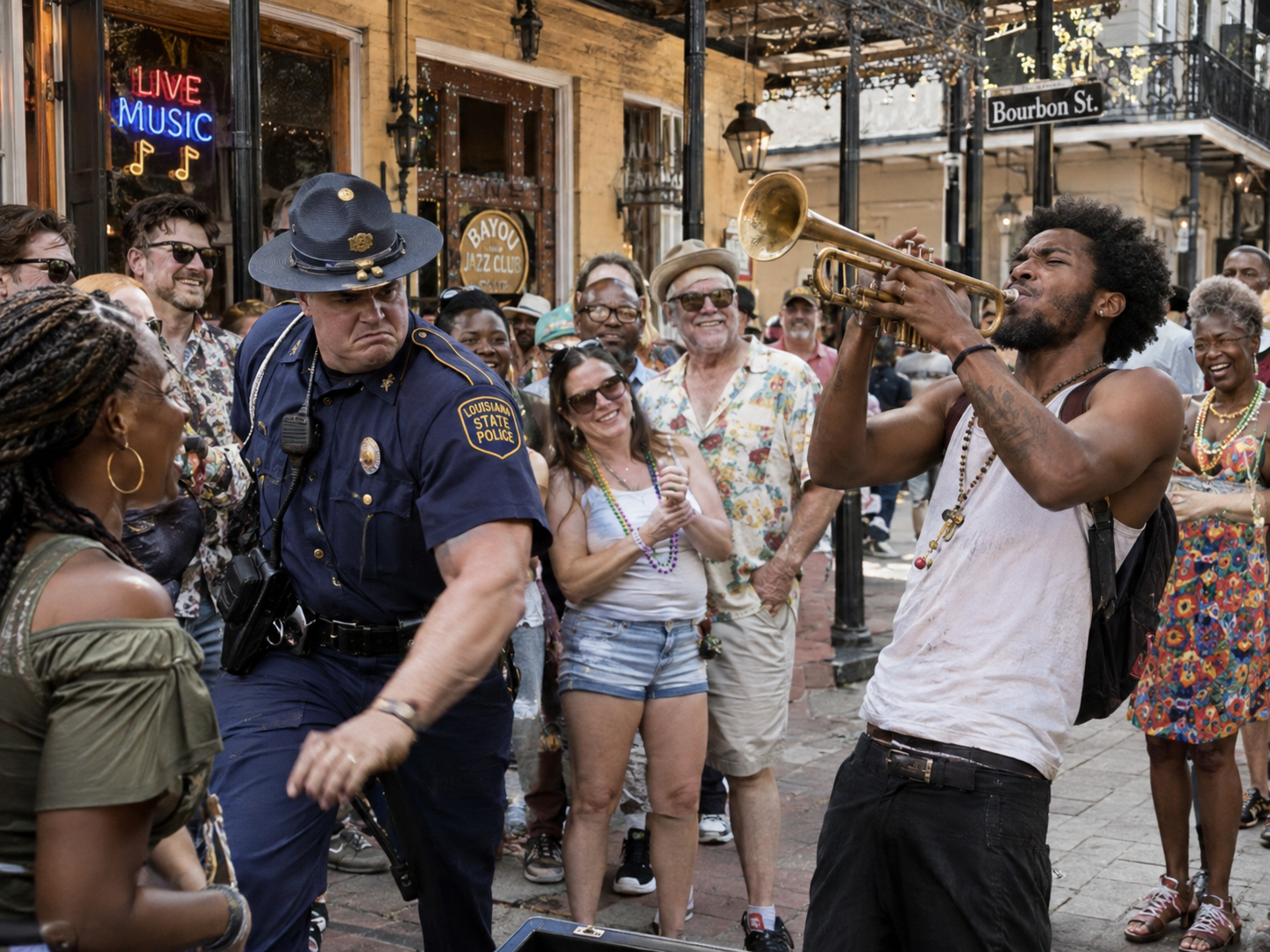
New Orleans has a strange way of treating the people who make it special. We spend millions telling the world there’s nowhere else like us. Brass bands are on the billboards. Second lines are in the commercials. Then we send police to run the musicians off the corner.
That’s what has been happening to New Orleans street musicians in the French Quarter since Nov. 14. On that night, NOPD, the Orleans Parish Sheriff’s Office and Louisiana State Police started joint sweeps on Bourbon Street and the blocks around it. The target was an existing 8 p.m. curfew for street performers on Bourbon. Royal Street’s curfew is 10 p.m.
Musicians got the message. So did tarot readers, and a teenager playing buckets.
On Nov. 19, more than a dozen of them packed the City Council chamber and told their stories. I want to walk through what they said, what the council said back, and what the council did next. That last part matters most.
What New Orleans Street Musicians Told the Council
Sariyah Idan is a singer-songwriter who plays at Royal and St. Louis. On the night the sweeps started, she says five state troopers walked up to her and a tarot card reader. They told her she needed a permit to perform. She doesn’t. New Orleans doesn’t require one. When she didn’t pack up fast enough for one trooper, she says he threatened her with jail.
Alicia Renee Smith, the Grammy-nominated singer known as “Blue Eyes,” described a run-in with a trooper last year. He told her to move onto the sidewalk. She told him that would block the sidewalk, which is illegal. Smith says he got angry, threatened to arrest her and demanded her ID. It took an NOPD officer and a second trooper to calm it down.
Think about that. She was trying to follow the law. The trooper was the one asking her to break it.
These aren’t troublemakers. They’re the people tourists fly in to hear.
The Music Was Here First
Music didn’t show up on New Orleans corners because the tourism office needed a soundtrack. It came out of churches, funerals, social and pleasure clubs and front porches. Grandfathers passed it to grandsons, aunts to nieces. Today the musicians on those corners are Black, white, young, old, locals and folks who moved here because they couldn’t play this music anywhere else. The street doesn’t care what you look like. It cares whether you can play.
The tourism industry came later and built itself on top of that. Hotels sell rooms off it. Bars sell drinks off it. The city sells its whole identity off it.
Meanwhile, the people actually playing the music mostly live on tips. No contract, no benefits. For a lot of them, the street is the job. Every one of them is running a small business, with a corner for a storefront and a hat for a cash register. The street is also the classroom. Some of the best musicians this city ever produced learned in public, in front of strangers, with a bucket or a hat on the ground.
Are they all Louis Armstrong? No. Some of them need a lot more practice. That’s always been part of it. You can’t grow the next Trombone Shorty if you run every kid with a horn off the block.
Yes, Sidewalks Matter
NOPD Capt. Sam Palumbo, who runs French Quarter operations, told the council the patrols were a response to complaints about blocked roadways and sidewalks. Fair enough. People in wheelchairs need to get through. Businesses need customers to reach the door. Ambulances need a lane.
Nobody I know wants a brass band parked in the middle of an intersection at 11 o’clock on a Saturday night.
But a singer with a guitar at Royal and St. Louis is not an intersection blockade. A tarot reader at a folding table is not a public safety threat. Police can tell the difference. When they act like they can’t, that’s a choice.
Morrell put it plainly. “We do not have an endemic of street performer violence going on in the city of New Orleans,” he said. He called the crackdown “completely and totally ridiculous.” He told Palumbo to tell state troopers to “stay in your lane.”
Willard called it “unacceptable, and if we’re being honest, embarrassing.” He called what Idan and Smith described “selective enforcement,” warned that First Amendment lawsuits could follow and asked Palumbo to pause the push. District C Councilmember Freddie King III said he’d ask for a meeting with the performers and Troop NOLA’s commander, Capt. Rodney Hyatt.
Good. All of that needed saying.
Then the Council Voted to Pay for More of It
Here’s the part that bothers me.
The musicians showed up at the meeting where the council, sitting as the board of the French Quarter Economic Development District, was approving that district’s 2027 budget. That budget includes $3.75 million for supplemental police patrols. It passed 6-0.
Inside that budget, money for State Police patrols in the Quarter goes from $260,000 this year to $600,000 next year. That’s enough to double the number of trooper patrols.
So the council spent the morning telling troopers to leave the musicians alone. Then it voted to put more troopers in the Quarter.
I’m not against paying for police in the French Quarter. It’s the busiest few blocks in Louisiana, and it needs real policing. But money is the only leverage the council has over State Police. Troop NOLA doesn’t answer to City Hall. If the council wanted those troopers to understand what New Orleans expects, the time to say so was before the check cleared, in writing, as a condition of the money.
Instead, they got a speech and a raise.
Who Ordered This?
Nobody at City Hall has said where this push came from. Gambit reported that an NOPD officer, on a recording, said the enforcement was directed by the mayor’s office and “indirectly” by Gov. Jeff Landry’s office. I can’t confirm that, and nobody has said it on the record.
Deputy Mayor for Public Safety Michael Harrison told the council he would “get to the bottom” of it with State Police leadership. State Police put out a statement saying Troop NOLA is working with NOPD and city officials to get clear on their shared goals.
That’s a lot of agencies working to get clear on something that should have been clear before anybody knocked on a musician’s hat.
Mayor Moreno should say plainly whether her office asked for this. If it didn’t, she should say that too, and tell NOPD to stop. Gov. Landry has put a lot of State Police resources into New Orleans, and plenty of people here welcome the help on crime. Running off street musicians isn’t crime-fighting. I’d expect him to agree.
Moreno Already Knows How to Help a Struggling Business
Here’s what makes this hard to swallow.
This summer, Decatur Street business owners were bleeding. The Sewerage and Water Board tore up their blocks to replace 115-year-old water mains. A job that was supposed to take a year dragged on past that. Customers couldn’t reach the door. Some shops closed. Owners went to court.
Mayor Moreno stepped in. In June she stood on Decatur Street and announced a $200,000 Business Stabilization Fund, with grants of up to $5,000 for businesses hurt by the construction. Nearly 50 businesses applied.
I didn’t have a problem with that. Government broke something, so government helped fix it. That’s how it should work.
And remember who was at the Sewerage and Water Board when that work was authorized. Steve Nelson, who now runs infrastructure for the Moreno administration. The city’s own people caused the damage, and the mayor wrote checks to ease it.
Now look at the street musicians. They’re running businesses too. Their customers are the same tourists walking past those Decatur shops. When they can’t play, they don’t eat. And what’s hurting them isn’t a broken pipe. It’s an enforcement push that somebody in government decided to turn up.
So one set of French Quarter businesses got grant money. Another got threatened with jail. Same mayor, same neighborhood, same year.
Mayor Moreno needs to be consistent about who she supports and why. If the Decatur grants were about protecting the French Quarter economy, the musicians are part of that economy. They’re also a big reason that economy exists. They create the sound, the feel and the atmosphere people travel here for. You can’t put a price on that in a grant application, but every hotel and restaurant in the Quarter cashes in on it every night.
French Quarter Businesses, It’s Your Turn
The Decatur Street owners didn’t wait on anybody. They packed meetings, called reporters and sued. And they got results.
Now I want to hear from the rest of the Quarter. The restaurants, bars, hotels and shops on Bourbon, Royal and Decatur owe a good share of their foot traffic to the music outside their doors. Nobody books a flight to New Orleans to walk down a quiet street. People follow the trumpet. Then they stop in, sit down and spend money.
If the music goes, the business goes with it. The owners who were so loud about Decatur should be just as loud now. Show up on Nov. 30. Tell the committee the musicians are good for business. Because they are.
Then go one step further. Sit down with the musicians and write the rules together.
Business owners know which doorways need to stay clear and which corners get jammed on a Saturday night. Musicians know where the sound carries, where the crowds gather and which spots have worked for decades without a problem. Put those two groups at the same table and they’ll come up with a better map than any police captain or state trooper ever will.
That’s how you get peace in the Quarter. Not with a sweep. With an agreement that the people who work those blocks every night helped build and actually believe in.
What the Nov. 30 Meeting Should Produce
The Criminal Justice Committee picks this up again on Nov. 30. Musicians have heard enough speeches about how much this city loves them. Here’s what that meeting should produce.
Write the rules down in plain English: where performers can play, until what time, and how far from a doorway or ramp. Don’t let the police write them alone. Let the musicians and French Quarter business owners draft them together, then send them to the council for approval. Put the final version on one page and hand it to every officer, every musician and every business in the Quarter.
Make every agency enforce the same rules the same way. A musician shouldn’t get one answer from NOPD and a different one from a trooper ten minutes later.
Start with a warning. A musician blocking a ramp should be told to move, not threatened with jail on the first contact.
And tie the $600,000 to those rules. If State Police want the city’s money, they follow the city’s ordinances the way the city reads them.
Finally, the people who profit from the music should be in the room. Hotel managers, restaurant owners and bar owners should testify for the musicians, the same way they testified for themselves over Decatur, and commit to helping write the rules.
What Are We Preserving?
This city has a habit. We love our culture when it sells. We’re less excited about the people who make it.
We’ve already watched rising rents and insurance bills push families out of the neighborhoods that raised this music. We keep losing ground in Baton Rouge. Now we’re making it harder to play on the street, too.
If the musicians can’t afford to live here and can’t play when they get here, what exactly are we preserving? A theme park version of ourselves?
When a visitor hears a trumpet coming down a French Quarter street, they’re hearing something generations of New Orleanians built. Hotels can sell the rooms. Bars can sell the drinks. Nobody can manufacture that sound.
New Orleans has made a lot of money selling its music. The least we can do is make sure the musicians still have a place to play it.
About the Author
Jeff Thomas is the publisher of Black Source Media and owner of WBOK 1230 AM. He writes about New Orleans politics, power and the people who pay for decisions made at City Hall and in Baton Rouge.
Sources
- Gambit: City Council President JP Morrell Tells New Orleans Police to Halt Anti-Busker Sweeps
- Gambit: New Orleans Targets Musicians, Street Performers in New French Quarter Law Enforcement Sweep
- Axios New Orleans: City Council questions police sweeps targeting musicians
- Verite News: Dozens of French Quarter businesses apply for relief funds, but several say it’s not enough
- Verite News: French Quarter businesses file suit over Decatur Street construction
- WDSU: Musicians and tarot readers say Bourbon Street curfew enforcement is threatening New Orleans culture
Get Black Source Media in Your Inbox
Every Monday and Thursday: accountability journalism, Black health, New Orleans politics and the occasional roast. No spam, no fluff.
