
TL;DR
New Orleans is not just losing people. It is losing power. The 2026 Louisiana legislative session reduced the city’s judges, eliminated its criminal clerk of court, cut its congressional representation, and stripped more than $33 million from local priorities — while the prison system gained $100 million. Senator Royce Duplessis called the cuts “continued political retribution.” The numbers suggest something even deeper: a systematic reduction of New Orleans’ leverage inside Louisiana.
Key Points
- Governor Jeff Landry vetoed more than $33 million tied to New Orleans projects and programs.
- New Orleans-area cuts accounted for more than 62% of operational vetoes and 53% of capital-project vetoes reviewed by local officials.
- The 2026 session also reduced Orleans Parish criminal judges, eliminated the criminal clerk of court position, and left Louisiana with one Black-majority congressional district instead of two.
- While New Orleans lost public investment, the prison system gained $100 million, including $17.5 million for Angola expansion.
- Senator Royce Duplessis called the cuts “continued political retribution.” The pattern runs deeper than one governor’s veto pen.
- New Orleans remains Louisiana’s cultural and economic engine. Yet the state keeps stripping the city of the leverage needed to protect that value.
New Orleans Is Losing Louisiana. The 2026 Session Just Made It Official.
Before we talk about Governor Jeff Landry’s veto pen, we need to establish what the outrage cycle misses. The 2026 Louisiana legislative session was not just a story about one governor’s grudges. It was a story about institutional power — who has it, who is losing it, and how those losses pile up.
New Orleans is losing Louisiana. Not all at once, but steadily and measurably. Population decline costs the city legislative seats. Consequently, fewer seats mean less influence. Less influence means fewer funding wins, and fewer wins push more residents out. The cycle feeds itself. As a result, the 2026 session did not just reflect that cycle — it accelerated it.
The Veto Numbers Tell the Story Before the Politics Do
Start with what Landry cut, because the specifics matter more than the total. The Louisiana Illuminator reported that New Orleans projects and groups serving Black communities took some of the largest hits from the governor’s line-item vetoes. Local reporting placed the losses at more than $33 million.
The list reads like a blueprint for weakening a city’s future. Gone: $16 million for Armstrong Park. Gone: $2 million for a new City Hall. Gone: $1 million for Behrman Stadium — the only high school football venue in Algiers. Additionally, more than $9 million for housing and healthcare disappeared. So did $6 million for homelessness providers, recreation, and community groups.
Also cut: Dillard University scholarships, the Mayor’s Office of Cultural Economy, Central City economic development, and Heroes of New Orleans. Landry also vetoed Senate Bill 384 by Senate Leader Jimmy Harris. That bill would have created Innovation Hubs letting local governments partner with businesses on technology and infrastructure. The Senate passed it unanimously. Even so, the governor killed it anyway.
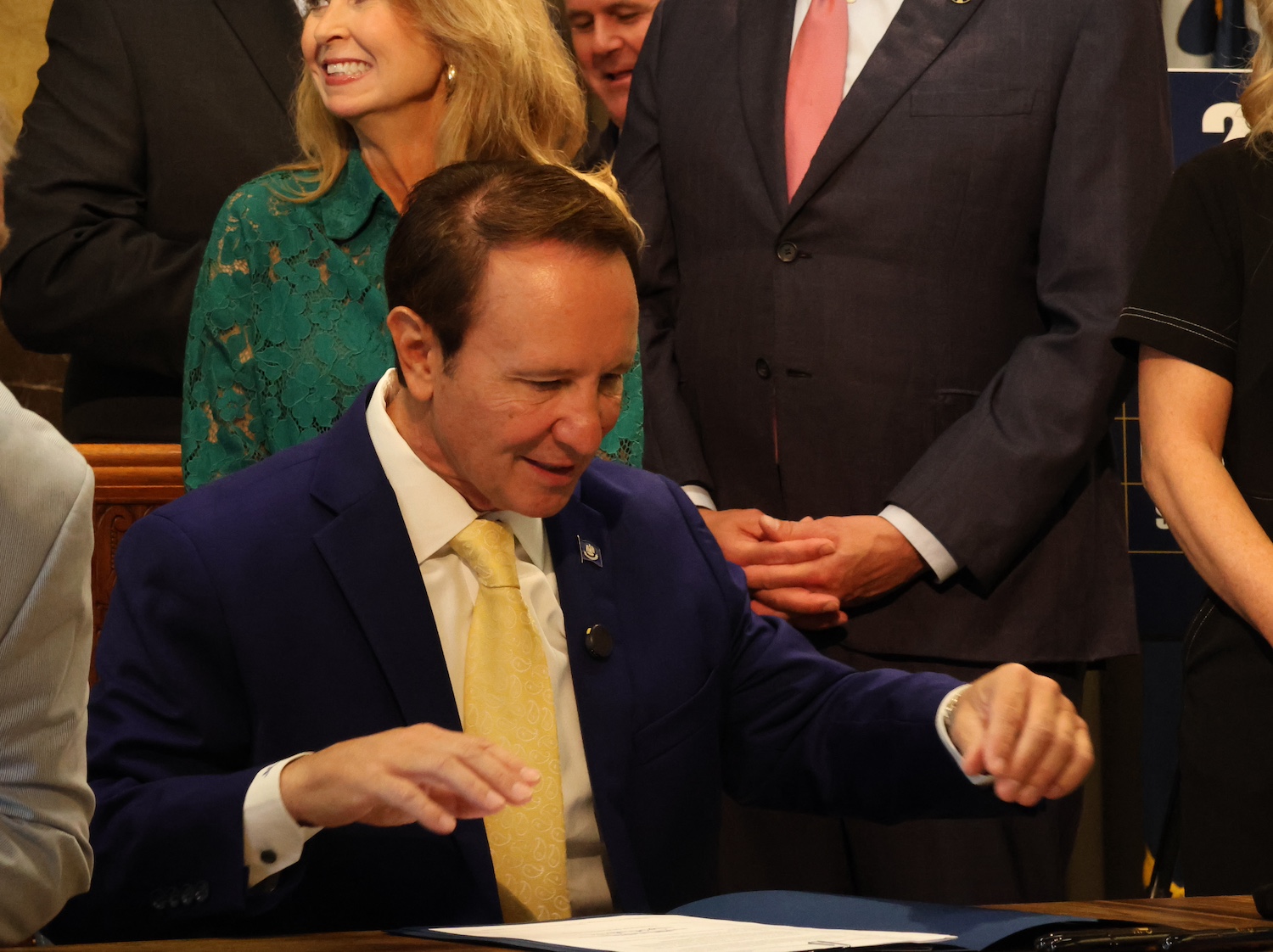
More Than Half the Statewide Cuts Landed on One City
City officials reported that more than 62% of operational funding vetoes and 53% of capital-project vetoes targeted New Orleans. Senator Royce Duplessis called it plainly: “continued political retribution.” Mayor Helena Moreno confirmed that more than half of the governor’s statewide line-item vetoes hit New Orleans.
“Continued political retribution.”
— Senator Royce Duplessis, on Governor Landry’s $33 million in New Orleans vetoes
Duplessis is right that retribution is part of the story. Several legislators believe the vetoes punished those who opposed Landry’s plan to pull $168 million from school operations for teacher stipends. Rep. Delisha Boyd of Algiers lost more than $1.5 million from her district. She put it directly:
“We are serving under a governor that if you don’t agree with him you will be penalized.”
— Rep. Delisha Boyd, Algiers, whose district lost more than $1.5 million in Landry vetoes
However, retribution alone does not explain a pattern this consistent. Retribution is personal. What the data shows is structural.
While New Orleans Lost $33 Million, the Prison System Gained $100 Million
The cuts do not stand alone. They sit beside choices about where Louisiana’s money did go. Those choices reveal state priorities more clearly than any press release.
The Louisiana Illuminator’s session review reported a $100 million year-over-year boost to the prison system. That included $17.5 million for Angola expansion, $15.2 million for a new juvenile facility in Vernon Parish, $18.6 million for prison guard raises, and more than $8 million for prison medical costs.
Louisiana’s prison population has grown by 2,000 people since Landry took office. Meanwhile, early childhood education lost a funding fight to college athletics. Teachers faced pay uncertainty. New Orleans lost Armstrong Park, Dillard scholarships, and funding for groups serving elderly residents and children.
That is not an accident of arithmetic. It is a statement of values written in budget lines.
The Courts, the Clerk, and the Dismantling of Local Governance
Money was only part of what New Orleans lost. The 2026 legislature also reshaped the city’s court system in ways that will last long after this budget year.
WWNO reported that lawmakers passed court changes leaving Orleans Parish with two court systems, one clerk, and three fewer judges. Criminal court judges dropped from twelve to nine. Louisiana Supreme Court records confirm the law abolished the criminal clerk of court office — the same position Calvin Duncan had just won.
Supporters in Baton Rouge called it “right-sizing.” The New Orleans delegation called it what it is: a cut to the city’s judicial capacity and a direct hit to Black electoral power. Beyond the courts, the session left Louisiana with one Black-majority congressional district instead of two — in a state that is one-third Black.
Each Move Has a Justification. Together They Follow a Pattern.
Viewed alone, every action has a technical explanation. Viewed together, they tell a consistent story: the city’s ability to govern itself, speak for its residents, and hold power in Baton Rouge is shrinking. That is not one governor’s doing. It is the result of years of population loss, political realignment, and a state capital that no longer depends on New Orleans’ coalition to win.
The Deeper Pattern: A City Losing Its Leverage
Political power in a state capital comes from population. More people means more seats, more committee chairs, more floor votes, and more credible ability to block bad legislation. As New Orleans has lost residents since Katrina, it has lost each of those tools — one by one, in sequence.
The city that once led Louisiana politics now holds a minority position in a Republican supermajority legislature. Many legislators outside New Orleans see the city as a problem to manage rather than an asset to protect. That view did not start with Landry. Instead, it built over two decades of population loss and political drift.
Landry Accelerated the Problem. He Did Not Create It.
What Landry has done is accelerate the consequences while the city is least able to absorb them. The Innovation Hub veto is the clearest proof. That bill passed the Senate unanimously. Furthermore, it would have brought technology investment and partnerships to New Orleans. A state government comfortable with the city’s decline had no reason to fund it — so it did not.
What the Delegation Must Do Differently
Identifying a structural problem does not excuse the people who must respond to it. The New Orleans delegation — Duplessis, Harris, Boyd, and others — spent this session playing defense. Rather than building alliances, they protected what existed.
Calling the vetoes “political retribution” is accurate. However, as a legislative strategy, it changes nothing.
The delegation needs allies beyond Orleans Parish. Baton Rouge, Shreveport, Lake Charles, Monroe, and Alexandria all lost funding this session too. Rural parishes that depend on state education and health dollars are also caught in the same squeeze. The shared interest is real. The shared political coalition to act on it does not yet exist — and building it is the delegation’s most urgent off-session task.
Until that coalition exists, Baton Rouge will keep treating New Orleans as a piggy bank during Super Bowl season and a punching bag during election season.
The City Also Has to Fix What It Can Control
The delegation also has to be honest about something closer to home. Landry’s fiscal responsibility argument works with some voters because New Orleans has had real management problems. Every budget crisis that pulled in state intervention gave Baton Rouge more leverage over city affairs. Every S&WB failure that went national made the case for local control harder to win.
The external attack and the internal dysfunction reinforce each other. The delegation cannot push back on one while ignoring the other.
The Economy New Orleans Generates Deserves a Better Return
Here is the final point — and it is the one New Orleans advocates keep leaving on the table. The city generates an outsized share of Louisiana’s tax revenue, tourism dollars, port activity, film income, music exports, and convention business. Those assets fund the state budget. That same budget pays for parishes whose legislators vote against New Orleans every session.
That is not a grievance. Rather, it is a leverage point. The case for New Orleans has been made emotionally for too long. Instead, it needs to be made economically. Louisiana cannot afford New Orleans’ decline — because the city’s decline is the state’s decline.
Cut Armstrong Park and the tourism economy weakens statewide. Eliminate Dillard scholarships and Louisiana loses graduates from its workforce. Defund homelessness providers and public safety costs shift elsewhere. Kill innovation legislation and the state loses jobs that do not yet exist but would have. Consequently, the math runs in every direction — and it always comes back to the same conclusion.
What Rebuilding Leverage Requires
New Orleans cannot wait for a friendlier governor. The work starts now, between sessions, in the relationships and coalitions the delegation builds before the next fight begins.
That means a sharper economic message. Regional alliances with other underfunded cities. Defending Black political power in court and at the ballot. Cleaning up local governance to remove easy excuses. Treating population loss as a political crisis, not just a housing problem.
Above all, it means making cuts to New Orleans politically costly. Right now, Landry can veto $33 million from the city and receive applause from voters who do not connect their own parishes’ wellbeing to New Orleans’ health. Changing that calculation is the whole game.
Senator Duplessis is right that the 2026 session carried political retribution. But retribution only lands when the target has lost the power to hit back. The real question is not what Landry did with his veto pen. The real question is how New Orleans rebuilds the leverage to make the next governor think twice before signing.
Related Reading on Black Source Media
Sources
- Louisiana Illuminator: “New Orleans, local groups see biggest cuts from Gov. Landry’s budget vetoes” — June 26, 2026
- Hoodline: “Landry’s Budget Axe Slices $33 Million From New Orleans Projects” — June 26, 2026
- Louisiana Illuminator: “2026 Louisiana legislative session: Winners and losers” — June 5, 2026
- WWNO: “State lawmakers pass bills to ‘reform’ Orleans Parish courts” — June 3, 2026
- WVUE Fox 8: “Louisiana lawmakers vote to cut 3 judges from Orleans Parish criminal court” — June 1, 2026
- Louisiana Supreme Court / Justia: Crockett v. State of Louisiana — 2026
- Senator Royce Duplessis — official statement, June 25, 2026
Langston Price
Langston Price writes economic and policy analysis for Black Source Media. He diagnoses institutional patterns before evaluating the individuals inside them, and believes the numbers always tell the story before the politics do.
