
Trump wants Americans to know he can fix the economy. His proof: a $5,000 “dividend” promised if Republicans hold Congress in November. It’s the fourth time since 2020 he’s promised direct payments to the public — a bigger COVID check, a “DOGE Dividend,” and a tariff dividend all came before it, and none of them arrived. Federal Reserve data show the real problem runs far deeper than one check can reach anyway — especially for Black households, which have far less financial cushion than White households. Only 40% of Black adults could cover a $400 emergency with cash or its equivalent in 2025, compared with 73% of White adults. A one-time payment doesn’t close a gap like that, assuming it even shows up. This is a financial-resilience story, not an inflation story.
- Trump proposed a $5,000 “Trump Dividend” if Republicans keep Congress in the midterms.
- This is his fourth promise of direct payments to the public since 2020 — a $2,000 COVID check demand, a $5,000 “DOGE Dividend,” and a $2,000 tariff dividend all failed to materialize.
- Consumer inflation stayed elevated in August; energy costs are surging.
- Only 40% of Black adults could cover a $400 emergency in 2025, versus 73% of White adults.
- Only 38% of Black adults had three months of emergency savings, versus 61% of White adults.
- Financial well-being among Black adults fell five points in one year.
- Trump promised to lower prices “starting on Day One.” Nineteen months later, inflation is holding at 3.4% and he’s still blaming Biden.
- In February 2026, administration officials told reporters their plan to “run the economy hot” ahead of the midterms — timing, not steady policy.
- Affordability could decide the November midterms.
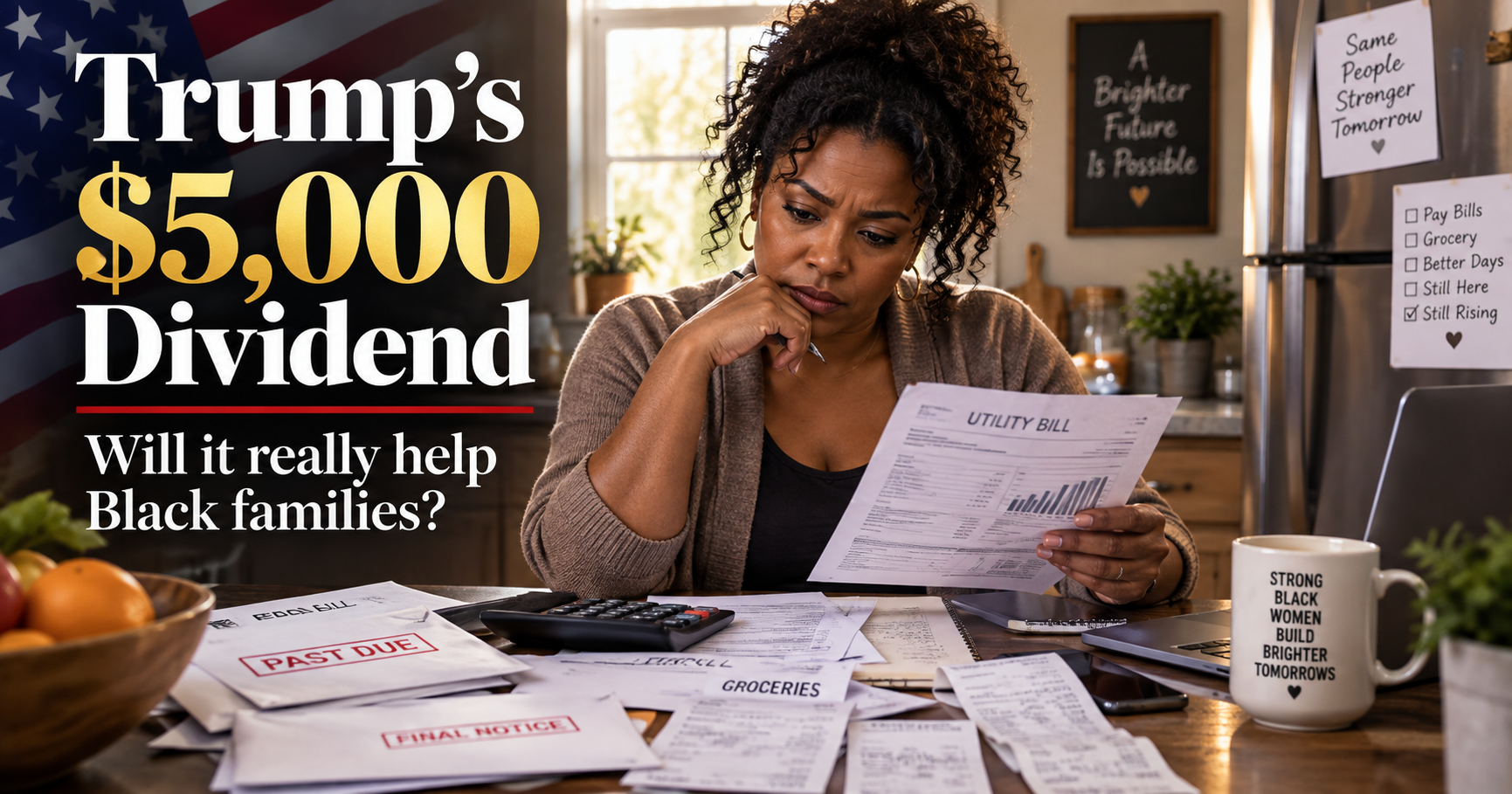
Donald Trump just made Black voters an offer.
Five thousand dollars. One check. If Republicans keep Congress in November. He’s calling it the Trump $5,000 dividend.
He announced it at the GOP’s midterm convention in Dallas, standing in front of a crowd that erupted like he’d just handed out lottery tickets.
Here’s the question nobody in that room asked out loud.
If the economy is really working, why does it need a $5,000 bribe to prove it?
You don’t hand a massive check to people who already feel secure. You hand it to people you know are hurting — and hope the check arrives before they notice why.
The Trump $5,000 Dividend Doesn’t Touch the Real Problem
Congress hasn’t approved this. Nobody knows if it’s even legal. Vice President Vance was already walking parts of it back within the hour. This is a campaign promise, not a policy.
But say it happens. Say the check clears. Then what?
If housing, food, energy, insurance and health care are still expensive the week after, you haven’t fixed affordability. You’ve rented relief for thirty days.
And for Black families, thirty days of relief doesn’t touch a gap this size.
That’s a 33-point gap. One check doesn’t close it. A pattern closes it, or a pattern keeps it open.
This Isn’t Trump’s First Promised Check. It’s His Fourth.
Count them.
- December 2020: Trump demanded Congress raise COVID relief checks from $600 to $2,000 per person, calling the smaller amount a “disgrace.” The Senate blocked the increase. The $600 checks went out. The $2,000 never did.
- February 2025: Trump and Elon Musk floated a “DOGE Dividend” of roughly $5,000 per household, funded by 20% of the Department of Government Efficiency’s claimed savings. It never materialized.
- November 2025: Trump promised a $2,000 “tariff dividend” for the middle of 2026, funded by tariff revenue. No bill ever passed. The Supreme Court then struck down a large share of the tariffs that were supposed to pay for it. Nobody got a check.
- September 2026: The $5,000 “Trump Dividend” — the one making headlines this week.
Three promises. Different funding sources each time. Different price tags each time. Zero checks delivered.
Now compare that record to the one dividend Trump actually paid out. In December 2025, his administration sent $1,776 “Warrior Dividend” checks to 1.45 million service members before Christmas. The Defense Department funded those directly. No new law required. No tariff revenue needed. It happened because the money and the authority to spend it already existed.
That’s the difference between a promise and a check. Three needed Congress, or a savings figure that never showed up, and none of them came through. The fourth didn’t need either, and it arrived on schedule.
The new $5,000 dividend needs the same thing the last two needed and never received: an act of Congress, or a funding source that survives contact with reality. Nothing about that math has changed since 2020.
Trump Has a Math Problem
At that same Dallas convention, Trump also tried to convince Americans that prices were already falling.
But Reuters reported that affordability remains one of voters’ biggest concerns, even as Trump keeps insisting his economic program is succeeding.
The latest inflation numbers don’t exactly support a victory parade. Consumer prices rose 0.4% in August from July. Energy deserves much of the blame. Gasoline and diesel prices have surged amid international conflict.
That matters because fuel doesn’t stay at the gas station. Diesel moves America. Trucks carry the groceries. Warehouses restock with those same trucks. Clothing racks fill because trucks kept moving. Almost everything sitting inside your local Walmart, Costco or neighborhood grocery store got there by truck.
Eventually, somebody pays those transportation costs.
Guess who?
You.
Grocery Prices Aren’t Even the Whole Story
This is where Democrats and Republicans both sometimes insult voters. They argue over whether inflation is 2%, 3% or 4%. The average person doesn’t live inside a percentage. People live inside a monthly budget.
Your mortgage doesn’t care about political talking points. Entergy doesn’t either. Your insurance company won’t budge for a press release. Your child’s tuition and your car note don’t care what Washington says.
If your income rises 3% while the things you actually buy rise faster, you are poorer. Period. Maybe not on an economist’s spreadsheet. But definitely on Friday night when the bills are due.

Black America Has Less Room for Economic Mistakes
This is where the conversation matters most for BlackSourceMedia readers.
Higher prices hurt everybody. They don’t hurt everybody equally. The Federal Reserve’s latest household financial data expose the difference.
Now consider another number. Only 38% of Black adults had enough emergency savings to cover three months of expenses. For White adults, the figure was 61%. See the full emergency savings breakdown by race for yourself.
That’s why another $30 at the grocery store matters. That’s why another $60 filling the tank matters. That’s why a $500 insurance increase matters — and Louisiana readers already know that story firsthand from BSM’s coverage of Louisiana’s insurance crisis.
People with substantial savings absorb inflation. Families without it reorganize their whole lives around it. No $5,000 check changes which category a family is in — it just delays the reckoning by a month or two.
Black Financial Well-Being Is Moving Backward
The numbers get worse.
The Federal Reserve found that overall financial well-being remained relatively stable in 2025. But not for everybody. Only 60% of Black adults reported doing okay financially or living comfortably. That compared with 79% of White adults.
More troubling, financial well-being among Black adults fell five percentage points in one year. That should be national news. Instead, Washington keeps giving us political theater. Republicans say everything is wonderful. Democrats say everything is Trump’s fault.
Meanwhile, somebody in New Orleans is deciding whether to pay Entergy or buy groceries. That’s the economy I care about.
Stop Telling People What They Feel
This is one of the dumbest things politicians do. They tell voters their personal economic experience isn’t real.
If somebody’s grocery bill increased, don’t show them a chart. When their homeowners insurance doubled, don’t quote GDP. And if gasoline jumped, skip the stock market lecture.
Listen to them. Economic statistics matter. But household experience matters too.
The Federal Reserve found that price increases remained Americans’ most common financial concern. More than nine out of ten adults considered rising prices at least a minor concern. People responded accordingly. Sixty-two percent switched to cheaper products. Sixty percent reduced or stopped buying some products. Forty-six percent delayed major purchases. And 41% reduced savings.
That’s not economic confidence. That’s adaptation.
And Yes, Biden Shares Some Blame
Now comes the part some Democrats won’t like.
Trump didn’t invent America’s affordability crisis. Inflation exploded during Joe Biden’s presidency. Housing affordability deteriorated. Interest rates climbed. Insurance became increasingly brutal in Louisiana. Families entered Trump’s second administration already exhausted by years of higher prices.
That matters. But Trump has been president again since January 2025. At some point, blaming Biden stops being an economic policy — and a one-time check doesn’t replace one either.
Trump asked Americans to judge him on whether he could fix the problem. So judge him against six plain questions, dividend or no dividend:
- Are groceries cheaper?
- Is housing more affordable?
- Has insurance gotten cheaper?
- Did the electric bill go down?
- Is it cheaper to borrow money?
- Is your family keeping more money at the end of the month?
Those questions matter more than whether somebody in Washington can manipulate a statistic — or write a check timed to an election.
Nineteen Months In, Where’s the Fix?
Judging him means remembering what he actually promised. “When I win, I will immediately bring prices down, starting on Day One,” he said, over and over, on the 2024 campaign trail. It was specific. It had a deadline. Day One has since stretched to month nineteen.
Here’s what actually happened along the way:
- January 2025: Trump takes office. Inflation is already running near 3% before his first full month closes.
- February 2026: After a brief jobs bump, Trump declares on social media that “The Golden Age of America is upon us!!!”
- March 2026: The Golden Age lasts about a month. The economy sheds 92,000 jobs in a single month, December’s report gets revised down to an outright loss, and gas prices climb.
- By his eleventh month back in office: GDP growth has nearly halved, from 2.8% to 1.6%. Unemployment sits at 4.3%. Only 37% of Americans approve of how he’s handling the economy, and more of them blame him for it than blame Biden.
- August 2026: Annual inflation holds at 3.4%, unchanged from July, with gasoline up 27.4% over the year.
Through all of it, the explanation hasn’t changed. As of last December, he was still describing the situation as a “mess” left by Biden — eleven months into his own term. By March, he was still telling the country that any problems people were feeling belonged to the Democrats.
Here’s the part that should bother you more than the blame game. In February 2026, administration officials told the Washington Post their actual plan: run the economy hot heading into the midterms — tax refunds, rate cuts, deregulation — engineered to peak right as voters go to the polls in November. Not steady management. A push, scheduled for right before an election.
A $5,000 check announced at a midterm convention, on that same calendar, isn’t a coincidence. It’s the same playbook.
Black Voters Should Demand More
Black voters should stop accepting economic arguments based solely on party loyalty. Ask both parties the same questions:
- How will you raise Black household wealth?
- How will you lower housing costs?
- How will you make insurance affordable?
- How will you expand Black homeownership?
- How will you help small businesses access capital?
- How will you protect Medicaid and food assistance?
- How will you create jobs that actually build wealth?
- How will you close that enormous emergency-savings gap?
Republicans should answer those questions. Democrats should answer them too. Black voters don’t owe either party economic amnesia — and they don’t owe Trump gratitude for a check that hasn’t been written yet.
The Real Black Economic Indicator
Forget Wall Street for a minute. Forget the dividend, too. I propose another economic measurement. Call it the Black Household Affordability Test. At the end of every month, ask five questions:
- Can you pay your housing?
- Can you buy quality food?
- Can you pay your insurance?
- Can you handle an emergency?
- Can you save something?
If millions of families answer “no,” then I don’t care how beautiful Washington says the economy is. I don’t care how big the check is either. Something isn’t working.
Donald Trump can say prices are coming down. Democrats can blame Trump. Economists can debate decimal points. But Black families don’t live in Washington talking points. We live in the space between the paycheck and the bills. And right now, that space is getting awfully tight — five thousand dollars or not.
[AWeber newsletter signup block — insert your standard embed code here]
