

Louisiana funds transformational projects every single session. Bayou Phoenix is exactly that. So why is the delegation going quiet when it matters most?
Let’s start with what we know.
The state of Louisiana has never had a problem spending public money on big projects. Not once. Not ever. When the vision is large enough and the jobs are real enough, Baton Rouge finds a way to write the check.
The question has never been whether Louisiana invests in transformational development. The question has always been: who gets the investment?
Right now, New Orleans East is watching the rest of the state get the answer — while their 225-acre opportunity sits waiting on a $50 million gap. A gap that the state legislative session, which opens tomorrow, March 9, could close in a single vote.
What Louisiana Has Always Done for Big Projects
Let’s talk about private companies. Because the state has been writing checks to private developers for years — and nobody called any of those deals a scheme.
The Meta Deal: Louisiana Rewrote the Law in Weeks
When Meta told state officials it needed a tax incentive for its massive data center in Richland Parish, Governor Landry’s administration didn’t hesitate. Within weeks, state officials rewrote existing legislation to create a brand new sales and use tax exemption specifically for data centers. The Legislature passed it with large bipartisan majorities. As a result, Meta is now building its largest data center complex in the world — a $27 billion investment on a 3,650-acre site in rural northeast Louisiana. Furthermore, the state purchased over 1,400 acres of land and leased it directly to Meta. Louisiana didn’t just open the door. It built a new one.
The Hyundai Deal: $600 Million in Public Commitment
When Hyundai Steel wanted to build a $5.8 billion steel mill in Ascension Parish — the company’s first North American facility — Louisiana responded with staggering public support. The total public commitment reached $600 million. That included a $100 million performance-based infrastructure grant, $91 million in state land acquisition, and hundreds of millions more in road, rail, utility, and port upgrades. In addition, a multi-decade property tax PILOT arrangement brought total state and local tax relief to over $1 billion across the life of the deal. For a private foreign corporation. Moreover, Governor Landry flew to South Korea personally to close it. Nobody called that a scheme.
The River District: Right Here in New Orleans
Closer to home, the $1 billion River District — a private mixed-use development on New Orleans riverfront land — tells the same story. That project received $15.4 million in state housing funds, city bond money for infrastructure, and a 15-year property tax exemption worth over $21 million for its first office tenant alone. Beyond that, it secured ongoing public investment through multiple cooperative endeavor agreements. Private developers. Public money. That is the standard playbook in this state.
FastSites: $150 Million Deployed Across 16 Parishes
The state legislature also created the $150 million FastSites program under Act 365 of the 2025 Regular Legislative Session. In the inaugural funding round, 19 sites spanning 16 parishes moved forward. Individual awards reached up to $25 million each. Industrial corridors across the state got in line — and got funded.
Louisiana clearly knows how to invest in private development. Consequently, the argument that Bayou Phoenix doesn’t qualify strains credibility. Public infrastructure investment is not charity — it’s how this state competes and wins.
All of that is established. Documented. Done.
So tell me why Bayou Phoenix — the largest proposed development in New Orleans East in 50 years — was denied a FastSites loan. And why it is heading into a legislative session opening tomorrow asking for $50 million with no clear champion at the microphone.
What Bayou Phoenix Actually Is
Because some people still need to hear it plainly.
Five Years of Real Work on the Ground
Developer Troy Henry of Henry Consulting, along with partner TKTMJ, Inc., has held exclusive development rights to the former Six Flags/Jazzland site since 2021. That’s 225 acres of publicly-owned land in New Orleans East that has sat abandoned since Hurricane Katrina. Twenty years of blight. Twenty years of the East being told to wait.
Henry’s team didn’t show up with a dream board. Instead, they completed technical and financial feasibility studies, signed a development agreement with the New Orleans Redevelopment Authority, and demolished the old amusement rides. They are ready to move.
Signed Partners. Real Timelines.
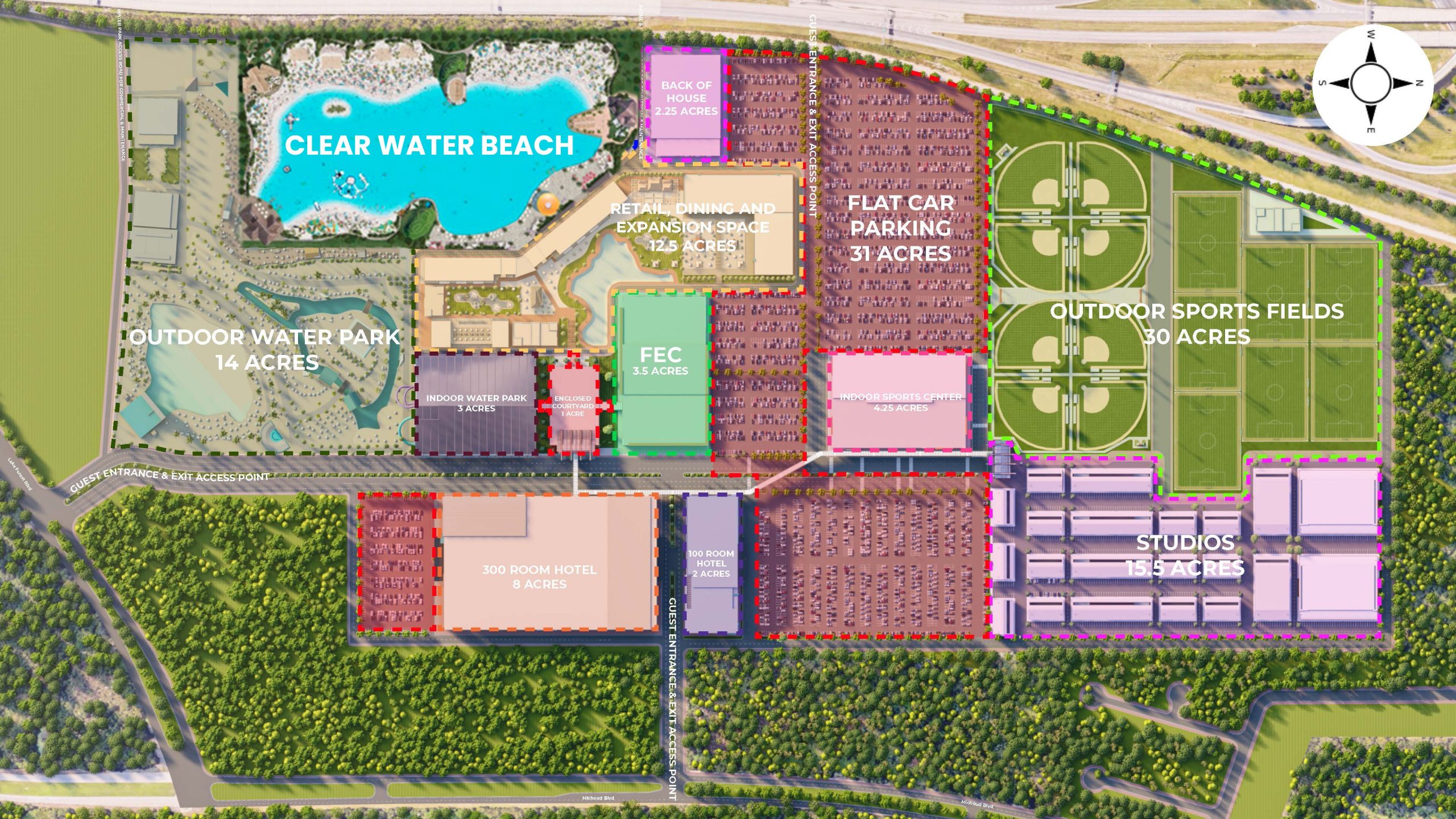
The $500 million project includes:
- A film production studio, with E. Ross Studios signed and under formal agreement — phase one targeted for completion by end of 2027.
- An indoor-outdoor youth sports complex, with Eastern Sports Management selected as the operator.
- A clearwater lagoon, indoor waterpark, 300-room hotel, and family entertainment center, with American Resorts Management on board.
These are not renderings waiting on funding. These are signed partners who showed up at Franklin Avenue Baptist Church on March 6 with timelines and construction schedules. Troy Henry told the room what New Orleans East has been waiting years to hear: we are done planning. Construction starts this year.
The Revenue This Project Generates
Consider what flows back to the public once this project opens. Film revenue. Sports tourism. Hotel occupancy taxes. Sales taxes from retail and dining. Permanent, high-paying jobs — not seasonal gigs or temporary contracts. In addition, regional travel spending from sports tournaments will draw families from across the Gulf South.
This project generates tax revenue at every level — city, parish, and state. It doesn’t drain the public treasury. It refills it. That is precisely what FastSites was created to support.
The FastSites Denial Deserves a Second Look
The FastSites program’s own selection criteria include market viability, economic impact, public benefit, return on investment to the state, strategic location, and future growth potential.
Bayou Phoenix checks every single one of those boxes.
Why the Denial Makes No Sense
The project sits on publicly-owned land — NORA owns it — which is exactly the kind of entity FastSites was designed to work with. Additionally, the project has committed private partners with signed agreements and a defined construction timeline. It is positioned in a historically underinvested corridor of New Orleans that is, at the same time, experiencing some of the fastest-rising property values in the city.
And yet, the first FastSites application was denied. No public explanation. No detailed reasoning. Just no.
That answer needs to be revisited. If FastSites is not the right vehicle, then state lawmakers need to find one that is. The notion that this project doesn’t deserve public investment falls apart the moment you compare it to what this state has funded elsewhere.
Related: Bayou Phoenix Will Transform New Orleans East
The Ask Is Modest by Any Measure
Bayou Phoenix is asking the state to bridge a $50 million gap on a $500 million development. That is a 10-cent ask on every dollar of private investment already committed. Any economic developer in this country would call that exceptional leverage. Furthermore, with a legislative session opening tomorrow and $150 million in FastSites capital actively deploying, the mechanism to say yes already exists.
The Local Delegation Needs to Step Up
The Louisiana legislative session opens tomorrow — Monday, March 9. It runs through June 1.
The Roadmap Is Already Written
New Orleans East has elected officials in Baton Rouge — a state house delegation and state senators. This is the moment, not next session or after another feasibility study, where those officials need to do their jobs.
Troy Henry asked directly. At the March 6 public forum, he laid out a clear funding strategy: the FastSites program, infrastructure funds tied to the city’s bond sale, and state legislative appropriations. That is not a vague ask. That is a roadmap with specific lanes. The delegation’s job is to take it to Baton Rouge and fight for it.
The Precedent Is Already Set
This is not a request for special treatment. Rather, it is a request for the same standard of investment this state has applied to private projects for years. Meta got a custom-written tax exemption. Hyundai got $600 million in public commitments. The River District received state grants, bond money, and tax breaks. By that measure, investing $50 million here is not generous. It is simply consistent.
New Orleans East deserves that same energy. Not a scaled-down version. Not a watered-down conversation. The same energy.
Councilman Hughes, That Podium Moment Deserves a Do-Over
Bayou Phoenix sits in Jason Hughes’s council district. As the area’s representative, he was a scheduled speaker at the March 6 community forum. After the mayor finished her remarks, Hughes stepped to that podium. The room was full of New Orleans East residents — people who have been waiting for this community’s moment for two decades. Cameras were rolling and the development community was paying attention.
From that podium, Hughes chose to describe the project’s financial structure as a “funding scheme.”
Words Matter When You’re at That Microphone
Not a public-private partnership. Not a capital investment framework. No, not a financing structure. A scheme.
That word carries real weight. A scheme implies deception. It signals suspicion. It is the language of skepticism — and when it comes from the representative of the very district where the project is being built, spoken publicly and on the record, it does damage that a quiet clarification doesn’t fully undo.
Consider what Troy Henry brought to that meeting. Five years of feasibility studies, lease negotiations, NORA agreements, partner recruitment, and demolition work. He arrived with signed partners, concept art, construction timelines, and a specific public ask for the $50 million needed to close the financing gap on a half-billion-dollar development.
Every Other Deal in This State Works the Same Way
That is not a scheme. That is a capital stack — and importantly, it is how every major development this state has ever funded gets structured.
Louisiana gave Meta a brand new tax exemption written specifically for them in a matter of weeks. Nobody called that a scheme. The state committed $600 million in public funds to bring Hyundai Steel to Ascension Parish. Nobody called that a scheme. The River District received state housing grants, city bond money, and a 15-year tax exemption on its first building. Nobody called that a scheme either.
Councilmember Hughes represents New Orleans East. Therefore, his language and his public posture on this project carry real weight — positive or negative. The community deserves to know, without ambiguity, which side of this he is on. He should find the nearest microphone and correct the record.
Mayor Moreno: This Is Your Moment. Don’t Miss It.
Helena Moreno campaigned on a promise to New Orleans East.
She said it on the trail and repeated it in office. In every speech where the East comes up, she calls herself a champion for that community and pledges that the East will no longer be treated as an afterthought.
The East Has Heard This Before
New Orleans East has been patient with that promise. This is a community of homeowners and working families with disposable income and a real tax base. Nevertheless, residents have watched grocery stores, restaurants, and retailers keep choosing other zip codes. They’ve seen infrastructure dollars flow downtown while their roads, drainage, and commercial corridors got the back of the hand. Generation after generation has heard “we support the East” — and then watched development announcements land everywhere but there.
This Is the Opportunity She Campaigned On
Now, the largest development in New Orleans East in 50 years is standing at the finish line — $50 million short — with the Louisiana legislature opening tomorrow. The window is open. The partners are signed. The roadmap is written.
This is not a complicated moment. It is a clarifying one.
Mayor Moreno has relationships in Baton Rouge. She has a platform that the governor hears, that legislative leaders listen to, and that the economic development community respects. A mayor who personally champions this project during an active legislative session — with a defined funding gap and committed private partners already in place — has every tool she needs to move this forward.
She attended the March 6 forum. She spoke before Hughes. And she knows exactly what is at stake. The question is whether “I support New Orleans East” remains a campaign sentiment — or becomes executive-level action during a session that opens tomorrow and runs through June 1.
Here Is What Leadership Looks Like
Mayor Moreno: call the delegation together this week. Get them aligned behind a funding strategy. Walk into Baton Rouge personally and advocate for the infrastructure investment that makes Bayou Phoenix whole. Use the bond funds. Push for FastSites reconsideration. Find the path and lead it.
This is why people elected you. Not to show up, speak first, and leave before the hard conversation starts.
New Orleans East is watching. This time, they are not asking for a promise. They are asking for results.
The Math Is Not Complicated
New Orleans East has watched the rest of this state collect investment after investment for decades. The River District. The Hyundai steel mill. The Meta data center. Every one of those projects received public money, tax breaks, infrastructure grants, or land deals — often all of the above.
Nobody called any of those financing structures “schemes.”
The residents of New Orleans East fully support this project without hesitation.
Tangie walls
What New Orleans East Has — and What It Deserves
Bayou Phoenix is the largest development opportunity New Orleans East has seen in half a century. It sits on publicly-owned land with committed private partners. It is led by a local Black developer who refused to quit when lesser people would have walked away. Furthermore, it has the backing of a community that has been patient, supportive, and deserving for longer than anyone should have to wait.
The state has a $150 million FastSites fund, a legislative session that opens tomorrow, and 16 parishes already in line for infrastructure investment. New Orleans East should be 17.
The Decision Belongs to the People in the Room
The NOLA delegation knows what to do. Mayor Moreno knows what to do. The governor’s office knows what to do.
The only question is whether they’ll do it.
New Orleans East is not asking for special treatment. They are asking for the same deal this state has cut with private developers — from rural Richland Parish to the New Orleans riverfront — for years.
Lead. Fund it. Get it done. Bayou Phoenix is ready.
Langston Price is a contributing writer at Black Source Media. Follow the conversation at BlackSourceMedia.com.