

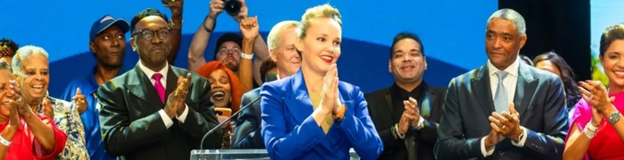
Helena Moreno didn’t run to be a visionary mayor.
She ran to be a competent one.
That distinction matters. It defines both her greatest strength and her biggest constraint. Moreno steps into City Hall at a moment when New Orleans is exhausted. Residents aren’t asking for speeches or slogans. They want a city that works.
That demand gives her a clear mandate. It also puts her in a box.
TL;DR Key Takeaways
- Helena Moreno was elected to fix what’s broken, not to chase grand visions.
- New Orleans voters want basic city services to work—consistently and visibly.
- That mandate creates a “Fix-It Box” that limits big-idea spending in the short term.
- Major investments in tech, health, or growth won’t sell while streets, pipes, and services fail.
- Moreno’s challenge is fixing the basics fast enough to earn public trust for future growth.
- Competence is not the end goal—but it is the price of admission for ambition.
A City That Just Wants to Function
Voters didn’t elect Moreno to experiment. They elected her to fix things that have been broken and neglected for too long. Streets. Lights. Drainage. Trash pickup. Permits. Payroll. Water bills.
These issues don’t generate national headlines. But they dominate daily life in New Orleans. People experience them every morning on the way to work and every night on the way home.
Moreno understands this. She ran on the promise of “Super Bowl–level city services.” For most voters, that didn’t mean grand ambition. It meant basic competence. Do the simple things well. Do them every day. And do them on time.
That’s the floor. And in New Orleans, the floor is high.
The Fix-It Box Is Real—and It’s Limiting
This is the reality of the Fix-It Box. Everything Moreno proposes will be filtered through one question: Does this fix what’s broken?
That creates a dilemma.
How does a mayor sell big ideas when the pipes are collapsing under our feet? How does she justify spending millions to build a mini tech hub, a health innovation corridor, or a green-energy cluster—ideas other cities pursue—when residents are still boiling water and dodging potholes?
She can’t. Not yet.
And that’s not a knock on her leadership. It’s political reality.
Related: What Will NOLA Demand From Moreno
Competence Before Vision
Moreno has little margin for error. Any move that looks like a distraction from basic services risks backlash. The public isn’t in the mood for future-focused messaging until the present stops malfunctioning.
That means no shortcuts. No shiny projects before visible repairs. No growth narratives before stability.
The Fix-It Box demands discipline. It demands focus. It demands that Moreno spend political capital on unglamorous work instead of legacy-defining initiatives.
This is where sympathy is warranted.
Every mayor wants to leave a mark. Big ideas are how legacies are made. But big ideas only work when the public trusts the foundation underneath them.
Right now, that trust is thin.
Why Big Ideas Feel Premature
Other cities have successfully rebranded themselves. Austin leaned into tech. Nashville became a healthcare hub. Pittsburgh reinvented itself after industrial decline.
But those cities had one thing New Orleans lacks: a baseline of reliability.
Their residents weren’t asking for survival-level fixes. They weren’t questioning whether city services would show up at all. New Orleans residents are.
That reality makes even good ideas feel premature.
Why build when the streets are sinking?
Why expand when the pipes are failing?
Or why innovate when the lights still flicker?
Those aren’t cynical questions. They’re rational ones.
The Risk of Staying in the Box Too Long
Fixing what’s broken is necessary. But it’s not sufficient forever.
Cities don’t grow on maintenance alone. At some point, stability must give way to direction. Repair must create space for reinvention.
Moreno’s real challenge isn’t whether she can fix the basics. It’s whether she can fix them fast enough to earn permission for what comes next.
That requires sequencing.
Deliver visible wins. Communicate progress relentlessly. Make City Hall boring in the best way possible—predictable, professional, functional.
Competence must become her brand.
Buying the Right to Dream Bigger
If Moreno delivers on the basics—consistently and publicly—she buys credibility. And credibility is the currency that allows a mayor to say, “Now that the city works better, here’s where we’re going.”
Until then, the Fix-It Box is non-negotiable.
She can’t resent it. She has to master it.
The risk isn’t that Moreno focuses too much on fixing things. The risk is that she never gets the chance to move beyond it.
The Moment Demands Precision, Not Panic
Move too fast, and she looks disconnected from reality.
Move too slow, and the city stagnates.
This moment demands timing, not theatrics. Precision, not posturing.
If Moreno can fix what’s broken and prepare for what’s next, she won’t just be the mayor New Orleans needed after dysfunction.
She’ll be the mayor who proved that competence isn’t the enemy of ambition—it’s the foundation for it.
New Orleans Needs Leadership Built for the Real World We Live In
New Orleans has never been an ordinary city, and it cannot afford ordinary leadership. Guiding a blue, urban community within a predominantly red state requires a level of clarity, steadiness, and strategic focus that goes beyond the usual political playbook. Our city generates enormous retail tax revenue for Louisiana, yet the support we receive from the state rarely reflects the economic value we provide. That imbalance leaves New Orleans carrying responsibilities far larger than the resources we’re given to meet them.
A successful leader here must be willing to advocate fiercely for the city’s needs while also reaching across political lines with purpose and respect. Collaboration is not weakness; it is the only way to secure the long‑term stability that both New Orleans and the state depend on. When leaders build relationships instead of resentments, they create room for shared solutions — especially on issues that affect every community, regardless of party.
Nowhere is that more urgent than in our infrastructure. New Orleans cannot thrive on tourism alone, yet year after year we rely on a volatile industry to fund essential services. A strong leader must push for a broader, more resilient economic base while also addressing the fundamentals that keep the city functioning: reliable drainage, safe streets, dependable utilities, and housing that families can afford. These are not luxuries. They are the foundation of public safety, economic growth, and basic dignity.
The path forward requires a leader who can hold two truths at once: that New Orleans deserves stronger support from the state, and that progress depends on building bridges rather than burning them. With clear purpose, resilience, and a commitment to the people who call this city home, New Orleans can move toward a future where its contributions are recognized, its infrastructure strengthened, and its potential fully realized.