

OPINION | BLACK SOURCE MEDIA
Troy Henry asked the state for $50 million on a $500 million deal. Louisiana gave Meta a billion-dollar custom tax exemption and flew to South Korea for Hyundai. So why are people acting like Henry committed a crime?
My phone has been ringing.
People I know and respect — good people who genuinely care about this city — are calling to say some version of the same thing. Troy Henry is asking the state for $50 million for Bayou Phoenix, and that doesn’t look right. It’s a bad look, they say. It’s unusual. And perhaps most telling, I’ve heard this word used more than once: begging.
I want to be careful here, because I understand where some of that sentiment comes from. For generations, Black professionals in this city have worked twice as hard for half the recognition. Consequently, there’s a protective instinct in the community — a genuine fear that one of our own might be exposed or embarrassed, might hand ammunition to people who never wanted us to succeed in the first place. That instinct comes from a real and painful history.
Nevertheless, right now that instinct is flat wrong.
What Troy Henry did is not begging. Moreover, it is not unusual and it is certainly not a bad look. What Troy Henry did is called economic development — the same thing Louisiana has done for white developers, foreign corporations, and out-of-state billionaires for years, without a single raised eyebrow.
The only thing unusual about Troy Henry’s ask is that his name doesn’t sound like the ones Louisiana usually writes checks for.
Let’s Talk About What Louisiana Actually Does
New Orleans currently draws roughly 18 million visitors a year. Bayou Phoenix, when fully built, is projected to bring 2 million visitors to New Orleans East alone. In other words, that’s more than one in ten tourists to this entire city coming specifically to a site that, until now, has sat as a monument to neglect since Hurricane Katrina. One project. Eleven percent of the city’s total visitor draw. Built on 225 acres of publicly owned land that currently generates nothing for anyone.
So let’s talk about what Louisiana calls ‘investment’ when the developer isn’t Black.
When Meta announced its data center plans for rural Richland Parish, Governor Landry’s administration didn’t deliberate for months. Instead, they rewrote state law — crafting a brand new sales and use tax exemption specifically for data centers — and passed it through the Legislature with bipartisan majorities. Beyond that, the state purchased over 1,400 acres of land and leased it directly to a trillion-dollar corporation. The result: Meta’s largest data center complex on earth, a $27 billion investment. Louisiana didn’t open a door. It built a new one and held it open.
Nobody called that a scheme. Not one person.
When Hyundai Steel sought to build its first North American facility — a $5.8 billion steel mill in Ascension Parish — Louisiana’s total public commitment reached $600 million. That figure included $100 million in performance-based infrastructure grants, $91 million in state land acquisition, and hundreds of millions more in road, rail, utility, and port upgrades. Additionally, a multi-decade property tax arrangement brought total public relief to over $1 billion across the life of the deal. Governor Landry flew personally to South Korea to close that deal for a foreign corporation.
Still, nobody called that unusual.
And right here in New Orleans — not in Richland Parish, not in Ascension, but right here on our own riverfront — the River District received $15.4 million in state housing funds, city bond money for infrastructure, and a 15-year property tax exemption worth over $21 million for its first office tenant alone. Furthermore, it secured ongoing public investment through multiple cooperative endeavor agreements. The Lauricella family built a capital stack that relied heavily on public subsidy at every layer.
Yet nobody called that begging.
$600 million for a South Korean steel company. $1 billion in custom incentives for Meta. $15 million-plus for the River District. And people are clutching pearls over $50 million for a Black developer with signed partners and a construction timeline?
The Math Louisiana Should Be Running
Troy Henry’s ask is $50 million on a $500 million project. That is a 10 percent public leverage ratio — meaning for every single dollar the state puts in, nine dollars of private capital follow. Any economic developer in any state in America would call that ratio exceptional. In fact, the FastSites program — the very vehicle that denied Bayou Phoenix without a public explanation — was designed precisely for projects with exactly this kind of return profile.
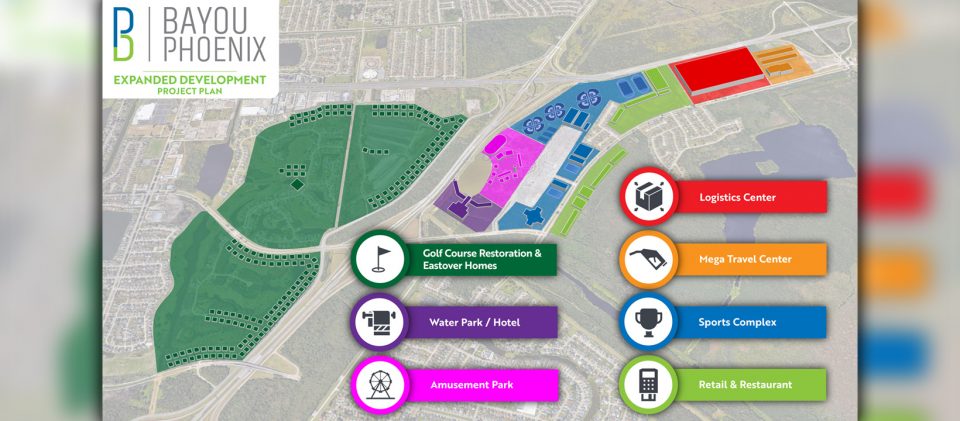
The project sits on land owned by NORA, a public entity. It also has signed anchor partners: E. Ross Studios for the film production complex, Eastern Sports Management for the youth sports facility, and American Resorts Management for the hotel, waterpark, and lagoon. These are not renderings on a dream board. Rather, these are signed agreements with real construction timelines. Troy Henry stood at Franklin Avenue Baptist Church on March 6 and told a room full of New Orleans East residents — people who have waited 20 years for this moment — that construction begins this year.
And then a city council member stepped to that same podium and used the word ‘scheme.’
Words matter when you’re at that microphone. A scheme implies deception. It signals to every investor, every partner, and every state official paying attention that the project’s own district representative has doubts. That kind of damage doesn’t disappear with a quiet clarification. Accordingly, Councilman Jason Hughes owes New Orleans East residents a public correction — not a whispered walkback — and he owes Troy Henry the same professional respect Louisiana’s political class extends automatically to every developer who comes to Baton Rouge with a capital stack.
What Georgia and Texas Figured Out That Louisiana Hasn’t
People often wonder why Georgia’s film industry now generates more production revenue than Hollywood. Similarly, they ask how Texas built the second largest economy in the United States. Why has Atlanta become a global Black business capital while New Orleans — a city with a majority Black population, an internationally recognized brand, and one of the most visited destinations on the continent — keeps watching talent and capital leave?
Here is part of the answer: Georgia and Texas made a decision, years ago, that Black-owned businesses are economic engines — not charity cases, not political favors, not social programs. As a result, they recognized that investing in Black entrepreneurs generates returns that flow to all citizens, across all zip codes and all tax brackets. In short, they treated Black business the same way they treated every other sector of their economy: as something worth developing.
Georgia, for instance, gave Tyler Perry hundreds of millions in tax incentives to build the largest film studio complex in the world on the outskirts of Atlanta. Officials there didn’t ask whether it looked unusual for a Black man to seek public support. Instead, they asked whether the economics made sense. They did. Georgia wrote the check.
Louisiana has Troy Henry. Troy Henry, who built Henry Consulting into one of the most significant Black-owned firms in this state. Troy Henry, who ran for mayor of New Orleans and nearly won on a platform of economic transformation. Moreover, Troy Henry has held development rights to this Jazzland site since 2021 — completing feasibility studies, executing agreements with NORA, demolishing old infrastructure, and recruiting signed private partners — all while the doubters kept doubting.
He didn’t come to Baton Rouge with a dream. He came with a deal.
Let’s Be Honest About Troy Henry — All of It
Now, I’m going to say something that some people won’t expect in an article defending Troy Henry: he is not everybody’s favorite person. He knows that. Troy Henry is not a man who moves through rooms trying to make everyone comfortable. He is direct, ambitious, and unapologetic about what he wants. In a city that often runs on relationships, deference, and the unspoken rules of who gets to push and who is supposed to wait, that kind of energy creates friction.
Troy Henry has ruffled feathers. He ran for mayor in 2021 and was unapologetic about his vision the entire time. And he has been in rooms and said things that made people squirm. He doesn’t soften his edges for an audience. Some people find that quality refreshing; others find it abrasive. Additionally, there are people in this city and in this business community who carry a personal or political beef with the man that has nothing whatsoever to do with Bayou Phoenix.
I’ll grant all of that. Every word of it.
However, here is what I need you to understand: none of it matters. Not one syllable matters when we are talking about whether the state should invest $50 million in a $500 million development on 225 acres of publicly owned land in one of the most neglected corridors of this city.
Because here is the truth about how Black multi-millionaires get built in America: you do not get there by making everyone comfortable. You do not get there by waiting for permission, or by shrinking yourself to fit the expectations of people who were never going to champion you anyway. The same qualities that make Troy Henry ‘too much’ for some people in this city are the exact qualities that kept him at that table for five years — when lesser people would have walked away from the Jazzland site after the first denial.
Call him abrasive if you want. Even so, he’s still there. Partners are signed. Feasibility studies are done. The NORA agreement is executed. Demolition is complete. The construction timeline is set. While the comfortable crowd was calling him too loud, too aggressive, or too something — he was simply doing the work.
Related: The East Has the Money. They Need to to Use It
You don’t build a Black-owned empire in Louisiana by being agreeable. You build it by being relentless. The people calling Troy Henry difficult are often the same ones who have never built anything.
We have a habit in this community — and I’ll include myself in this critique — of holding our high achievers to a standard of likability that we never apply to their counterparts. Nobody asked whether the Lauricella family was universally beloved before approving the River District’s tax package. Nobody polled Jefferson Parish on whether the Hyundai executives were too direct before committing $600 million. In both cases, the deal was evaluated on its merits. The man’s personality was completely irrelevant.
Troy Henry’s personality should be equally irrelevant to this conversation. Ultimately, the project stands or falls on whether it delivers for New Orleans East. By every measurable metric, it delivers. If you have a problem with Troy Henry the man, then work that out on your own time. This is about a half-billion-dollar development bringing 2 million visitors a year to a community that has been waiting two decades for this exact moment.
Part of what keeps Louisiana behind is the quiet, corrosive belief that Black businessmen don’t deserve the same standard of public investment this state extends to everyone else. That belief has a cost — and New Orleans East has been paying it for 20 years.
To the People Calling This the Death Knell: You’re Wrong
There’s also a different crowd calling me. These are the haters — and I’ll name them plainly — who claim that Troy Henry asking for state support is proof the project is failing. That signals desperation. That investors are backing out. That the whole thing is collapsing.
This is either ignorance or bad faith, and frankly I’m not sure which is worse.
Every major development in this state is built on a capital stack that includes public money. Without state grants and city bonds, the River District would not exist. Without $600 million in public commitment, the Hyundai steel mill would be in a different state. And for sure, without a custom-written tax exemption, the Meta complex would be in Texas. Asking for public infrastructure investment is therefore not a sign of weakness. It is how development finance works. It is the standard playbook — and it is, in fact, the same playbook Louisiana wrote for everyone else.
The project is not dying because Troy Henry went to Baton Rouge. Rather, the project is waiting on Louisiana to decide whether it applies its own standards consistently — or only when the developer has the right last name.
What Needs to Happen Right Now
The Louisiana legislative session runs through June 1. The window is open right now. The FastSites program currently has $150 million deploying across 16 parishes, and there is no credible argument that Bayou Phoenix — with publicly owned land, signed private partners, committed construction timelines, and a projected 2 million annual visitors — fails to meet the program’s criteria better than half the projects already funded.
The New Orleans delegation needs to get in that room and fight. Not next session. Now. Mayor Moreno campaigned specifically on being a champion for New Orleans East. Consequently, this is the moment that promise either means something or it doesn’t. She has relationships in Baton Rouge, a platform the governor’s office listens to, and she attended the March 6 forum. She knows exactly what is at stake. The question is whether she leads — or whether ‘I support the East’ remains a line she delivers at campaign rallies.
And to everyone who called me suggesting that Troy Henry asking for $50 million is somehow embarrassing: sit with this for a moment. Louisiana rewrote tax law in weeks for Meta. It committed $600 million for a company headquartered in Seoul. It handed the River District state grants, city bonds, and a decade and a half of property tax relief. So you’re uncomfortable because a Black developer with a half-billion-dollar project and signed partners asked for a 10 percent public bridge on publicly owned land?
That discomfort isn’t about Troy Henry. That discomfort is about us — and about the standards we’ve internalized, without realizing it, about who deserves what in this state.
New Orleans East has been waiting 20 years. The partners are signed. The timeline is set. The ask is reasonable. The only question left is whether Louisiana has the will to apply its own rules equally.
Fund it. Build it. Get it done.
Bayou Phoenix is ready. The only question is whether Louisiana is.
Jeff Thomas is a contributing writer and columnist at Black Source Media. Follow the conversation at BlackSourceMedia.com.