
TL;DR
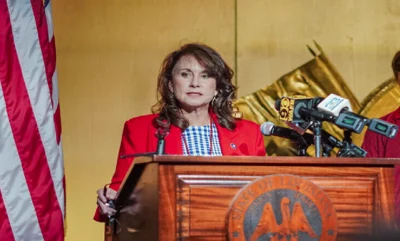
Louisiana Attorney General Liz Murrill sent eight letters threatening to strip New Orleans elected officials of their offices if they didn’t fall in line. An Orleans Parish grand jury is now investigating whether those letters were a crime. This is what happens when you assume New Orleans will just take it.
Key Points
- AG Liz Murrill sent eight letters to New Orleans elected officials threatening office forfeiture if they didn’t comply with her demands.
- Mayor Moreno publicly identified the letters as potentially criminal under Louisiana’s public intimidation statute — RS 14:122.
- An Orleans Parish grand jury has been meeting for six weeks, with a special prosecutor appointed and a criminal court judge presiding.
- The penalty for public intimidation of an elected official in Louisiana is up to five years in prison.
- If indicted, Murrill would be required to appear in Orleans Parish Criminal District Court — the city she tried to bully.
She Came for New Orleans. New Orleans Came Back.
Liz Murrill thought she had this figured out. The Louisiana Attorney General — fresh off winning a landmark U.S. Supreme Court case that gutted the Voting Rights Act in Louisiana v. Callais, flush with national Republican praise, already being whispered about as a future governor — turned her attention to New Orleans in May. Specifically, she sent eight letters. To Mayor Helena Moreno, District Attorney Jason Williams, five City Council members, and retired judge Calvin Johnson. And in those letters, she said something remarkable.
She told them she would take their jobs.
Your actions, she wrote, “trigger serious consequences under Louisiana’s usurper statutes, including the possible forfeiture of your own office.” She ordered them to immediately rescind their resolutions. She told them what would happen if they refused. In plain terms, the Attorney General of Louisiana wrote to the elected leaders of the state’s largest city and said: do what I say, or I will remove you from office.
What she apparently did not account for is what happened next.
The City That Wasn’t Supposed to Fight Back
Mayor Moreno didn’t fold. She went on social media and said it plainly: “I will not be intimidated or threatened by the state attorney general. I won’t back down.” Then she did something more precise — she pointed directly at the law Murrill appeared to have overlooked in her own letter-writing campaign. “It is surprising,” Moreno said, “that the attorney general put all of this in a letter, considering there is a criminal law that prohibits intimidating or threatening a public official in an effort to try to influence their decision or change their position.”
That wasn’t rhetoric. That was a legal roadmap.
An Orleans Parish criminal grand jury has been meeting for six weeks. The court appointed former Criminal District Court Judge Laurie White as special prosecutor, and Criminal District Judge Leon Roche is presiding. Meanwhile, DA Williams recused himself — as he had to, since he is one of the officials Murrill threatened, making him a potential witness in the very case he would otherwise prosecute. Moreover, sources familiar with the proceedings say an indictment could come soon.
When asked about the investigation, Murrill said she had no direct information about it. She stood by the letters. Then she said something that tells you everything about how she views this city: “I can’t explain why they do things in New Orleans the way they do them.”
She still doesn’t get it.
What the Law Actually Says
Let me be precise here, because the law is where this gets important.
Louisiana Revised Statute 14:122 defines the crime of public intimidation and retaliation. Under Section A, public intimidation is the use of “violence, force, extortionate threats, or true threats” upon a public officer with the intent to influence their conduct in relation to their position or duty. Under Section B, retaliation against an elected official occurs when threats are directed at a person elected to public office in connection with their official duties.
The statute defines “extortionate threats” as communicating an unlawful threat to harm another person with the intention to obtain “any acquittance, advantage, or immunity.” It defines “true threats” as a “serious expression of an intent to commit an unlawful act” with the intent to place a person in fear. Critically — and this matters — the law states that “the person need not actually intend to carry out the threat.”
Now read Murrill’s letters against that standard. In writing, on official letterhead, she communicated that seven duly elected officials would lose their offices — the ultimate harm to an elected official — if they did not change their conduct. Additionally, she demanded they rescind their resolutions and stated what would happen if they refused. That is the textbook structure of an extortionate threat under Louisiana law.
The penalty for public intimidation or retaliation against an elected official: up to five years in prison.
— Louisiana Revised Statute 14:122
Murrill’s defense will be that she was acting within her authority as Attorney General — advising public officials of legal consequences she was authorized to enforce. That is a real argument. Nobody should dismiss it. The Louisiana Supreme Court ultimately sided with her legal interpretation of Act 15.
However, here is the distinction that matters legally: being right on the underlying law does not immunize the method used to compel compliance. An attorney general can file a lawsuit, seek an injunction, or issue a formal legal opinion. What an attorney general cannot do — if the grand jury concludes the statute applies — is threaten elected officials with personal ruin as a tool of persuasion. The law does not create a “correct legal position” exception to criminal intimidation.
The Historical Dimension Nobody Is Saying Loudly Enough
DA Williams identified something important when he called the usurper statutes Murrill deployed a “relic of the Reconstruction era.” He is right. Louisiana enacted those laws in the 1870s — originally as tools to combat white supremacist insurgents who were violently overthrowing Louisiana’s biracial Reconstruction government.
Consequently, the irony runs deep. A Republican attorney general used those same Reconstruction-era laws against a majority-Black city’s elected leadership — to enforce a legislative act that wiped out the elected position of a Black man who won with 68 percent of the vote. That is not a subtle point. It is a direct line.
Furthermore, Louisiana Supreme Court Justice John Guidry wrote in dissent that it was actually the legislature that “usurped” the will of New Orleans voters by unseating Calvin Duncan before he could take office. That dissent matters. It means the highest court in Louisiana was not unanimous that Murrill’s side of this dispute was legally clean.
Can New Orleans Actually Convict Her? Here’s the Honest Answer.
This is hard. Not impossible, but hard. I am not going to pretend otherwise.
The prosecution would need to prove that Murrill’s letters constituted “extortionate threats” or “true threats” under RS 14:122, and that her intent was to influence the officials’ conduct through those threats rather than to advise them of legal consequences. Murrill’s team will argue that every statement in those letters was a legally accurate description of potential consequences under Louisiana law. That is a credible defense.
The prosecution’s strongest ground is the demand element. Rather than simply inform the officials of the law, Murrill ordered them to act — to “immediately rescind” their resolutions — with the forfeiture threat as the stated consequence of non-compliance. That moves the letters from legal advisory into the territory of coercive demand. As a result, the grand jury will have to decide whether that line was crossed criminally.
The First Amendment Question and What It Means for Indictment
There is also a First Amendment dimension. The U.S. Supreme Court’s 2023 decision in Counterman v. Colorado established a subjective recklessness standard for true threats — meaning the speaker must have been aware their communication could be perceived as threatening. Given that Murrill is the state’s top law enforcement officer and sent the letters on official letterhead, and given that every news outlet in Louisiana covered them as threats, that element is not difficult to establish. Consequently, conviction is not certain — but indictment is looking more likely every day.
The Question Nobody in Baton Rouge Wants to Answer
If the grand jury hands up an indictment, Liz Murrill will be summoned to appear in Orleans Parish Criminal District Court. Before a New Orleans judge. Answering to New Orleans law.
Will she show up, as every other Louisiana citizen would be required to do? Or will she claim some form of executive immunity — that the Attorney General is somehow above the reach of a local criminal court? Will she argue that her official actions cannot be subject to local prosecution?
If she shows up: a sitting Louisiana AG stands in a New Orleans courtroom in the city she publicly dismissed as doing things in ways she “can’t explain.” The symbolism alone is seismic. If she tries to fight jurisdiction: she becomes the most prominent example of exactly what she accused New Orleans officials of — refusing to follow the law when it doesn’t suit her. Either way, New Orleans wins the argument it was always making. That the law is the law. That elected officials answer to the people who elected them. That no one — not the legislature, not the governor, not the attorney general — can simply decree that the votes of New Orleans residents don’t count.
What This Moment Actually Means
Calvin Duncan won his election with 68 percent of the vote. Nevertheless, the Louisiana legislature erased it before he could take office. The AG threatened everyone who pushed back. The Louisiana Supreme Court sided with the state. By every conventional measure, Baton Rouge won.
But something happened in that fight that isn’t showing up in the legal box score. New Orleans didn’t fold. Mayor Moreno didn’t resign. Council members didn’t beg forgiveness. Jason Williams didn’t look the other way. Furthermore, an Orleans Parish grand jury — citizens of this city, not politicians in Baton Rouge — decided on its own that what they witnessed deserved a criminal investigation.
Democracy Is Slow. New Orleans Showed Up Anyway.
That is democracy. Imperfect, slow, grinding — but functioning. The people of New Orleans decided that being threatened is not the same as being wrong. And they decided, through their institutions, to say so with the force of law.
For decades, New Orleans has absorbed what the state sends down — budget cuts, indifference, condescension, and the dismantling of locally elected positions. Throughout all of it, the steady assumption baked into every Baton Rouge power player’s calculation was the same: New Orleans will complain and then comply.
Liz Murrill made the same assumption. She sent eight letters and expected eight capitulations.
She got a grand jury instead. Times have changed. And whoever sits in Criminal District Court when this is over — whether it’s Liz Murrill in the defendant’s chair or the city of New Orleans watching a case get dismissed — New Orleans will have made its point. You can come for this city. But this city will come back.
Related Reading on Black Source Media
Sources
- Louisiana Revised Statute 14:122 — Public Intimidation and Retaliation
- Louisiana v. Callais — U.S. Supreme Court, 2025
- Louisiana Supreme Court — Act 15 ruling and Justice Guidry dissent, 2026
- Counterman v. Colorado — U.S. Supreme Court, 2023
- WWNO / The Lens — Coverage of Murrill letters and grand jury investigation, June 2026
- NOLA.com — “Orleans Parish grand jury investigating AG Murrill over letters to city officials,” June 2026
- Mayor Helena Moreno — public statement, June 2026
- DA Jason Williams — public statement on recusal and usurper statute history, June 2026
Jeff Thomas
Jeff Thomas is the Publisher of Black Source Media and Owner of WBOK 1230 AM in New Orleans. He covers Louisiana politics, voting rights, and civic accountability with a direct eye on power and who holds it. This article reflects independent editorial analysis and does not constitute legal advice.

I think you are going to get a letter from the AG. You are crazy if you think New Orleans can arrest the AG
Awesome article! Keep educating and shining the light, Jeff. Respect, dkh