
Louisiana just passed Act399, and most people still don’t understand what it truly does. Supporters call it a simple immigration-enforcement bill. Headlines say it “helps ICE.” But read the fine print and a different truth appears. Act 399 is one of the most sweeping, punitive immigration laws in the country — and its reach extends far beyond immigrant communities.
Act 399 is not an immigration bill.
It is a power bill — expanding policing authority, shrinking civil rights, and overriding local control. And anyone who cares about justice, democracy, or the future of New Orleans should be paying attention.
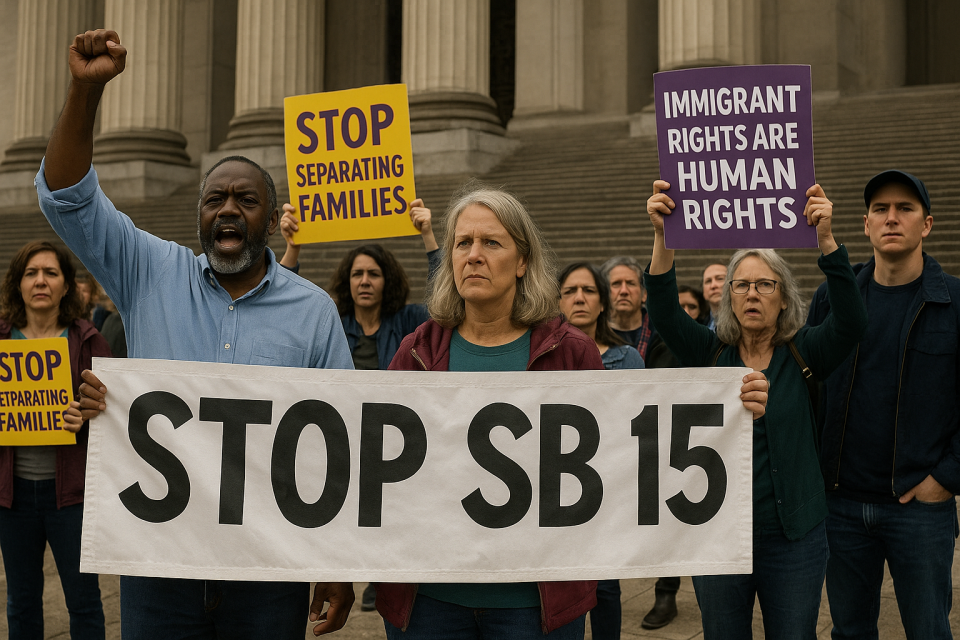
Act 399 Makes Protesters Easier to Arrest — By Design
The law makes it a crime for any person to “hinder, delay, interfere, or prevent” federal immigration enforcement. That sounds narrow until you realize “interference” is left completely undefined.
That means individuals can be arrested for:
- Filming ICE officers
- Standing too close to an operation
- Warning neighbors that ICE is nearby
- Offering food, water, shelter, or transportation
- Being a legal observer
- Chanting or marching in a protest
- Refusing to move quickly enough
Under Act 399, nonviolent civil resistance — the foundation of every major American justice movement — is now criminalized in Louisiana. Just imagine if this was the law during the 1960’s Civil Rights Movement.
This is not accidental. It is intentional.
It Also Forces Sheriffs to Cooperate With ICE — Or Go to Prison
Act399 directly targets sheriffs, jailers, and local officials who refuse ICE detainer requests. If they don’t comply — even when detainers are constitutionally questionable — they can be charged with felony malfeasance and face up to 10 years in prison. In New Orleans, the sheriff is under a federal consent decree that requires the sheriff to violate this new law. Yep. You read that right.
- The sheriff’s office — under a federal court settlement (from a 2011 civil-rights case) — has maintained a policy that prohibits deputies from honoring most ICE detainer requests and limits cooperation with ICE.
- The policy requires release of detainees within 48 hours after they are eligible for release — even when ICE requests a detainer.
- In other words: OPSO agreed (under court order) to restrict cooperation with immigration enforcement when detainers would extend detention beyond constitutional limits or without warrant. Verite News+1
That consent decree remains in effect as of now.
This is unprecedented.
It strips local governments — especially New Orleans — of the ability to limit cooperation with ICE or follow federal consent decrees designed to protect civil rights. It effectively turns Louisiana jails into mandatory immigration holding centers.
For a state that claims to value “local control,” Act399 is a complete reversal.
A Constitutional Disaster Waiting to Happen
Additionally, Act399 violates the US Constitution:
1. Tenth Amendment — Anti-Commandeering
Federal law cannot force states to enforce federal immigration policy. SB15 punishes officials who don’t.
2. First Amendment — Speech and Protest
The vague “interference” standard criminalizes protest, filming police, and providing humanitarian aid.
3. Fourth Amendment — Due Process
ICE detainers are not warrants. Holding people based on detainers alone is unconstitutional — yet SB15 encourages it.
Lawsuits are coming.
And Louisiana’s taxpayers will be the ones paying for them.
Why Black Louisiana Still Needs to Pay Close Attention
Let’s be clear: immigrant communities will feel the sting of Act399 first. They are the direct and immediate target. But in Louisiana, any time the state expands policing authority, those expanded powers eventually flow into Black neighborhoods.
Act 399 creates a new model of enforcement — criminalizing “interference,” overriding local autonomy, and giving the governor unprecedented leverage over jails and police agencies. Today it applies to immigration. Tomorrow it can be applied to:
- crime suppression initiatives
- protest control
- “public disorder” emergencies
- environmental justice protests
- voting-rights demonstrations
History tells the story:
When law enforcement gets new tools, Black communities always feel those tools more heavily — not because the law names us, but because policing patterns and political agendas always bend in that direction.
So no — Black people are not the first in line for harm under SB15. Immigrants are.
But the architecture of overreach rarely stays confined.
And SB15 builds the kind of architecture that can be easily repurposed.
Black Louisiana ignores this at its own risk.
What Act399 Really Represents
Act399 is not about safety.
It is not about crime.
It is not about protecting the public.
But it is about control.
Control of speech.
Control of local governments.
Also control of protests.
Control of jails.
Control of communities.
And control of political narrative.
This law gives ICE—and by extension the Governor—the broadest enforcement power Louisiana has seen in years. Immigrants will feel it first. Black neighborhoods will feel it next. And eventually, every Louisianan who believes in democracy may feel it too.
Related: Black Satisfaction But Hispanic Panic
If Louisiana can arrest people for standing near an ICE operation today, it can arrest people for standing near a police operation tomorrow. If we criminalize protecting immigrant families today, we can criminalize protecting our own communities tomorrow. And if the state can override local government in the name of “immigration enforcement,” it can override local government in the name of anything.
Act399 is not a law we can afford to ignore.
When the state builds a bigger cage, it never builds it for just one group.
