
TL;DR
The post-Katrina school overhaul raised test scores and graduation rates. It also wiped out about 7,600 stable jobs and pulled schools out of neighborhoods. Now the same system is closing schools in Black neighborhoods, with L.B. Landry in Algiers and Fannie C. Williams in the East on the line. That is a double wallop. Before the school board votes, New Orleans has to decide what those closures mean for Black families, Black wealth and the blocks they live on.
Key Points
- About 7,600 school employees lost their jobs after Katrina. Roughly 4,300 were teachers, and 71% of those teachers were Black.
- Only 10% of surveyed students live in the same neighborhood as their school.
- Enrollment has dropped by 4,046 students since 2019-20, and the district counts more than 5,400 open seats.
- L.B. Landry, a historically Black high school in Algiers since 1942, could close after its charter operator walked away.
- The superintendent presents closure recommendations to the school board on Dec. 9.
- School decisions are also decisions about jobs, housing and whether families stay.
Twenty-one years after Hurricane Katrina, New Orleans school closures are back on the table. The district has formally declared that it has too many seats, more than 5,400 of them measured against enrollment targets. Superintendent Fateama Fulmore takes her recommendations to the school board on Dec. 9, and she is weighing whether to close up to four schools this spring.
Most of the coverage will be about buildings and budgets. I want to talk about the Black middle class, because we’ve been here before. The last time this city remade its schools, it took apart one of the surest ways a Black family here could get into it. That round took the jobs. This round is coming for the schools themselves, and one of them is L.B. Landry in Algiers.
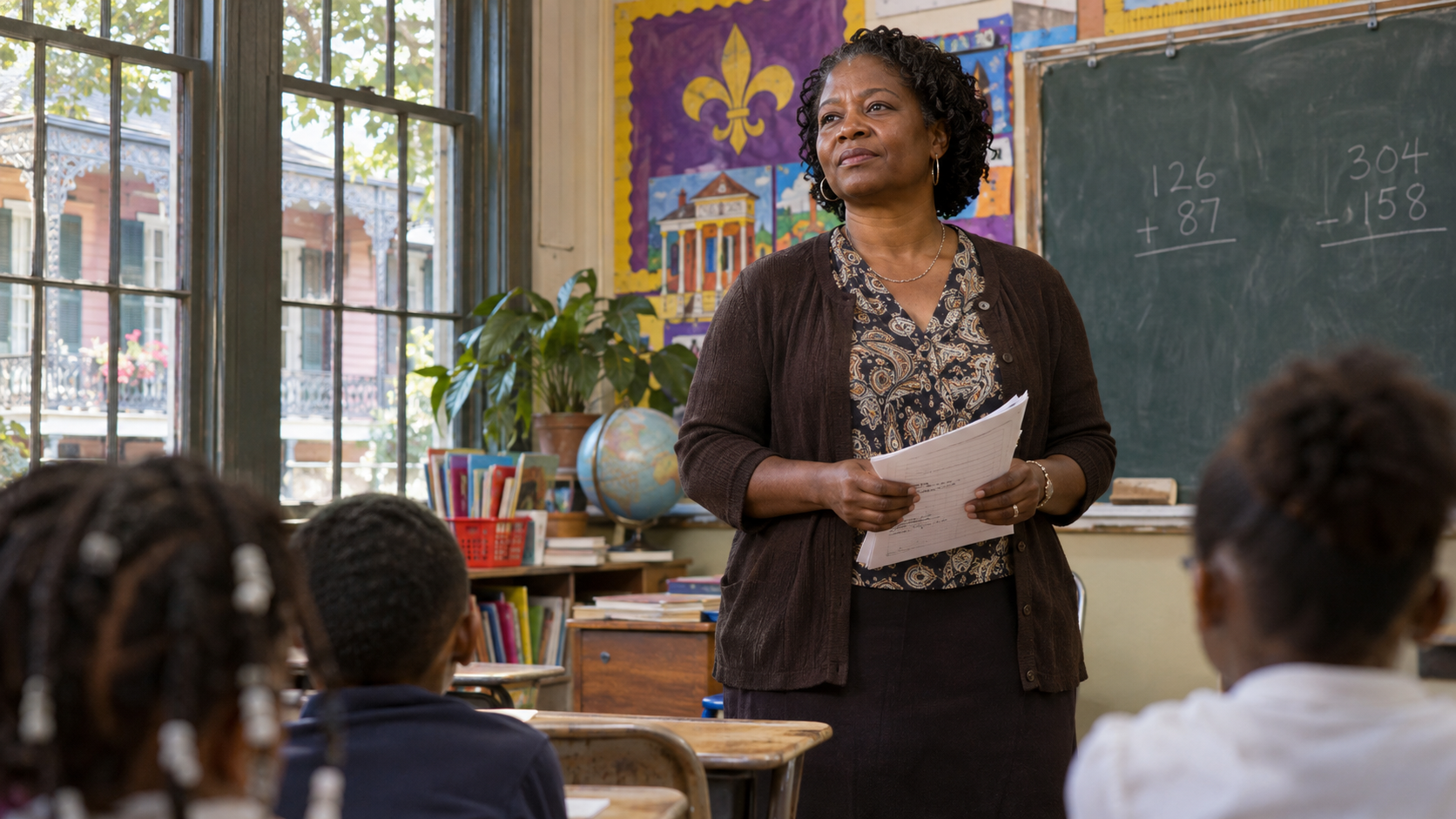
The First Blow: 7,600 Jobs
In late 2005, with most of the city still empty, the Orleans Parish School Board moved to fire nearly everyone who worked for it. The Louisiana Supreme Court later counted approximately 7,600 teachers and other permanent employees. Their terminations took effect on March 24, 2006.
About 4,300 of them were teachers, according to Tulane’s Education Research Alliance. Seventy-one percent of those teachers were Black.
School jobs lost after Katrina
All terminated employees: about 7,600
Teachers within that total: about 4,300
Approximate figures. Teachers are part of the total, not in addition to it. Sources: Louisiana Supreme Court, Oliver v. Orleans Parish School Board; Education Research Alliance for New Orleans.
Those weren’t just government jobs. They paid the house note and the car note, and they sent children to college. For generations, teaching was how a Black family in this city got into the middle class and stayed there. You knew these people. The teacher on your block owned her house, went to your church and kept an eye on your children whether you asked her to or not. When thousands of those paychecks stopped, whole neighborhoods felt it.
Now, let’s be fair. Katrina flooded the school buildings and scattered the families who filled them. Nobody could have reopened in the fall of 2005 as though nothing had happened. But needing to rebuild didn’t make every choice after that inevitable. We should still ask who absorbed the losses and who benefited from the new system.
A Neighborhood School Was More Than a Building
Before Katrina, plenty of families had history with the school down the street. Mama went there, and so did her mama. The principal knew your people. Somebody’s grandmother was always on a porch watching the children walk to class.
The overhaul replaced that with a citywide choice system run almost entirely by charter schools. Families gained options. They also gained a commute. In the Education Research Alliance’s 2024-25 youth survey, only 10% of students lived in the same neighborhood as their school. Just 38% lived in the same planning district.
How close do students live to their school?
Same neighborhood: 10%
Same planning district: 38%
2024-25 survey of about 2,000 students in grades 6-11. The categories overlap. Source: Education Research Alliance for New Orleans.
Picture a single mother in New Orleans East whose child goes to school across town. A late bus unravels her whole morning. When her child gets sick, she leaves work and drives across the city. If the afternoon ride falls through, she has another crisis on her hands. A 2026 article in the Anthropology of Work Review examines the busing system that grew up around school choice and the hidden costs it puts on families.
Choice on paper becomes a daily logistics problem for working parents. Families with flexible jobs and reliable cars handle it far better than families without them.
What It Cost the Black Middle Class
Here’s where the discussion gets uncomfortable. The Black middle class in New Orleans was under pressure before the storm. Good jobs had been leaving, and families were moving to surrounding parishes. Katrina sped up the displacement. Then the school overhaul eliminated a major source of steady professional work.
I can’t honestly blame every economic loss since then on school reform. Nobody can pretend, either, that erasing thousands of careers cost nothing.
The Data Center reports that Black households in New Orleans had a median income of $40,285 in 2024. White households had $90,322. That’s a gap of more than $50,000. Meanwhile, the share of Black households in the bottom income tier grew from 42% in 2000 to 46% in 2021.
Those numbers can’t tell us how much of the damage traces back to the schools. They do show why steady professional jobs matter. Speeches about opportunity don’t build a middle class. Steady paychecks do, along with a house that gets paid down every year and children who start out ahead of their parents. Pull enough of that away and the whole thing gives.
The Schools Improved. That’s Not the Whole Scorecard.
Critics of the reforms have to acknowledge something. The schools got better. Tulane’s researchers found gains in test scores, graduation, college attendance and college completion. Their updated analysis credits the reforms with raising the graduation rate by 9 to 13 percentage points.
Those gains matter. Black children deserve excellent schools, and nobody should romanticize the old system.
But academic results are not the only measure of education policy. What happens when children do better in class while the neighborhood around them empties out? A school can succeed while the blocks around it struggle to hang on. We should have aimed for better schools and stronger neighborhoods. The two goals were never in conflict.
Now the Families Are Disappearing
Enrollment in the city’s shared application system fell from 48,510 students in 2019-20 to 44,464 this year. That’s 4,046 fewer children, and the district expects the decline to continue.
New Orleans public school enrollment
2019-20: 48,510 students
2025-26: 44,464 students
Students in the city’s shared public-school application system. Source: NOLA-PS figures reported by WWNO/WRKF.
Falling birth rates are part of it, and that’s a national problem. New Orleans adds its own: housing costs, insurance premiums, thin economic mobility and a shrinking population.
Consider the cycle. A working family leaves the city, and its children leave the school system. The school loses enrollment and funding, and eventually it closes. Now the neighborhood has one less reason to stay, so more families think about leaving.
Are we closing schools because families are leaving? Or are families leaving because their neighborhoods keep losing what made them worth staying in? Probably both. We need neighborhood-level evidence to know how much of each, and the district should produce it before the board votes.
The Double Wallop
Here’s the irony nobody at the district wants to say out loud. Twenty years ago we were told the old system had to go. Fire the teachers, hand the schools to charters and let families choose. Weak schools would close, and better ones would take their place. We paid for that promise with 7,600 jobs. Now the same system is back for the buildings.
Start in Algiers. L.B. Landry opened in 1938 as a school for Black children and became a high school in 1942. It carries the name of Dr. Lord Beaconsfield Landry, a Black physician who served that community. Generations of West Bank families walked across its stage. In September, the charter board that runs it voted not to seek another contract. Landry had 496 students last year, down from 743 four years earlier. The district says it will decide in December whether to find a new operator, run the school itself or close it. Several hundred alumni packed a community meeting to fight for it.
Think about what that vote means. A charter operator can walk away. The neighborhood can’t. If Landry closes, a West Bank teenager is left with a thriving but bursting at the seams Edna Karr, a small military academy or a bus across the river.
People at that meeting blamed the citywide enrollment system for pulling students away from Landry, and they have a point. When only one student in ten lives near their school, no neighborhood school can count on its own neighborhood. We built a system that drained these schools. Now we cite their low enrollment as the reason to close them.
Then look at New Orleans East. In October, the superintendent stood in the gym at Fannie C. Williams and told a crowd of parents that, as things stand, she would recommend closing it. More than 400 children go to school there. The alternative on the table hands the campus to another operator and offers those children seats about five miles away. A Lower 9th Ward school is under review too.
Notice the map. These are Black neighborhoods, and they have been asked to be patient for twenty years.
I won’t pretend the numbers are good. Only 10% of Landry’s students scored mastery on state tests last year, against 36% for the district’s high schools. Fannie C. Williams has a D from the state. But ask who has been running these schools. It wasn’t the teachers we fired in 2006. The system that replaced them has had two decades, and when it falls short, the operator leaves and the neighborhood loses its school.
That’s the double wallop. The first hit took the paychecks. This one takes the schools, and every closure brings its own round of layoffs. None of this is history. It’s hurting us right now.
A City Cannot Live on Culture Alone
New Orleans loves to celebrate Black culture: the music, the food, the Mardi Gras Indians, the second lines. But culture doesn’t pay homeowners insurance. Jazz doesn’t build a retirement account. A reputation as a cultural destination means little to a family that can’t afford to live here.
A city needs teachers, nurses, firefighters, tradespeople and small-business owners. It needs families who can buy houses and children who expect to build their lives here. Without them, Black culture survives as a tourist attraction while the people who created it struggle to stay. That’s not progress. That’s a warning.
Five Questions Before More New Orleans School Closures
Sometimes a school has to close. No city can pay for empty classrooms forever. But enrollment figures alone shouldn’t decide it. Before the board votes on any closure, city and school leaders should answer five questions.
- What happens to the neighborhood, and how will its families get their children to school?
- What does the closure cost school employees and the businesses nearby?
- How far will displaced students actually travel?
- Can the building become a community center, a job-training site or an early-childhood hub?
- Which housing, jobs and education policies, working together, would keep families here?
The mayor, the school board, state officials and the business community have to answer those together. New Orleans cannot treat education, housing, jobs and population loss as unrelated problems. They’re connected. Until we treat them that way, we’ll keep responding to symptoms while ignoring the disease. The same squeeze shows up in Moreno’s 2027 budget and in this year’s property tax bills.
The Bottom Line
The biggest mistake New Orleans could make is to debate school closures without debating the future of its Black middle class. Katrina exposed this city’s weak points, and the decisions that followed reshaped its institutions. Two decades later, we can look honestly at what worked and what we gave up to get it.
We already took the first hit. Nobody should ask Algiers and the East to take the second one quietly.
So let’s stop asking only how many schools New Orleans needs. The better question is what kind of city we’re building, and whether Black families will still be able to call it home.

Related reading at BSM: Louisiana’s Insurance Crisis Is Destroying Black Wealth
About the Author
Jeff Thomas is the founder and publisher of Black Source Media and the owner of WBOK 1230 AM in New Orleans. He is also CEO of Fenix AI and leads Total Computer Solutions and Services, a New Orleans IT firm that has served government agencies for 30 years. He writes about New Orleans and Louisiana politics, power and accountability.
Sources
- WWNO/WRKF: Under-enrollment at NOLA public schools could lead to more closures, consolidations under new law (Nov. 9, 2026)
- WWNO: L.B. Landry could close or get a new operator as enrollment continues to fall (Sept. 30, 2026)
- Fox 8: New Orleans East elementary school recommended for either closure or consolidation (Oct. 16, 2026)
- Louisiana Supreme Court: Oliver v. Orleans Parish School Board (Oct. 31, 2014)
- Education Research Alliance for New Orleans: Did the Teachers Dismissed after Hurricane Katrina Return to Public Education?
- Education Research Alliance for New Orleans: Voices of New Orleans Youth, 2024-25 survey (May 2026)
- Harris and Larsen: The Effects of Hurricane Katrina on Medium-Term Student Outcomes (updated May 2021)
- The Data Center: Who Lives in New Orleans and Metro Parishes Now?
- The Data Center: Potential Economic Impact of Increasing Income for Black New Orleanians
- Anthropology of Work Review: Navigating Choice: School Buses as Racializing Infrastructure in Post-Katrina New Orleans (June 2026)
Don’t Miss the Next One
Black Source Media lands in your inbox every Sunday and Wednesday with the New Orleans and Louisiana stories other outlets won’t tell straight. Sign up free.
