
TL;DR
Louisiana voting rights have been under attack since Reconstruction. In 1876, the U.S. Senate refused to seat P.B.S. Pinchback. This year, lawmakers abolished the office Calvin Duncan won, and the Supreme Court struck down the district that elected Cleo Fields. On Nov. 3, Jamie Davis could become Louisiana’s first Black U.S. senator. The question running through all of it: who decides whether our votes really count?
Key Points
- The U.S. Senate voted 32–29 in 1876 against seating P.B.S. Pinchback, whom Louisiana’s Legislature had elected in 1873.
- Calvin Duncan won the Orleans Parish criminal clerk’s race with 68% of the vote. Act 15 eliminated the office before he could hold it, and the Louisiana Supreme Court upheld the law 4–3.
- The Supreme Court struck down Louisiana’s second majority-Black congressional district in April. Lawmakers redrew it to favor Republicans, and Cleo Fields is not seeking reelection.
- Jamie Davis faces Julia Letlow for U.S. Senate on Nov. 3. Early voting runs through Oct. 27.
From P.B.S. Pinchback’s denied Senate seat to Calvin Duncan’s abolished office and Cleo Fields’ redrawn district, Louisiana keeps facing the same question: who decides whether the people’s votes really count?
America likes to believe elections are won with ideas, debates and the will of the people. In Louisiana, powerful interests often shape the outcome long before anyone casts a ballot.
Yesterday’s tools were literacy tests, poll taxes, intimidation and violence. Today’s arrive dressed as legislation, court rulings, redistricting maps and promises of “election integrity.” The methods have changed. The fight over who holds power has not.
Two U.S. Supreme Court decisions cleared the way. Shelby County v. Holder (2013) effectively ended the requirement that states like Louisiana get federal approval before changing their voting rules. Rucho v. Common Cause (2019) closed the federal courthouse door to challenges against partisan gerrymandering. States gained room to maneuver, and Louisiana has become the test of how far that room extends.
When officials can’t persuade voters, some simply change the rules. That leaves a disturbing question. If politicians can’t win elections fair and square, will they bend the system to win anyway?
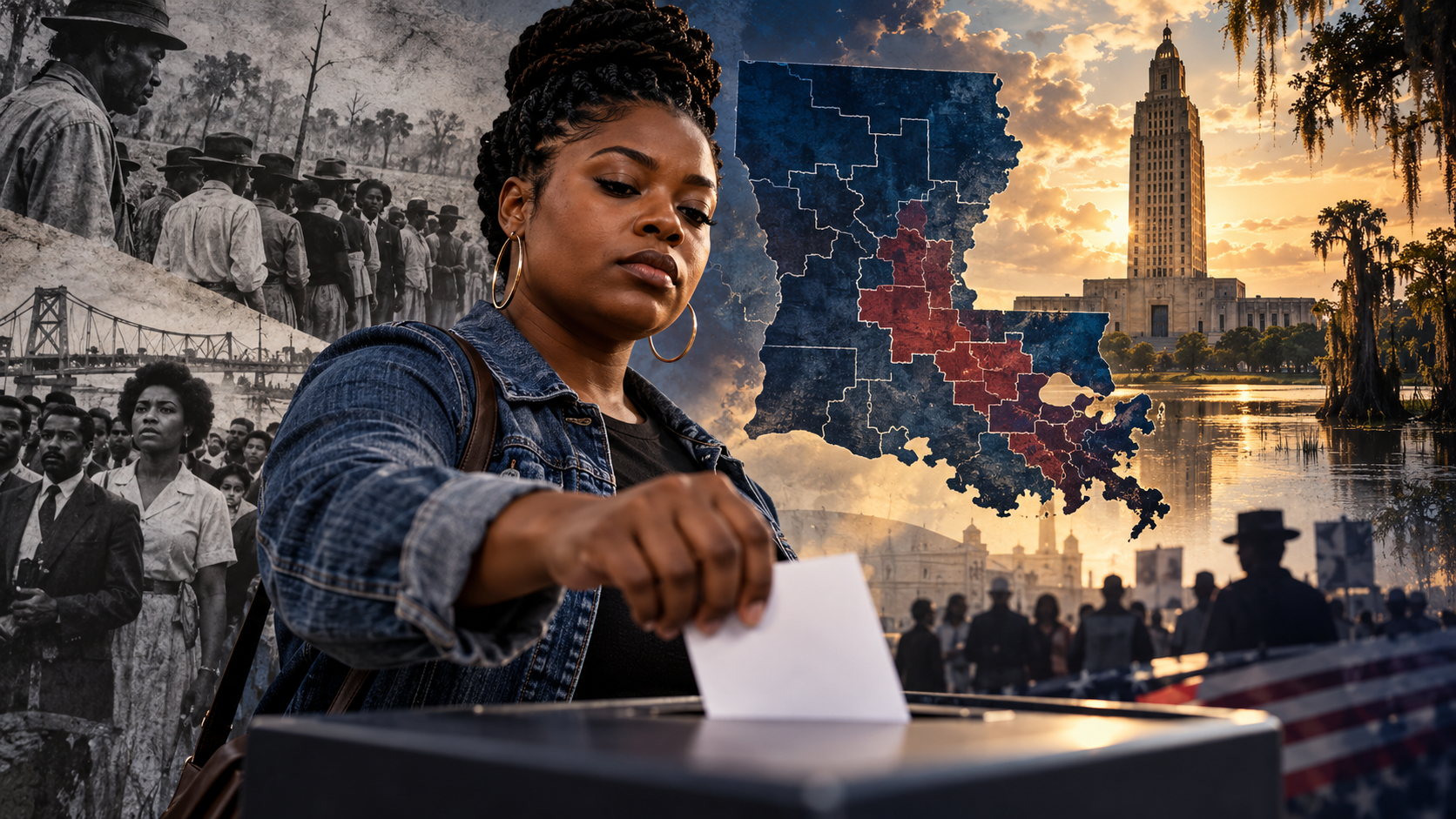
Calvin Duncan Won. Then His Office Disappeared.
Democracy rarely collapses in one dramatic moment. It erodes one weakened safeguard, one legislative maneuver and one grab for power at a time.
Consider Calvin Duncan. Last November, New Orleans voters elected him Clerk of Criminal District Court with 68% of the vote. Duncan spent decades fighting a wrongful conviction before he ever ran for office. He was the voters’ clear choice.
Days before he was set to take office on May 4, the Legislature passed and Gov. Jeff Landry signed Act 15. The law folded the criminal clerk’s duties into the civil clerk’s office and handed the combined job to Civil District Court Clerk Chelsey Richard Napoleon. The office Duncan won ceased to exist.
Supporters called it consolidation and efficiency. Critics saw the government erasing an election result. A lower court briefly sided with Duncan, and he performed the clerk’s duties for only a few hours before an appeals court shut it down. Attorney General Liz Murrill went further. She threatened to remove Mayor Helena Moreno, District Attorney Jason Williams and five City Council members from office for appointing an interim clerk and setting an election date to fill the post.
On June 1, the Louisiana Supreme Court upheld Act 15 in a 4–3 vote. Duncan said the court had “blessed this ‘coup,'” borrowing a word one of the justices used. His federal lawsuit is still alive.
Voters made a choice. Government eliminated the seat they had just filled. The issue reaches far beyond one man. It asks whether citizens truly control their government or simply participate under rules politicians can rewrite whenever the result displeases them.
Louisiana Has a History of Resistance
For generations, powerful interests in this state decided who could vote, who could govern and whose voices counted. Louisiana’s history is not one of surrender, though. It is a history of resistance.
Remember the Congress of Racial Equality, whose activists challenged segregation across the state. The Deacons for Defense and Justice, born in Jonesboro, protected civil rights workers when local authorities would not. In New Orleans, the Black Panther Party demanded justice, education, health care and community self-determination. Decades later, Take ‘Em Down NOLA forced the city to reckon with its monuments to white supremacy. Behind many of these fights stood Louisiana attorneys who defended organizers when doing so carried real personal risk. And in 1953, the Rev. T.J. Jemison led the Baton Rouge bus boycott, an early proof of what organized economic pressure could accomplish.
These movements shared one conviction: progress requires organized people willing to confront powerful institutions. Frederick Douglass said it plainly in 1857. “Power concedes nothing without a demand. It never did and it never will.” Dr. Martin Luther King Jr. warned America about “the fierce urgency of now.” Ida B. Wells understood that exposing injustice was the first step toward defeating it.
None of them settled for hope alone. They demanded action, and the struggle they joined never really ended.
P.B.S. Pinchback: The Senate Seat Louisiana Never Got
No Louisiana story shows that struggle more clearly than what happened to P.B.S. Pinchback.
Pinckney Benton Stewart Pinchback was a Union veteran, a Reconstruction leader and America’s first Black governor, serving as acting governor of Louisiana from December 1872 to January 1873. In 1873, the Republican-controlled Louisiana Legislature elected him to the U.S. Senate.
It should have been a historic breakthrough. Instead, his credentials got tangled in the fight between Louisiana’s rival state governments, and the Senate left the seat empty for three years while it argued. On March 8, 1876, senators voted 32–29 against seating him.
Pinchback never served a day as a U.S. senator. The Senate later paid him roughly $16,000 for the salary and expenses of the years he spent contesting the seat. Money could not replace the representation Louisiana lost. A Black Reconstruction leader had won his election, and the Senate shut the door anyway.
Days after the vote, Frederick Douglass stood before a crowd in Washington to condemn the Senate’s decision. For Black Louisianans who had fought their way into democracy after slavery, the lesson was devastating. Winning political power did not guarantee the right to use it.
A century and a half later, that lesson still stings.
Cleo Fields and the Fight for Black Representation
Fast-forward to 2024. After years of litigation over Black voting strength, Louisiana drew a second majority-Black congressional district. Voters in the new 6th District elected Cleo Fields.
On April 29, 2026, the U.S. Supreme Court ruled 6–3 in Louisiana v. Callais that the district was an unconstitutional racial gerrymander. The majority found lawmakers had relied too heavily on race, and that federal voting rights law did not require the second district. Supporters of the ruling argue government should not sort voters by race without strong constitutional justification. Fields called the decision a grave setback to voting rights and equal representation.
Within weeks, the Legislature redrew the map. Landry signed the new lines on May 29, turning the 6th District into a Republican-leaning seat and leaving Louisiana with one majority-Black district. In July, Fields announced he would not seek reelection. The plaintiffs behind Callais have since asked the courts to scrutinize the state’s last remaining majority-Black district too.
The ruling did not remove Fields from Congress. It removed the district that made his election possible.
Black voters fought for representation, won another seat and then watched a higher institution take it apart. The century is different, and so are the institution and the legal circumstances. The question is the same. Who controls representation once the people finally gain the power to choose?
Jamie Davis and a 150-Year-Old Unfinished Story
Louisiana now faces another historic moment. Jamie Davis, a Tensas Parish farmer making his first run for office, is the Democratic nominee for U.S. Senate. He faces Republican Rep. Julia Letlow on Nov. 3 for the seat now held by Sen. Bill Cassidy.
Cassidy, a two-term incumbent, did not make it out of his own party’s primary. With President Trump backing Letlow, Cassidy finished third in the May 16 Republican primary. Letlow then beat State Treasurer John Fleming in the June runoff to claim the nomination. For the first time in twelve years, Louisiana’s Class 2 Senate seat is open.
If Davis wins, he would become Louisiana’s first Black U.S. senator. Pinchback stood at that same threshold in 1873, and the Senate slammed the door in 1876. Now Davis has a chance to walk through it.
His victory would not undo what happened to Pinchback. It would still mark an extraordinary milestone in a state that, according to reporting cited by Axios, has not elected a Black person to statewide office since Reconstruction.
Davis faces long odds. Letlow carries President Trump’s endorsement and a large fundraising edge, and national Democrats have not sent him checks. Victory is not guaranteed. It has to be earned through votes, organization, persuasion and turnout.
That is exactly the point. Democracy belongs to the voters, not to institutions that prefer a predetermined outcome.
The Time for Political Complacency Is Over
Louisianans cannot stay spectators while leaders make decisions about our schools, courts, neighborhoods, voting rights and representation. History shows what happens when ordinary citizens surrender their political power. It also shows what organized communities can do when they refuse.
CORE, the Deacons, the Panthers and generations of Louisiana civil rights lawyers were never fighting over just one election. Their fight was for the right of people to determine their own destiny. That right takes vigilance. It means understanding legislation, questioning motives, challenging unfair rules and holding officials accountable. Above all, it means voting, even when powerful institutions seem determined to make that vote count for less.
Early voting runs through Tuesday, Oct. 27, and Election Day is Tuesday, Nov. 3. The ballot carries the Senate race, U.S. House primaries under the new map and ten state constitutional amendments. For more on how Louisiana’s political map is shifting, read The Black Vote in Louisiana Is Being Engineered Out of Existence.
Political power rarely gives itself away. People must organize to claim it, then organize again to protect it.
Pinchback never received the Senate seat he won. Duncan won an election, and lawmakers abolished his office. Fields won a district the Supreme Court then struck down. Davis now seeks to send a Black Louisianan to the U.S. Senate for the first time. These stories are not legally identical, but together they demand our attention.
Democracy means more than letting people cast ballots. It means respecting the power those ballots carry.
Louisiana remembers 1876. We can all see what is happening in 2026. Now the state must decide whether its future belongs to its voters or to politicians who keep finding new ways to control the rules.
If you can’t win elections fair and square, cheat. That may be an old political strategy. Louisianans still have the power to reject it.

Related reading at BSM: New Orleans Is Losing Louisiana. The 2026 Session Just Made It Official.
About the Author
C.C. Campbell-Rock writes about civil rights and voting rights for Black Source Media. [JEFF: insert C.C.’s full bio.]
Sources
- American Battlefield Trust: Pinckney Benton Stewart (P.B.S.) Pinchback
- Frederick Douglass Papers Project: Address on Pinchback, March 13, 1876
- Fox 8: Louisiana Supreme Court upholds law eliminating Calvin Duncan’s clerk position (June 1, 2026)
- Louisiana Illuminator: Supreme Court upholds state law blocking Orleans clerk from taking office (June 1, 2026)
- WRKF: Calvin Duncan revives federal lawsuit against state officials (Aug. 18, 2026)
- U.S. Supreme Court: Louisiana v. Callais judgment (April 29, 2026)
- Rep. Cleo Fields: Statement on Louisiana v. Callais (April 29, 2026)
- The Advocate: Cleo Fields will not seek reelection after district redrawn
- Democracy Docket: Will Louisiana’s last majority-Black district survive Callais?
- WAFB: Letlow, Davis win Senate primary runoffs (June 29, 2026)
- Axios New Orleans: 2026 midterms, a Louisiana voter’s guide (Oct. 19, 2026)
Don’t Miss the Next One
Black Source Media lands in your inbox every Sunday and Wednesday with the New Orleans and Louisiana stories other outlets won’t tell straight. Sign up free.
