
TL;DR
Essence Festival 2026 just wrapped in New Orleans — and if you were there, you already know what happened. Something shifted in that building. Something that goes deeper than music. In a political moment designed to make Black women feel small, invisible, and exhausted, Essence showed up as the antidote. This is what that means for our health, our spirit, and our sense of self.
Key Points
- Essence Festival 2026 ran July 3-5 at the Caesars Superdome and the Ernest N. Morial Convention Center in New Orleans.
- This year Teyana Taylor served as Chief Curator, shaping the festival’s creative direction through her production company The Aunties.
- Former First Lady Michelle Obama appeared in conversation with Keke Palmer — one of the most talked-about moments of the weekend.
- Brandy and Monica performed together. Patti LaBelle commanded the Superdome stage. Cardi B made her first full Essence set.
- Research confirms that spaces of cultural belonging, community, and joy are not luxuries for Black women — they are health interventions.
Essence Fest Is More Than a Party. It Is a Permission Slip.
I want to talk about what actually happens when a hundred thousand Black women walk into the same building.
Not the music — though the music was extraordinary. Not the panels — though the conversations were necessary. Not the marketplace, the food, the fashion, or the glow of being in New Orleans in July with your people all around you. I want to talk about something that happens underneath all of that. Something quieter and more important than any headline act.
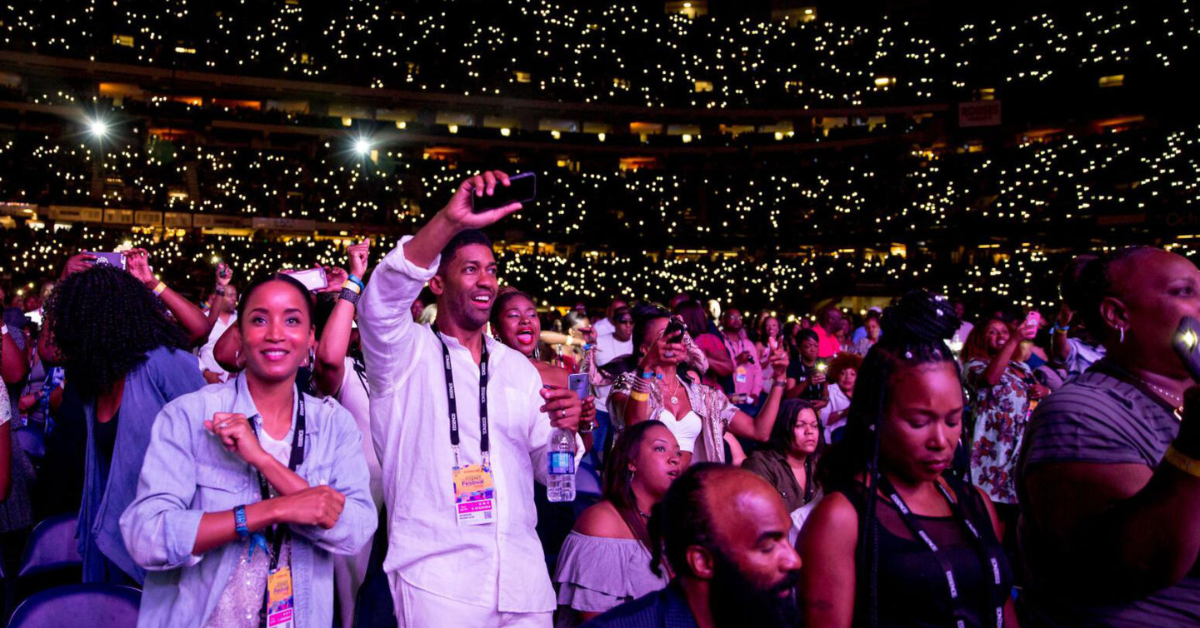
For three days at Essence Festival of Culture 2026, Black women gave themselves permission to exist without apology. And in this political moment — in this specific year, in this specific America — that is a radical act.
What Happened This Weekend — And Why It Mattered
The 2026 Essence Festival of Culture ran July 3 through July 5 at the Caesars Superdome and the Ernest N. Morial Convention Center. This year the festival did something different — it put a Black woman in charge of the entire creative vision. Teyana Taylor and her production company The Aunties served as Chief Curator, shaping not just the lineup but the spirit of the event from the inside out. That decision showed in everything.
The music was generational. Brandy and Monica performed together — and if you know what that means to a certain generation of Black women, you understand why the Superdome felt the way it did. Patti LaBelle, six decades into a legendary career, took that stage and reminded everyone in the building what endurance looks like. Cardi B made her first full Essence set. Kehlani, fresh off a Grammy win for “Folded,” brought a different kind of energy. Babyface. Public Enemy. George Clinton with Parliament-Funkadelic. And on Sunday, a last-minute addition that nobody saw coming — T.I. performing with an orchestra, alongside a tribute to Aaliyah curated by Missy Elliott. The range of that lineup alone told a story about the breadth of Black artistry across generations.
But the moment that may have mattered most happened during the day, not at night. Former First Lady Michelle Obama sat down in conversation with Keke Palmer at the Convention Center. Whatever was said in that room — and plenty was said — the image alone carried weight. Two Black women, different generations, different journeys, occupying one of the most visible stages in Black America and speaking honestly to each other and to the audience around them. That is Essence doing what only Essence can do.
Why Joy Is a Health Issue — Not a Luxury
I want to say something that does not get said enough in conversations about Black women’s health. Joy is not separate from health. It is not the reward you get after you have taken care of everything and everyone else. Joy is medicine. Belonging is medicine. Seeing yourself celebrated — not despite who you are, but because of who you are — is medicine.
The research on this is clear. Chronic stress — the kind that Black women carry in particular, the stress of being underestimated, overworked, unseen, and expected to hold everything together while the world debates whether your life matters — damages the cardiovascular system, suppresses immune function, accelerates aging at the cellular level, and contributes directly to the health disparities that kill Black women at higher rates than any other group. We talk about this in terms of statistics. But it lives in our bodies.
Consequently, what happens when you put a hundred thousand Black women in a space where they are not just tolerated but centered — where the music is for them, the panels are for them, the marketplace is built around their businesses and their beauty — is not just celebration. It is restoration. It is three days of the nervous system being allowed to exhale. And that exhale has real, measurable health benefits that no prescription can replicate.
In This Political Moment, Showing Up Is the Statement
This year’s Essence did not happen in a vacuum. It happened in an America where DEI programs are being dismantled, where Medicaid is being cut in ways that fall hardest on Black women, where the Voting Rights Act has been gutted, and where Black political power is being systematically reduced in state after state. It happened in a moment when Black joy itself has become something that certain forces in this country want to minimize, mock, or use as evidence that the struggle is over.
Against all of that, a hundred thousand people — most of them Black women — came to New Orleans and filled the Superdome and flooded the Convention Center and ate the food and bought from the vendors and sat in the panels and danced and cried and laughed and held each other. That is not escapism. That is resistance. Furthermore, it is the kind of resistance that sustains the longer fight — because you cannot keep fighting if you never refill what the fight drains out of you.
Being Black in America is a political statement whether you intend it to be or not. Essence understands that. It has understood that for more than 30 years. The festival calls itself a party with a purpose — and the purpose is exactly this: to remind Black women that they are worthy of celebration, that their culture is world-class, that their businesses deserve investment, that their stories deserve to be told, and that their presence in a room changes the room.
What New Orleans Gives That No Other City Can
There is a reason Essence stays in New Orleans. Other cities have tried to compete for it. Other cities have offered more money, newer facilities, bigger incentives. But Essence keeps coming back here — and the people who attend keep coming back here — because what New Orleans offers cannot be manufactured elsewhere.
This city is itself an act of Black survival. The music that fills the Superdome during Essence was born in these streets. The food that feeds the festival was created in these kitchens. The culture that the world spends billions of dollars trying to replicate and consume originated in these neighborhoods. When Black women come to Essence in New Orleans, they are not just attending a festival — they are walking through the living evidence that Black people created something extraordinary under conditions designed to destroy them. That is a different kind of medicine.
Additionally, this year New Orleans chef Nina Compton — James Beard Award winner and owner of Compère Lapin — curated the Essence Food and Wine Festival. Pulitzer-winning journalist Nikole Hannah-Jones and author Mara Brock Akil shaped the Essence Authors hub. The Community Book Center, a Black-owned New Orleans institution, was a festival partner. Essence is not just coming to New Orleans. It is increasingly being built with New Orleans — and that matters for our community in ways that go beyond the weekend.
What to Carry Home From This Weekend
Whether you were in the Superdome or watching from home, here is what I want you to take from this Essence weekend.
First — protect your joy the same way you protect your health. Schedule it. Prioritize it. Do not wait until you have finished everything else to give yourself permission to feel good. The research is clear that community, belonging, and positive emotional experience are not optional additions to a healthy life. They are foundational to one.
Second — find your Essence wherever you are. Not everyone can make it to New Orleans every July. However, the principle of Essence is available in every city. It is the Black women’s book club that meets monthly. It is the church women’s fellowship. It is the girls’ trip that you have been putting off for two years. It is the cousin chat group that makes you laugh until you cannot breathe. Those spaces are not trivial. They are keeping you well.
Third — support what sustains us. Essence stays in New Orleans partly because this community shows up for it — in attendance, in spending, in civic support. The same is true for every Black institution, Black business, and Black cultural space in your city. When we spend with our own, attend our own, and advocate for our own — we keep the spaces alive that keep us alive.
Brandy and Monica on the same stage. Patti LaBelle still commanding every room she enters. Michelle Obama in conversation with Keke Palmer. Teyana Taylor shaping the vision. A hundred thousand Black women filling New Orleans with their presence, their money, their beauty, and their joy. That is not just a festival. That is a declaration. And every year we show up for it — every year we choose joy in the face of everything trying to take it — we are making the declaration again. We are still here. We are still this. And we are not finished.
Related Reading on Black Source Media
Sources
Denise Tureaud
Denise Tureaud writes about health, wellness, and community life for Black Source Media. A New Orleans insider, she leads with heart before data and believes that healing our community starts with telling it the truth — including the truth that joy is not a luxury. It is medicine.
