

When the Smoke Shifts: Black Relief, Latino Disillusion, and America’s Harsh Social Ladder
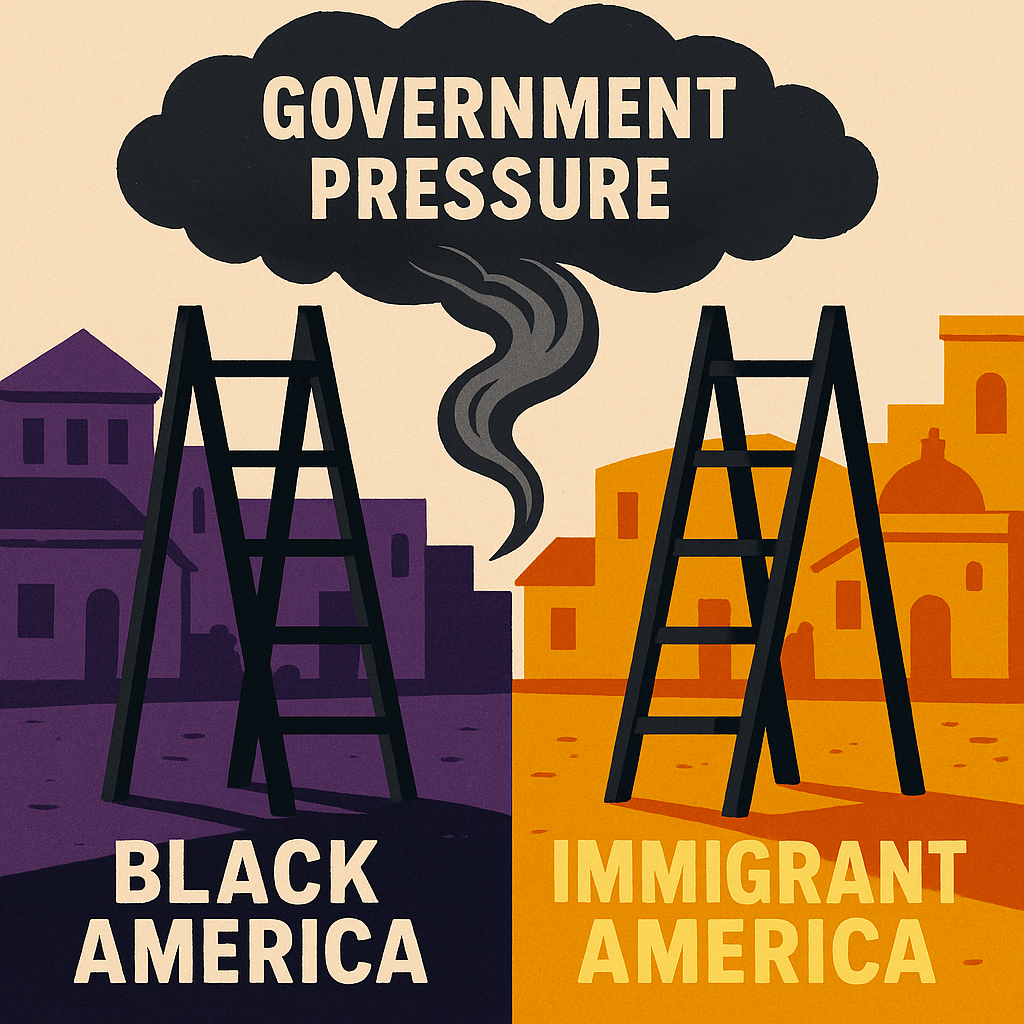
The latest wave of immigration crackdowns — raids, detentions, benefit restrictions, and political scapegoating — has shaken immigrant communities across the country. But something else is happening quietly in Black America, especially in places like New Orleans: a portion of Black folks are feeling a surprising emotion.
Relief.
Relief that, for once, someone else is catching hell from the government.
Yes relief that the relentless spotlight of state pressure isn’t aimed solely at us.
Relief that the bottom rung of America’s social ladder suddenly feels a little less crowded.
This emotion isn’t pretty. It isn’t polite. But it is real — and we need to deal with it honestly.
1. “Somebody Else Is Getting the Smoke.”
For generations, Black Americans have been the primary target of state surveillance, policing, media scapegoating, and political punishment. We’ve lived in the crosshairs so long that constant pressure feels normal.
So when ICE raids hit the news, and immigrant communities find themselves in the direct path of government aggression, some Black folks interpret the moment like this:
“Finally — the government ain’t hasseling us today.”
This isn’t cruelty. It’s trauma speaking.
It’s the exhausted sigh of a community that has carried the weight of America’s oppression for centuries.
But let’s be clear: relief is not freedom.
Watching someone else get targeted does nothing to dismantle the systems that have harmed us for generations.
2. “We’re Not the Bottom Anymore.”
There’s another emotion that’s even harder to admit.
Some Black people feel like the immigration crackdown lifts Black folks one rung higher on America’s racial hierarchy. When the government targets another group, it shifts public perception — even if only temporarily.
A few Black folks are saying bluntly:
“We’re not the bottom anymore.”
This is a survival psychology born from centuries of oppression.
When society constantly places you at the bottom, any upward movement — even symbolic, even temporary — feels like victory.
But it’s a trap.
Because you don’t rise by watching someone else fall.
3. “Some Immigrants Acted Like They Were Better Than Us.”
This part of the conversation gets real uncomfortable real fast. But honesty is the job.
Some Black people feel that segments of the Hispanic and Latino community looked down on Black Americans — adopting America’s racist hierarchy and positioning themselves as “above” us.
Black people felt that disrespect.
They remember the slights.
And they remember the attitudes.
They remember the avoidance, the stereotypes, the condescension.
So now that immigration enforcement has escalated, some Black folks see it as a reality check:
“You thought you were above us. America just showed you that you’re not.”
It’s not right.
It’s not healthy.
But it is real — and pretending otherwise won’t make it disappear.
Related: Ice Ice Baby
4. The Danger: Mistaking Someone Else’s Oppression for Our Advancement
Here is the truth that every Black person needs to confront:
If the government can target them today, it can target us again tomorrow.
This country has never run out of oppression.
It just rotates the target.
Black folks should understand this better than anyone:
- The War on Drugs
- Stop-and-frisk
- Redlining
- Katrina displacement
- Mass incarceration
- Police violence
- Underfunded schools
- Voter suppression
The weapon changes direction, but the weapon never changes nature.
If we celebrate when the smoke hits someone else, we forget that the same cloud has hovered over us for centuries — and will return.
5. Solidarity Is Not Sentiment — It’s Strategy
Black resentment toward anti-Black Latino behavior is valid.
Latino frustration toward systemic oppression is valid.
But the only real winner when oppressed groups fight each other…
are the systems that oppress both.
Solidarity is not about some cool brotherhood — it’s a survival tactic.
Black and Latino communities face:
- Economic exploitation
- Housing insecurity
- Policing disparities
- Wage suppression
- Environmental injustice
- Political neglect
We are not competing.
We are being divided.
And somebody benefits from that division — and it’s not either of our communities.
6. The Smoke Has Not Cleared — It Has Moved.
Yes, some Black people feel vindicated.
Yes, some feel lifted.
Also, some feel validated as the social hierarchy appears to shift.
But understand this:
If the system can flip its target so easily, that means it never left us.
It just turned its head.
And the wind always shifts back.
The smoke is not gone.
It’s just blowing through another neighborhood.
And if we don’t build real solidarity and political strategy,
it will circle right back to ours.
Another great editorial Jeff. One of these days minorities are going to realize that “the enemy of my enemy IS my friend”.
Hopefully, we’ll be around to witness it. (Fingers crossed!)