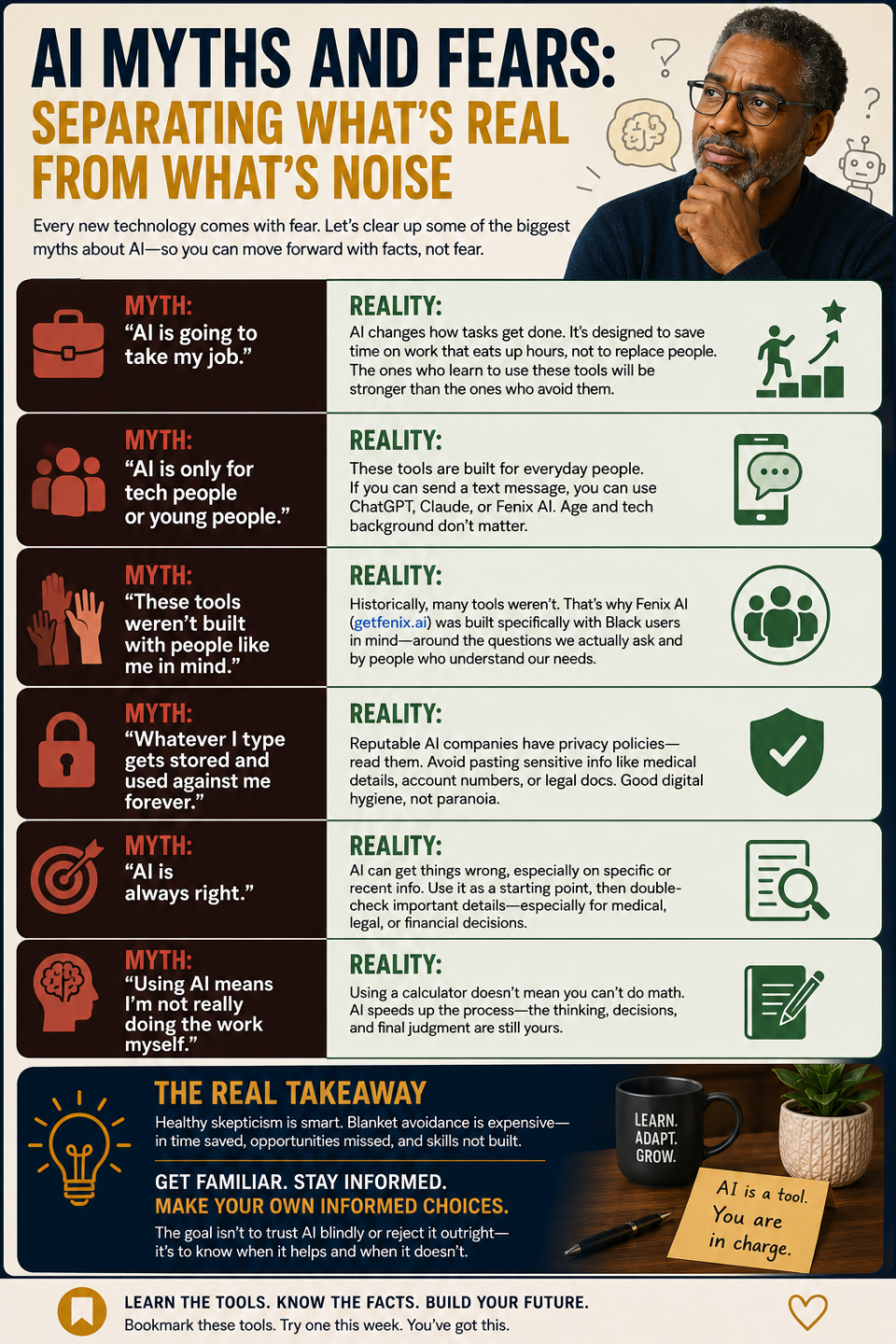
Every time a new technology shows up, fear shows up right alongside it. That’s not new, and it’s not irrational: it’s human. But some of the loudest fears about AI don’t hold up once you look at them closely, and some of the real concerns get drowned out by the noise. Let’s sort through a few of the big ones.
Myth: “AI is going to take my job.”
The honest answer is nuanced. AI is changing how certain tasks get done: some jobs will shift, some tasks within jobs will get automated. But the tools covered in this series aren’t designed to replace people; they’re designed to save time on the parts of a job that eat up hours without adding much value, drafting a first version of an email, organizing notes, summarizing a long document. The workers and business owners who learn to use these tools tend to be in a stronger position than the ones who avoid them entirely. Treating AI literacy like a skill worth having, the same way learning email or spreadsheets became non-negotiable twenty years ago, is a better long-term bet than treating it like something to fear.
Myth: “AI is only for tech people or young people.”
This one keeps a lot of capable, curious people on the sidelines. But every tool mentioned in this series was built to be used through plain typed conversation, no coding, no special training. If you can send a text message, you can use ChatGPT, Claude, or Fenix AI. Age and tech background have nothing to do with it.
Myth: “These tools weren’t built with people like me in mind.”
This one has more truth to it historically than most tech companies would like to admit; a lot of products get built for a default user who doesn’t look like most of the people reading this. That’s part of why it’s worth knowing that Fenix AI (getfenix.ai) was built specifically with Black users in mind, from the everyday questions it’s designed around to who’s behind it. Representation in who builds a tool shapes what it’s built to actually be useful for.
Myth: “Whatever I type gets stored and used against me forever.”
This deserves a real answer, not a dismissal. Reputable AI companies do have data and privacy policies, and it’s worth reading them, especially before pasting anything truly sensitive: medical details, financial account numbers, legal documents tied to an ongoing case. A reasonable middle ground: use AI freely for general writing, learning, and planning, and be more cautious with information you wouldn’t want anyone else to see. That’s not paranoia, that’s just good digital hygiene, the same way you wouldn’t hand your Social Security number to just anyone who asked.
Myth: “AI is always right.”
This is the fear that should probably be flipped: the real risk isn’t AI being too powerful, it’s people trusting it too much. AI tools can get facts wrong, especially about very specific or very recent information. Treat AI answers the way you’d treat advice from a knowledgeable friend: useful as a starting point, worth double-checking before you act on anything important, medical, legal, or financial.
Myth: “Using AI means I’m not really doing the work myself.”
Using a calculator doesn’t mean you can’t do math. Using spell-check doesn’t mean you can’t write. AI is a tool that speeds up a process; the thinking, the decisions, the final judgment calls are still yours. A resume written with AI’s help still reflects your actual work history. A business plan drafted with AI still runs on your actual idea and effort.
The real takeaway
Healthy skepticism is smart. Blanket avoidance is expensive, in time saved, opportunities missed, and skills not built. The goal isn’t to trust AI blindly or reject it outright. It’s to get familiar enough with it that you can make your own informed call about when it helps and when it doesn’t.