
TL;DR
In one week, a nationwide FAA ground stop, a Microsoft 365 outage and a United Airlines system failure hit back to back. Officials say none of it was a cyberattack. The Wall Street Journal calls it Bugmageddon: AI is finding software flaws faster than companies can safely fix them, and the rushed fixes are breaking things. You don’t need a conspiracy theory to take this seriously. Prepare the way New Orleans prepares for hurricane season.
Key Points
- The Nov. 13 FAA ground stop was the longest shutdown of U.S. airspace since 9/11.
- Transportation Secretary Sean Duffy blamed a contractor’s router upgrade. Congress says it will review the outage.
- Microsoft says it fixed about 1,400 security flaws in one monthly update, up from roughly 170 a year earlier.
- Officials say they’ve found no evidence of a coordinated cyberattack.
- Scammers are already using the outages as bait.
- Back up your data, lock down your passwords, keep small bills on hand and stock up as you would for a storm.
Bugmageddon sounds like a movie title. It’s actually what The Wall Street Journal is calling the run of system failures that has hit this country over the past week. The FAA grounded every departing flight in America. Microsoft 365 went down. United Airlines had its own system failure three days after the ground stop. According to the Journal, Chase, Workday, Apple and even the NSA have had problems too.
I’ve run an IT company in this city for 30 years. In that time, I’ve watched systems fail for every reason you can imagine. So let me tell you where I stand: whether or not somebody attacked us, this week proved how little it takes to stop the country cold. That’s the story, and it’s enough.

What Happened on Nov. 13
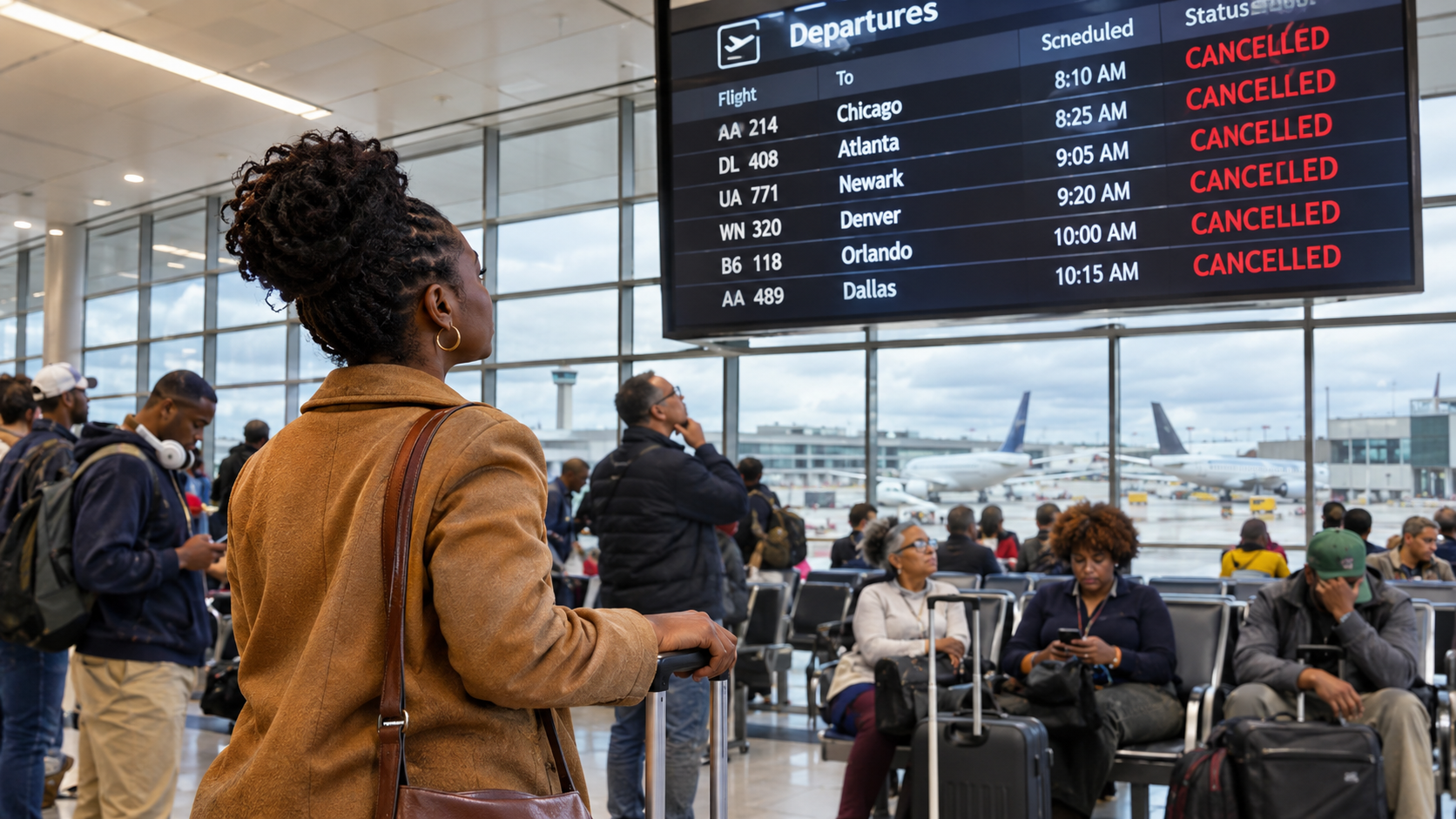
At about 3:30 p.m. Eastern on Friday, Nov. 13, the FAA issued a nationwide ground stop. Planes in the air landed. Nothing else took off. The order held for more than four hours, the longest such shutdown of U.S. airspace since 9/11. The FAA counts roughly 12,462 canceled flights in the aftermath.
Transportation Secretary Sean Duffy gave the official explanation. He said a contractor, L3Harris, was doing routine work at a remote FAA site, replacing old copper lines with fiber. A newly installed router then flooded the system with more than 1,000 connection attempts every four to five seconds. Controllers lost parts of their radar and radio feeds, so the FAA stopped departures.
Here’s what makes that believable: the network was already old. An FAA-commissioned review in 2023 called it obsolete, and it still runs partly on technology from another era.
Why I’m Not Taking “A Router” as the Final Word
I’ll be straight with you. “One router did it” doesn’t sit easily with me. A single box at a remote site shut down American aviation for an afternoon? If that’s true, it’s its own scandal.
But I’m not going to tell you something I can’t prove. Conspiracy thinking has done enough damage in this country already. Homeland Security officials said there was no evidence of a cyberattack, and Director of National Intelligence Jay Clayton said the outages don’t appear to be coordinated. Those are the official answers right now. They aren’t final. Sen. Maria Cantwell says the Senate Commerce Committee will review the outage, including the backup systems that were supposed to keep it from happening. When that report comes out, we’ll read it, and so should you.
Until then, the router is the official explanation. It isn’t the whole story yet.
So What Is Bugmageddon?
The term has been around security circles all year. New AI tools can comb through software and find weaknesses far faster than any human team. That’s good news and bad news. Defenders find holes before criminals do. But every hole has to be patched, and patches have to be installed on systems that are old, complicated and connected to everything else.
The numbers tell it. Microsoft’s monthly security update last month fixed about 1,400 flaws, according to the Journal. A year earlier it was about 170. In October, the people behind PHP, the software that runs as much as 70% of the world’s websites, disclosed a critical flaw that researchers found using AI.
The companies hit this week say the same thing: in most cases it wasn’t a hack. It was an upgrade gone wrong. Across the country, IT staff are racing to install fixes, and some of those fixes are knocking over the systems they were meant to protect.
That’s not a plot. It’s what happens when the whole economy runs on software and nobody built in enough slack.
Why This Hits Our Community Harder
When the airlines go down, a business traveler rebooks. When the card readers go down at the corner store, the woman paying with EBT goes home without groceries. If your paycheck lands on a card or your job runs through an app, one bad day in a data center costs you real money.
We also know something other cities don’t. New Orleans has lived through the day the power goes out, the phones don’t work and the bank is closed. We learned to keep water in the closet and cash in the drawer. This is the same lesson with a different kind of storm.
How to Prepare for the Next Bugmageddon Outage
None of this requires panic. It requires about one Saturday afternoon.
- Back up what matters. Keep your photos, important documents and phone contacts in the cloud, and keep a second copy on a thumb drive or external hard drive at home.
- Lock down your passwords. Use a password manager so every account has its own strong password. Turn on two-step verification for your email and your bank. And yes, keep installing updates. Even with everything going on, an unpatched phone is easier to break into than a patched one.
- Keep cash in small bills. Fives, tens and twenties. When the card machines are down, the store that will still sell to you wants exact change.
- Stock up like it’s hurricane season. Water, a few days of food, a full tank of gas and a refill on your prescriptions. Ready.gov has a good checklist.
- Write down your phone numbers. Most of us don’t know anybody’s number by heart anymore. Put family, doctors and your bank on a piece of paper in your wallet.
- Business owners, have a backup. Keep a second way to take payments and a printed list of your customers and vendors.
Watch Out for the Scammers
Here’s the part that worries me most. Criminals love a crisis. After the Nov. 12 Microsoft outage, security firm Field Effect caught fake emails claiming messages were held during the outage and would be deleted in 24 hours unless you clicked. Microsoft issued its own warning two days later.
Expect more of that. You’ll see texts about refunds, flight credits and “account problems” from the outage. Don’t click the link. Go straight to the company’s app or type its website in yourself. If somebody calls offering to fix your computer, hang up.
Just Get Ready
I don’t know everything that happened last Friday. Neither does anybody outside that investigation. What I do know is that a country this dependent on technology needs a backup plan, and so does every family in it.
You don’t have to believe in a conspiracy to get ready. Just remember what we learned in every storm we’ve survived: the people who prepared ahead of time had the easiest time getting through it.
Related reading at BSM: Louisiana’s Insurance Crisis Is Destroying Black Wealth and Right-Wing Embrace of Conspiracy Is ‘Mass Radicalization,’ Experts Warn

About the Author
Jeff Thomas is the founder and publisher of Black Source Media and the owner of WBOK 1230 AM in New Orleans. He is also CEO of Fenix AI and leads Total Computer Solutions and Services, a New Orleans IT firm that has served government agencies for 30 years. He writes about New Orleans and Louisiana politics, power and accountability.
Sources
- FAA: Nationwide Ground Stop: Questions and Answers (Nov. 15, 2026)
- Fox Weather: United Airlines experiences major widespread system outage days after nationwide ground stop (Nov. 16, 2026)
- ShiftDelete: FAA Ground Stop Traced to Aging Routers (Nov. 2026)
- Implicator: FAA Lifts Ground Stop as Duffy Blames Overloaded Routers (Nov. 14, 2026)
- Zacks: FAA Grounding Halted US Airspace: Do More Concerns Lie Ahead? (Nov. 2026)
- Hot Air: WSJ: Welcome to ‘Bugmageddon’ (Nov. 18, 2026)
- Editor & Publisher: AI just found a bug that puts up to 70% of the world’s websites at risk (Oct. 21, 2026)
- Field Effect: Microsoft 365 outage theme drives credential phishing and support scams (Nov. 13, 2026)
- Ready.gov: Build a Kit
Don’t Miss the Next One
Black Source Media lands in your inbox every Sunday and Wednesday with the New Orleans and Louisiana stories other outlets won’t tell straight. Sign up free.
AIOSEO Fields Post Title: Bugmageddon Isn’t a Conspiracy. It’s a Warning. Focus Keyphrase: Bugmageddon SEO Title: Bugmageddon: How to Protect Your Family From Tech Outages Meta Description: Bugmageddon grounded planes and knocked out Microsoft and United. There’s no proof of an attack, but plenty of proof we need a backup plan. Start here. URL Slug: bugmageddon-tech-outages-how-to-prepareTL;DR
In one week, a nationwide FAA ground stop, a Microsoft 365 outage and a United Airlines system failure hit back to back. Officials say none of it was a cyberattack. The Wall Street Journal calls it Bugmageddon: AI is finding software flaws faster than companies can safely fix them, and the rushed fixes are breaking things. You don’t need a conspiracy theory to take this seriously. Prepare the way New Orleans prepares for hurricane season.
Key Points
- The Nov. 13 FAA ground stop was the longest shutdown of U.S. airspace since 9/11.
- Transportation Secretary Sean Duffy blamed a contractor’s router upgrade. Congress says it will review the outage.
- Microsoft says it fixed about 1,400 security flaws in one monthly update, up from roughly 170 a year earlier.
- Officials say they’ve found no evidence of a coordinated cyberattack.
- Scammers are already using the outages as bait.
- Back up your data, lock down your passwords, keep small bills on hand and stock up as you would for a storm.
Bugmageddon sounds like a movie title. It’s actually what The Wall Street Journal is calling the run of system failures that has hit this country over the past week. The FAA grounded every departing flight in America. Microsoft 365 went down. United Airlines had its own system failure three days after the ground stop. According to the Journal, Chase, Workday, Apple and even the NSA have had problems too.
I’ve run an IT company in this city for 30 years. In that time, I’ve watched systems fail for every reason you can imagine. So let me tell you where I stand: whether or not somebody attacked us, this week proved how little it takes to stop the country cold. That’s the story, and it’s enough.
What Happened on Nov. 13
At about 3:30 p.m. Eastern on Friday, Nov. 13, the FAA issued a nationwide ground stop. Planes in the air landed. Nothing else took off. The order held for more than four hours, the longest such shutdown of U.S. airspace since 9/11. The FAA counts roughly 12,462 canceled flights in the aftermath.
Transportation Secretary Sean Duffy gave the official explanation. He said a contractor, L3Harris, was doing routine work at a remote FAA site, replacing old copper lines with fiber. A newly installed router then flooded the system with more than 1,000 connection attempts every four to five seconds. Controllers lost parts of their radar and radio feeds, so the FAA stopped departures.
Here’s what makes that believable: the network was already old. An FAA-commissioned review in 2023 called it obsolete, and it still runs partly on technology from another era.
Why I’m Not Taking “A Router” as the Final Word
I’ll be straight with you. “One router did it” doesn’t sit easily with me. A single box at a remote site shut down American aviation for an afternoon? If that’s true, it’s its own scandal.
But I’m not going to tell you something I can’t prove. Conspiracy thinking has done enough damage in this country already. Homeland Security officials said there was no evidence of a cyberattack, and Director of National Intelligence Jay Clayton said the outages don’t appear to be coordinated. Those are the official answers right now. They aren’t final. Sen. Maria Cantwell says the Senate Commerce Committee will review the outage, including the backup systems that were supposed to keep it from happening. When that report comes out, we’ll read it, and so should you.
Until then, the router is the official explanation. It isn’t the whole story yet.
So What Is Bugmageddon?
The term has been around security circles all year. New AI tools can comb through software and find weaknesses far faster than any human team. That’s good news and bad news. Defenders find holes before criminals do. But every hole has to be patched, and patches have to be installed on systems that are old, complicated and connected to everything else.
The numbers tell it. Microsoft’s monthly security update last month fixed about 1,400 flaws, according to the Journal. A year earlier it was about 170. In October, the people behind PHP, the software that runs as much as 70% of the world’s websites, disclosed a critical flaw that researchers found using AI.
The companies hit this week say the same thing: in most cases it wasn’t a hack. It was an upgrade gone wrong. Across the country, IT staff are racing to install fixes, and some of those fixes are knocking over the systems they were meant to protect.
That’s not a plot. It’s what happens when the whole economy runs on software and nobody built in enough slack.
Why This Hits Our Community Harder
When the airlines go down, a business traveler rebooks. When the card readers go down at the corner store, the woman paying with EBT goes home without groceries. If your paycheck lands on a card or your job runs through an app, one bad day in a data center costs you real money.
We also know something other cities don’t. New Orleans has lived through the day the power goes out, the phones don’t work and the bank is closed. We learned to keep water in the closet and cash in the drawer. This is the same lesson with a different kind of storm.
How to Prepare for the Next Bugmageddon Outage
None of this requires panic. It requires about one Saturday afternoon.
- Back up what matters. Keep your photos, important documents and phone contacts in the cloud, and keep a second copy on a thumb drive or external hard drive at home.
- Lock down your passwords. Use a password manager so every account has its own strong password. Turn on two-step verification for your email and your bank. And yes, keep installing updates. Even with everything going on, an unpatched phone is easier to break into than a patched one.
- Keep cash in small bills. Fives, tens and twenties. When the card machines are down, the store that will still sell to you wants exact change.
- Stock up like it’s hurricane season. Water, a few days of food, a full tank of gas and a refill on your prescriptions. Ready.gov has a good checklist.
- Write down your phone numbers. Most of us don’t know anybody’s number by heart anymore. Put family, doctors and your bank on a piece of paper in your wallet.
- Business owners, have a backup. Keep a second way to take payments and a printed list of your customers and vendors.
Watch Out for the Scammers
Here’s the part that worries me most. Criminals love a crisis. After the Nov. 12 Microsoft outage, security firm Field Effect caught fake emails claiming messages were held during the outage and would be deleted in 24 hours unless you clicked. Microsoft issued its own warning two days later.
Expect more of that. You’ll see texts about refunds, flight credits and “account problems” from the outage. Don’t click the link. Go straight to the company’s app or type its website in yourself. If somebody calls offering to fix your computer, hang up.
The Bottom Line
I don’t know everything that happened last Friday. Neither does anybody outside that investigation. What I do know is that a country this dependent on technology needs a backup plan, and so does every family in it.
You don’t have to believe in a conspiracy to get ready. Just remember what we learned in every storm we’ve survived: the people who prepared ahead of time had the easiest time getting through it.
Related reading at BSM: Louisiana’s Insurance Crisis Is Destroying Black Wealth and Right-Wing Embrace of Conspiracy Is ‘Mass Radicalization,’ Experts Warn
About the Author
Jeff Thomas is the founder and publisher of Black Source Media and the owner of WBOK 1230 AM in New Orleans. He is also CEO of Fenix AI and leads Total Computer Solutions and Services, a New Orleans IT firm that has served government agencies for 30 years. He writes about New Orleans and Louisiana politics, power and accountability.
Sources
- FAA: Nationwide Ground Stop: Questions and Answers (Nov. 15, 2026)
- Fox Weather: United Airlines experiences major widespread system outage days after nationwide ground stop (Nov. 16, 2026)
- ShiftDelete: FAA Ground Stop Traced to Aging Routers (Nov. 2026)
- Implicator: FAA Lifts Ground Stop as Duffy Blames Overloaded Routers (Nov. 14, 2026)
- Zacks: FAA Grounding Halted US Airspace: Do More Concerns Lie Ahead? (Nov. 2026)
- Hot Air: WSJ: Welcome to ‘Bugmageddon’ (Nov. 18, 2026)
- Editor & Publisher: AI just found a bug that puts up to 70% of the world’s websites at risk (Oct. 21, 2026)
- Field Effect: Microsoft 365 outage theme drives credential phishing and support scams (Nov. 13, 2026)
- Ready.gov: Build a Kit
Don’t Miss the Next One
Black Source Media lands in your inbox every Sunday and Wednesday with the New Orleans and Louisiana stories other outlets won’t tell straight. Sign up free.
