
TL;DR
Every Louisiana voter will see ten constitutional amendments on Tuesday’s ballot. New Orleans voters get an eleventh question: a City Charter change that would turn the city budget into a hard spending limit. Five of the state amendments touch property taxes. Each question stands alone, so read them one at a time.
Key Points
- Election Day is Tuesday, November 3, 2026.
- Each amendment needs a simple majority statewide to pass.
- Amendment 7 would let public money pay to replace lead water lines on private property.
- The New Orleans charter question would bar departments from spending past their approved budgets without a council vote.
- If approved, the charter change takes effect January 1, 2027.
Most people will walk into the booth Tuesday thinking about the Senate race. Then they will hit a long list of amendments written in legal language, and many will guess. Don’t guess. The Louisiana amendments on the November 2026 ballot could change your property tax bill, your water lines and who can run for governor.
New Orleans voters have one more decision. It sits at the bottom of the ballot, and it may matter more to this city than anything above it.
The 10 Statewide Amendments
Amendment 1: Surviving spouses of disabled veterans. Right now, a surviving spouse loses a special property tax exemption if she moves. A Yes vote lets her transfer it to another qualifying home one time. A No vote keeps the current rule.
Amendment 2: Local property tax rates. Local taxing bodies sometimes collect less than their authorized maximum. Today they have a limited window to raise the rate back up. A Yes vote lets them keep a lower rate longer without losing the right to return to the maximum. It does not raise taxes by itself, but it gives local governments more room to do so later.
Amendment 3: Bail after conviction for crimes against children. A Yes vote bans post-conviction bail for people convicted of certain aggravated offenses against minors. A No vote keeps judges’ current discretion. This covers people already convicted and appealing, not people awaiting trial.
Amendment 4: Lifetime term limit for governors. Governors can serve two straight terms, sit out, then run again. A Yes vote makes two terms a lifetime limit. A No vote keeps the door open for a former governor’s comeback.
Amendment 5: State retirement debt. Certain one-time state dollars must go toward the oldest pension debt first. A Yes vote gives lawmakers flexibility to choose which debt to pay down. The debt itself doesn’t shrink either way.
Amendment 6: More tax relief for seniors. A Yes vote lets parishes and cities offer extra property tax exemptions to homeowners 65 and older. Nothing happens automatically, since local governments would have to choose to offer it. Every exemption granted also means less local revenue for services.
Amendment 7: Lead water line replacement. Pay close attention to this one. Water service lines run from the public main onto private property, and the state constitution limits spending public money on private land. A Yes vote clearly allows public funds to find and replace hazardous lines, including the section in your yard. With the Sewerage and Water Board’s aging pipes, that matters here.
Amendment 8: Foreign adversaries and expropriation. A Yes vote bars foreign adversaries and their agents from using expropriation powers to take private property. A No vote leaves current rules in place.
Amendment 9: Assessment freeze income limit. Qualifying homeowners can freeze their home’s assessed value if they earn under $100,000. A Yes vote raises that cap to $150,000. A freeze holds the assessment steady. Your bill can still change if millage rates do.
Amendment 10: Rehabbed blighted property. A Yes vote lets parishes create tax exemptions for formerly blighted or abandoned buildings that owners bring back. In a city with as much blight as ours, that could help. Local leaders would still have to weigh the lost tax revenue.
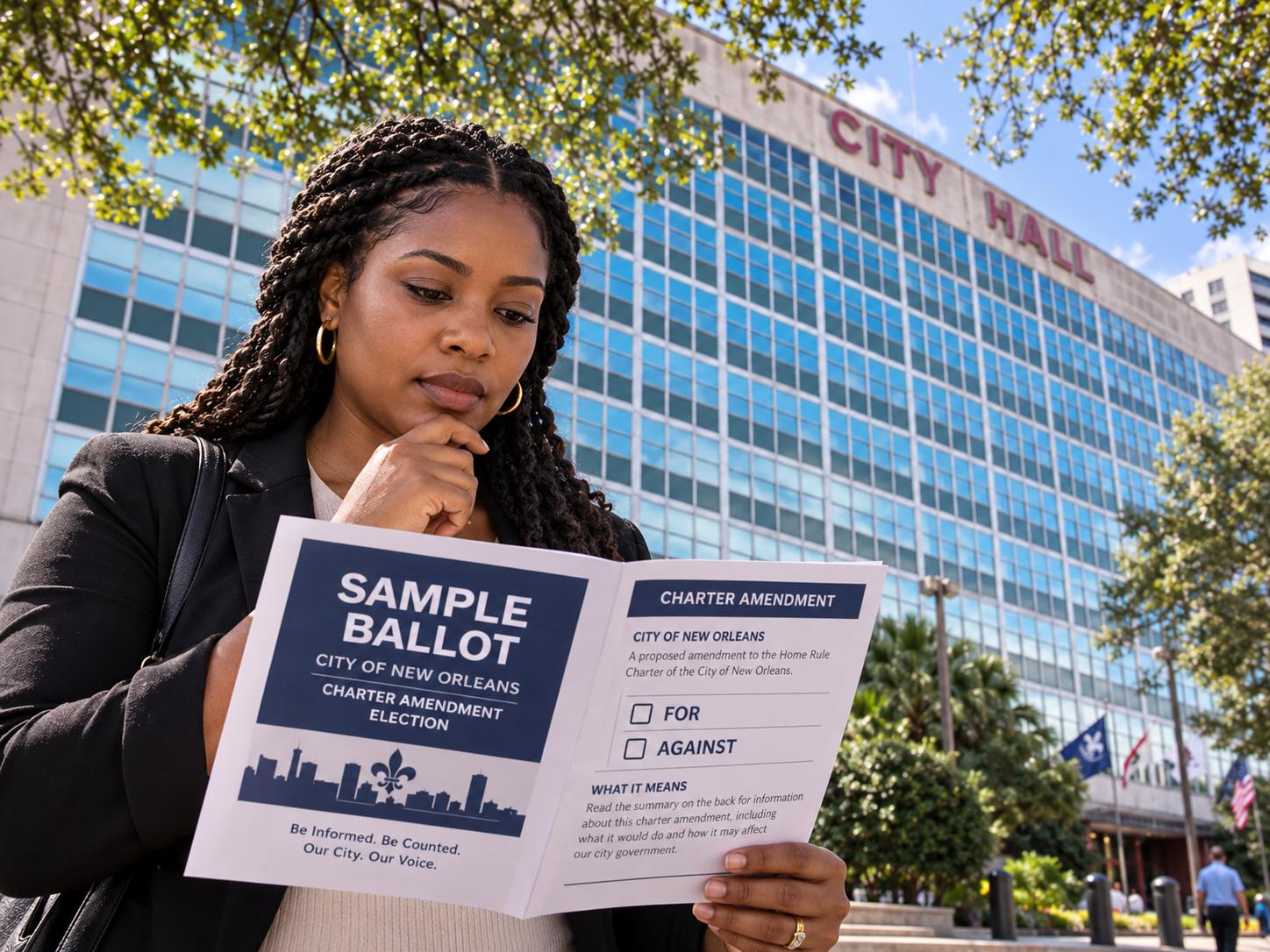
Question 11: The New Orleans Charter Amendment
This one is not on ballots outside Orleans Parish, and it is easy to miss. It amends Section 6-103 of the Home Rule Charter, the section that governs how the city carries out its budget.
Council President J.P. Morrell wrote the ordinance after the city’s 2025 cash crisis. That crisis ended with a $125 million loan from the State Bond Commission to make payroll, with state oversight attached. Morrell argued the budget had become a suggestion the administration reconciled after the fact.
A Yes vote makes the budget a hard ceiling. Departments could not shift or spend money past what the council approved without a formal budget amendment. Finance could not issue any purchase order, voucher or check that pushes spending over the line. The chief administrative officer and finance director would also have to report spending to the council every month.
A No vote leaves the charter as it is.
Supporters say monthly reports would catch the next shortfall before it becomes a crisis. The fair question is flexibility. When a storm hits or an emergency lands, the administration would need council action before spending beyond the budget. Voters should decide whether that extra step is a safeguard or a delay.
We covered this proposal in depth in The City Charter Change on the Ballot That Nobody Is Talking About.
Before You Vote
Several of these questions trade one good against another. A new exemption helps some homeowners and shrinks the money for public services. A stricter budget rule adds oversight and adds a step. Judge each one on its own.
Look up your polling place, hours and sample ballot on the Secretary of State’s GeauxVote voter portal. For a deeper read, see the Public Affairs Research Council’s amendment guide and our earlier breakdown of the ten amendments.
Tuesday’s headlines will be about who won. The amendments will still be shaping your tax bill and your City Hall long after those headlines fade.

Related reading at BSM: The Black Vote in Louisiana Is Being Engineered Out of Existence
About the Author
The Black Source Media Editorial Board covers New Orleans and Louisiana politics, power and accountability. Black Source Media was founded by publisher Jeff Thomas, owner of WBOK 1230 AM.
Sources
- WAFB: Louisiana voters face 10 constitutional amendments in November (Oct. 14, 2026)
- Public Affairs Research Council: Guide to the 2026 Constitutional Amendments
- New Orleans City Council: Regular meeting summary, charter amendment election set (Jan. 27, 2026)
- The Center Square: New Orleans to consider hard limit on city spending (Dec. 30, 2025)
Don’t Miss the Next One
Black Source Media lands in your inbox every Sunday and Wednesday with the New Orleans and Louisiana stories other outlets won’t tell straight. Sign up free.
