
TL;DR
Jeff Landry now controls Louisiana’s courts, its legislature, and its purse strings. His political strategy is built on one engine: attacking New Orleans. He is succeeding. But the city’s business community has the power to stop him — and so far they have been silent. That silence is the real crisis.
Key Points
- Landry controls the legislature, the state Supreme Court, and the AG — a level of political consolidation Louisiana has rarely seen.
- His strategy is to diminish New Orleans’ influence by building new tax revenue sources elsewhere — data centers, industrial recruitment, north Louisiana investment.
- He has eliminated judgeships, killed the criminal clerk of court, and positioned the state to starve New Orleans of resources.
- The Louisiana Supreme Court worked late on a holiday weekend to give Liz Murrill cover after she threatened New Orleans elected officials — possibly a crime.
- New Orleans business leaders — the owners of the French Quarter, the Popeyes founders, the Sidney Torres waste empire, the Shell Square tenants — have the leverage to push back and have not used it.
- Landry cannot actually afford to destroy New Orleans. It is still the state’s largest metro, its top tourist destination, and a major tax engine.
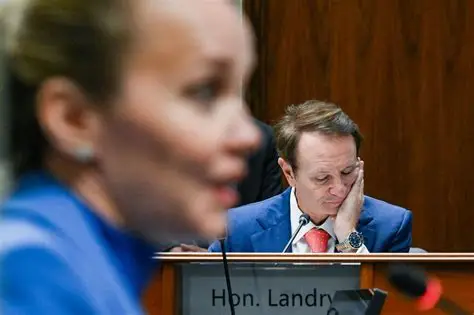
Jeff Landry has no clothes.
The governor of Louisiana has successfully convinced most of this state that he is an unstoppable political force. He controls the legislature. He controls the courts. He controls the attorney general. He pushed the Louisiana Supreme Court to work late on a Friday evening of a holiday weekend to give Liz Murrill cover after she sent letters threatening the elected officials of New Orleans — letters that were, by most reasonable legal readings, close to extortion. They moved fast. They moved in the dark. And they moved without apology.
That is the kind of political power most politicians only dream about. And Landry has accumulated a level of political might that Louisiana has rarely seen in a single executive — and with that much power consolidated in one set of hands, the temptation to use it without restraint is real.
The Strategy Is Simple
Landry’s political engine runs on one fuel source: attacking New Orleans. That message got him elected attorney general. It got him elected governor. Now, from the governor’s mansion, he is running the same play with more tools and fewer constraints.
To understand the strategy, start with history. New Orleans was once the most powerful entity in Louisiana politics. The city had the largest population and generated the most tax revenue. As a result, it heavily influenced state allocations, judicial appointments, and legislative priorities. When New Orleans spoke, Baton Rouge listened — not out of affection, but out of arithmetic.
Landry is trying to change that arithmetic permanently.
Economic Diversification — Real and Strategic
He has recruited new businesses into the state — data centers in Monroe, industrial projects in north Louisiana, and corporate relocations across the I-10 corridor. To be fair, it is working. Louisiana’s finances are on more solid footing than they have been in years. By diversifying the state’s economic base beyond oil and gas volatility, Landry has done something previous governors failed to do.
The data centers are not without controversy. They are significant energy consumers and raise environmental concerns. However, this is Louisiana — a state that has welcomed chemical plants and oil refineries for generations with little public debate about the tradeoffs. By that standard, data centers are tame.
Still, the political consequence of this economic success is real and deliberate. New Orleans is simultaneously struggling financially and growing more dependent on state support. Consequently, a governor with a diversified revenue base has leverage that his predecessors never had. Landry knows it. One of the most tangible results of this new dynamic is that he can now pressure New Orleans at precisely the moment when the city is least able to push back.
What He Has Already Done
The evidence is already on the record. Judgeships have been eliminated. One of the city’s two clerk of court offices is gone. Beyond that, Landry has made clear — in public and in private — that New Orleans’ days of automatic deference are over. His goal is to put the city in line with every other parish. No special treatment. No special allocation. No exceptions.
Moreno Is Trapped
For her part, Helena Moreno finds herself in an impossible position. We have written before about the trap she faces: she cannot appear weak and roll over, but every time she engages in a public letter war with Landry, she hands him a gift.
Each letter exchange gives the governor exactly what he wants. His base sees a Democratic mayor of a majority-Black city pushing back against state authority. That story has fueled his political career for a decade. Furthermore, the longer this conflict stays in the public arena, the more it feeds a narrative that benefits him politically — while costing the city practically.
She is right on the substance. Nevertheless, she is losing on the strategy. Meanwhile, the city bleeds while the argument plays out in the press.
The Business Community Has Been Silent Too Long
Here is the part nobody wants to say out loud.
The French Quarter does not run itself. Those restaurants, hotels, bars, and music venues exist because New Orleans has functioning infrastructure. Without working toilets, there are no restaurants in the Quarter. Without reliable electricity, there is no nightlife. Without passable roads, tourists stop coming. And when tourists stop coming, the businesses that have stayed silent about this conflict will find their silence very expensive.
The Stakes for New Orleans Business Leaders
Todd Graves of Raising Cane’s recently put his name on a football field in the Ninth Ward. That is a genuine investment in a community that needs it, and it deserves real credit. However, a field with no lights — in a neighborhood with deteriorating infrastructure, in a city struggling to keep basic services running — becomes a symbol of decline rather than renewal. Graves has a stake in New Orleans that goes far beyond one football field. He needs this city to function. Right now, that is not guaranteed.
Similarly, Sidney Torres picks up trash in seventy percent of this city. If residents continue leaving — and they are — there will eventually not be enough people to justify that contract. In other words, the population decline accelerated by funding cuts and political warfare is a direct threat to every business built on New Orleans’ density.
Then there is 1 Shell Square. An empty tower. A symbol of corporate retreat from a city that was once the financial capital of the Gulf South. If the governor’s good friend Shane Guidry has not noticed that New Orleans is hemorrhaging corporate presence, he should look out the window of whatever office he is actually working from these days.
The Emperor Has Limits
Here is what Landry knows but will not say publicly: he cannot actually afford to destroy New Orleans.
Consider the facts. New Orleans remains the largest metropolitan area in Louisiana. It is still the state’s number one tourist destination. Moreover, it is still home to the biggest businesses, the most significant port activity, and a substantial share of the state’s tax base. Even if the city has slipped to second or third as an economic engine, its relevance to Louisiana’s economy remains enormous.
The 2026 legislative session made clear that Landry intends to keep squeezing. However, squeezing too hard breaks the vessel. A weakened, depopulated, infrastructure-starved New Orleans does not just hurt the city — it hurts Louisiana’s bond rating, its tourism economy, its port revenues, and its ability to attract the very corporate investment Landry points to as proof of his success.
The danger of this much consolidated power is not that Landry is a bad actor — it is that when one person controls this many levers, the checks that normally produce good judgment stop functioning. A governor who controls the courts, the legislature, and the AG does not get a lot of honest feedback. And without honest feedback, even sound instincts can lead to decisions that hurt the very outcomes the governor says he wants.
Somebody Has to Say It
The business community of New Orleans has the leverage that the mayor does not. They are not political opponents Landry can dismiss. They are donors, employers, and economic engines that the governor needs to point to when he talks about Louisiana’s growth story.
The owners of the major French Quarter properties. The energy sector executives. The port-adjacent industries. The hospitality conglomerates. The financial institutions that still call New Orleans home. They have relationships with Landry that Moreno does not have. They have access that elected officials cannot buy. And they have a financial interest in a functioning New Orleans that is more immediate and more concrete than any political calculation.
The water and sewer crisis alone should have activated them months ago. If the infrastructure that makes New Orleans livable and profitable collapses, no amount of political posturing from either the mayor or the governor will bring it back.
Somebody needs to walk into the governor’s office — not with a letter, not with a press release, but in person, with a relationship and real economic credibility — and make the case that a weakened New Orleans is not a trophy. It is a liability.
Landry is not wrong that Louisiana needed to diversify beyond New Orleans. He is not wrong that the city has had structural advantages that shielded it from accountability. But there is a version of this story where the governor’s success in building a stronger Louisiana economy includes a thriving New Orleans — and a version where it does not. The business community is the only constituency with the access and the credibility to influence which version gets written.
The governor is powerful enough to do real damage to this city. He is also smart enough to know that a thriving New Orleans makes his economic story stronger, not weaker. Somebody needs to make that case to him directly — before the window to make it closes.
Stay with Black Source Media
Independent Black-owned analysis of Louisiana politics — delivered to your inbox every week.
Subscribe Free →Jeff Thomas
Jeff Thomas is the publisher of Black Source Media and the founder of Think504. He has covered New Orleans politics and Louisiana policy for more than two decades and has been a consistent voice for Black political and economic power in the Gulf South.

Does Landry want Helena on her knees? What do you mean Jeff