
By Langston Price
Louisiana Attorney General Liz Murrill’s threat against New Orleans elected officials is not just a local legal fight.
It exposes a broader southern power play.
Across the South, Republican-led state governments keep targeting Democratic cities. State leaders attack Black political power, challenge home rule, and weaken local governments that control major economic engines.
That is the real story.
Murrill sent letters to New Orleans leaders over the Orleans Parish clerk fight. Her office warned that city officials could face serious consequences under Louisiana’s usurper laws, including possible forfeiture of office.
That should alarm every New Orleans voter.
When a state attorney general threatens elected officials in a majority-Black city, she does more than argue procedure. She sends a political message.
Baton Rouge believes it can reach into New Orleans and challenge local democratic decisions.
New Orleans cannot accept that as normal.
Internal link: Read more Black Source Media coverage on New Orleans voting rights and state power.
This Is Bigger Than One Clerk’s Office
The immediate fight centers on the Orleans Parish clerk controversy.
State officials argue the law eliminated the criminal clerk’s office, transferred its duties, and renamed the continuing office. Murrill’s office says Chelsey Richard Napoleon remains the lawful Orleans Parish clerk. [External link: FOX 8 report]
Many New Orleans voters see something different.
They see Baton Rouge changing the rules after a local election. They also see state officials challenging city leaders who refuse to accept that move quietly.
This fight now reaches beyond one job.
It asks whether Black voters can elect leaders and expect the state to respect the result.
Internal link: Related: “This Is How the Voting Rights Act Dies — And It’s Happening in New Orleans.”
The Pattern Is National
New Orleans is not alone.
Tennessee went after Nashville by cutting its Metro Council from 40 members to 20. The law directly affected Nashville, a Democratic stronghold. A Tennessee appeals court upheld the state law in 2025.
Mississippi has moved against Jackson’s control over its water system. Jackson asked a federal court to block a state-created regional water authority. City leaders argued the new structure would leave Jackson without majority control.
Georgia moved against political power in metro Atlanta. Gov. Brian Kemp signed a law making many local elections nonpartisan in five major Atlanta-area counties. Critics say the law targets Democratic-leaning counties and weakens Black political power.
The tactics differ.
The purpose does not.
When blue cities build too much political power, red states change the rules.
They reduce councils. They take over boards. Then they redraw districts. They remove party labels. They merge offices. Finally, they threaten elected officials.
Then they call it reform.
But reform should expand democracy.
This does the opposite.
Blue Cities Power Red States
The economic contradiction makes the politics even uglier.
Blue cities power red states.
New Orleans gives Louisiana global identity. The city drives tourism, conventions, ports, restaurants, hospitals, universities, courts, music, and culture.
Memphis anchors a major logistics and cultural economy.
Atlanta powers Georgia’s corporate future.
Jackson remains Mississippi’s capital and civic center, despite years of neglect.
These cities are not burdens.
They are assets.
That explains why states want more control over them.
Red state leaders want the tax base, airports, ports, hospitals, universities, tourism, convention dollars, and corporate headquarters.
However, they do not want blue-city voters controlling blue-city power.
That contradiction defines the fight.
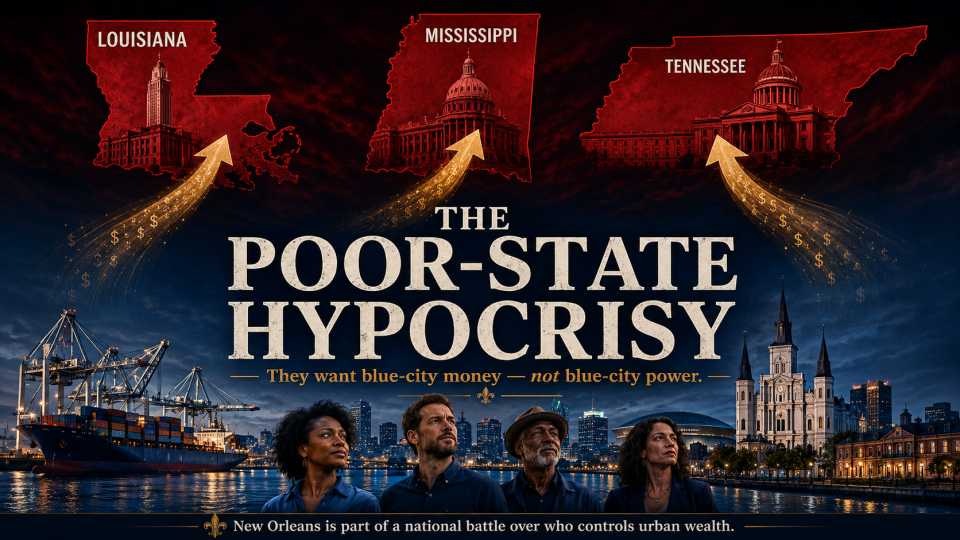
The Poor-State Hypocrisy
Here is the irony.
Many red states depend on two revenue streams they constantly attack: blue-city tax bases and a federal government funded heavily by larger, higher-output states.
Louisiana, Mississippi, and Tennessee combined produce about $1.04 trillion in annual economic output. California alone produces roughly four times that amount. Illinois and Pennsylvania each produce economies near the size of those three southern states combined. [External link: Bureau of Economic Analysis]
Yet many of these same southern states lecture New Orleans, Memphis, Jackson, Atlanta, and other blue cities about discipline, crime, efficiency, spending, and governance.
That lecture rings hollow.
These states often depend on the economic output of the cities they attack.
The same contradiction exists nationally. USAFacts reported that in fiscal year 2024, only 19 states sent more money to the federal government than they received back. The rest received more than they contributed. California paid about $275.6 billion more to Washington than it received. New York and Texas also sent more than they got back.
So call this what it is.
Many red states do not stand on pure self-sufficiency. They stand on federal redistribution, blue-city tax bases, and the output of places they often criticize.
That is not fiscal conservatism.
It is extraction.
Red states want the money, assets, culture, tax base, and national relevance.
But they do not want the people in those cities to control the power that comes with those assets.
This Is About Black Political Power
The attack on New Orleans also connects to the national attack on the Voting Rights Act.
Black political power often lives in cities.
Black voters elect mayors, council members, district attorneys, sheriffs, clerks, judges, school board members, and legislators.
Those offices shape daily life.
They decide who gets prosecuted, hired, contracted, heard, protected, and ignored.
So when states weaken city authority, they often weaken Black authority.
That is why the Voting Rights Act matters.
If conservative legal forces completely eliminate the VRA, states gain more room to dilute Black districts. They can redraw maps, challenge majority-Black local power, and make Black votes matter less.
Then they do not have to ban Black voting.
They only have to weaken its effect.
That makes the New Orleans fight dangerous.
If state leaders can erase local outcomes, threaten city officials, or seize local authority, democracy becomes conditional.
Conditional democracy is not democracy.
Related Black Source Media analysis: “They Erased 38,000 Votes. Black New Orleans Is Fighting Back.”
New Orleans Must Fight Back
New Orleans cannot treat this as ordinary Baton Rouge politics.
This fight concerns home rule, Black voting power, and local control.
The response must be serious.
City leaders should challenge unlawful state overreach in court. Civic groups should educate voters about the pattern. Black media should connect New Orleans to Memphis, Jackson, Atlanta, Nashville, and other targeted cities.
Business leaders also need to stop hiding.
This is not just politics.
It is economics.
State overreach destabilizes cities. It damages trust. Residents hear that the state can override their votes. Investors see political power mattering more than democratic stability.
That hurts the whole state.
New Orleans should not beg Baton Rouge to respect it.
The city should organize, litigate, legislate, and communicate like it understands its value.
The Real Question
The question now is simple.
Can red states keep taking blue-city money while attacking blue-city power?
Can they use cities as economic engines while treating city voters as political problems?
Or should they rely on Black labor, Black culture, Black tax bases, and Black votes while undermining Black political authority?
New Orleans should answer no.
The state does not get to market New Orleans to the world, then silence New Orleans at home.
It does not get to profit from Black culture, then punish Black political power.
State leaders do not get to erase elections and call that efficiency.
This is the fight.
Red states want blue-city money.
But they do not want blue-city power.
If blue cities do not fight back now, they may wake up with the tax burden, the public problems, and the cultural responsibility — but none of the authority.

She’s a real racist