
Black Source Media — Sunday — Opinion / Accountability — Jeff Thomas
Opinion / Accountability
The Motta-Giles verdict didn’t just convict two lawyers. It confirmed what everyone in Louisiana already suspected: the personal injury industry in this state is rotten at its edges. And the rot doesn’t start with staged crashes. It starts with the commercials.
By Jeff Thomas | Black Source Media | Sunday, March 22, 2026
Turn on your television in Louisiana on any given afternoon and count how long it takes before a lawyer appears on your screen. I have done this. The answer is not long.
They come in waves. Some stand in front of bookshelves wearing expressions of deep concern. Some lean against luxury cars. They all shout their phone numbers at you like they are running a furniture clearance sale. And almost all of them eventually get to the number — the settlement, the verdict, the “we got our client” moment. Two million dollars. Four million. Eight million. The bigger the number, the bigger the smile.
Here is what they never say while that number is on the screen: someone was badly hurt to produce it.
A $4 million settlement does not come from a minor fender bender and a sore neck. It comes from a shattered spine, a traumatic brain injury, a life permanently altered. The big payout is not a lottery win. It is the financial acknowledgment of real human devastation. Using it as an advertisement — as evidence that you should call this number and get paid — is not just distasteful. It is the first step on a very slippery slope.
That slope ends in a federal courtroom. This week, in New Orleans, two lawyers slid all the way to the bottom of it.
“The big payout is not a lottery win. It is the financial acknowledgment of real human devastation.”
— Jeff Thomas, Black Source Media
What Motta and Giles Actually Did
On Friday, a federal jury convicted personal injury attorneys Vanessa Motta and Jason Giles on all counts in what prosecutors called the Highway Robbery scheme. The two had paid so-called “slammers” — people hired to deliberately crash their vehicles into 18-wheelers — so that the passengers could claim injuries and file lawsuits. More than 50 people have already pleaded guilty in connection with the scheme. Someone murdered one cooperating witness before he could testify — and a disbarred attorney and his associate now face charges for it. The judge remanded both attorneys to federal custody immediately after the verdict, calling the case “anything but a typical fraud case.”
Louisiana’s legal ecosystem built this scheme. For years, it fed the idea that a car accident is a financial opportunity — and that the more dramatic the injury, the bigger the payday.
That ecosystem did not appear overnight. Deliberate carefully crafted advertising created it.
The Commercials Are Not Innocent
I want to be precise here, because precision matters when you are talking about an entire profession. The vast majority of personal injury attorneys in Louisiana are honest lawyers doing legitimate work for clients who genuinely need representation. A person injured by a negligent driver deserves competent legal help. That is not in dispute.
What is in dispute is the culture that a segment of this industry has built around the pursuit of maximum payout at minimum scrutiny.
Watch the commercials closely. They do not say: “if you have been seriously injured through no fault of your own, we will fight for your right to fair compensation.” That would be honest. Instead, they say: “we got our client —” and then the number. Big. Flashing. Celebratory. As if the point of the legal system is not justice but jackpot.
Then there are the clinics. The offices that have sprung up across this city offering heat therapy, massage, and basic chiropractic services — conveniently located near the law firms, or sometimes inside the same building. The purpose of these offices is not primarily to heal anyone. The purpose is to generate medical documentation — visit logs, treatment records, bills — that can be submitted as evidence of injury in a lawsuit to drive up the settlement value.
A client who receives three months of heat therapy and massage after a minor accident is not necessarily a fraud. But the system that routes them there automatically, generates a paper trail that inflates the value of a borderline claim, and then advertises the resulting settlement on television as evidence of the firm’s power — that system is not serving justice. It is gaming it.
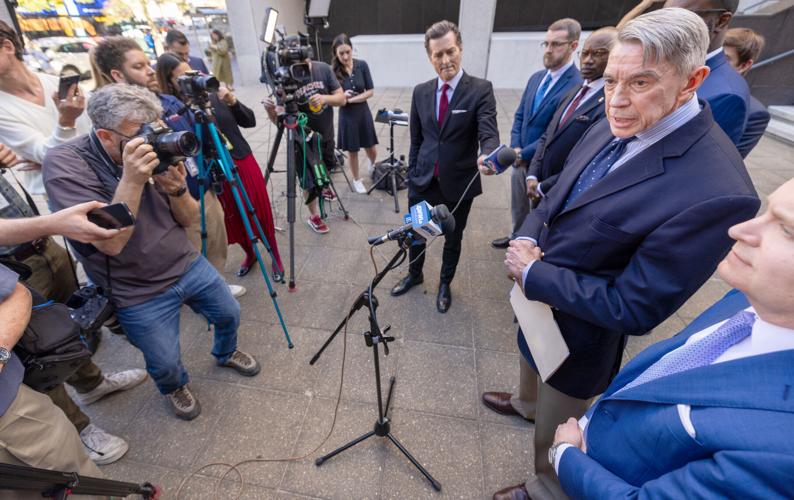
“The staged crash is just the logical conclusion of a business model that treated injury as inventory.”
— Jeff Thomas, Black Source Media
The Slippery Slope Is Not a Theory. It’s a Conviction.
The Motta-Giles case did not emerge from nowhere. You don’t get to staged crashes overnight. You get there one compromised case at a time, until nobody in the room remembers what honest looks like.
If you normalize the idea that every accident is a settlement opportunity, eventually someone decides they do not need to wait for an accident to happen. If you normalize generating medical records to inflate claim values, eventually someone decides to generate the accident itself. And if you normalize advertising your biggest payouts like they are evidence of your greatness, eventually you attract clients — and colleagues — who share your values.
The staged crash is just the logical conclusion of a business model that treated injury as inventory.
| The Slippery Slope — From Legal Grey to Federal Conviction Step 1: Advertise big settlements as evidence of your firm’s power, not as evidence of a client’s suffering. Step 2: Route accident clients to affiliated clinics for inflated medical documentation to drive up claim values. Step 3: Normalize the idea that every accident has a maximum extractable value regardless of actual injury. Step 4: Stop waiting for accidents to happen. Pay someone to create them. |
The Real Victims Are Driving Right Now
Here is what this costs the people of Louisiana who are not lawyers and have never staged a crash and never will.
Louisiana consistently ranks among the most expensive states in the nation for automobile insurance. The average Louisiana driver pays significantly more per year than the national average — not because Louisiana roads are uniquely dangerous, but because the insurance industry has priced in the cost of a legal environment that treats every accident as a potential multi-year litigation. When claims are inflated, when settlements are manufactured, when the system is gamed — the insurance companies do not absorb the cost. They pass it to the premiums. They pass it to you.
The people paying the most, proportionally, are the people who can least afford it.Working-class Black and brown New Orleanians drive older cars, live in neighborhoods where insurance companies already jack up the rates, and pay hundreds of dollars a month for coverage the law forces them to carry. They are subsidizing a fraud they did not participate in and will never benefit from.
Prosecutors in the Motta-Giles case said it plainly: this was not a victimless crime. The victims include every truck driver who lost their job after being falsely accused. Every Louisiana driver who has paid a premium inflated by manufactured claims is a victim. The victims include every honest attorney whose reputation has been tarnished by the industry’s worst practitioners.
The Legal Community Must Say It Out Loud
There is one more thing that must be said, and I say it with respect for the many good attorneys in this city and this state who do their work with integrity every day.
The legal community has been too quiet about this for too long.
Bar associations issue press releases. Ethics boards process complaints. But where are the prominent attorneys — the ones with the long careers and the respected names and the actual standing in this community — publicly calling out the advertising culture that makes their profession look like a used car lot? Where is the collective voice of Louisiana’s honest lawyers saying: not in our name?
The Motta-Giles verdict is an opportunity. Not just for the justice system, but for the legal profession itself. Every firm that has ever run a commercial celebrating a big settlement, every clinic that has ever been set up primarily to generate paperwork rather than provide genuine care, every attorney who has looked the other way at practices they knew were ethically compromised — this verdict is a mirror. Look into it.
Related: Insurance is Too High In New Orleans
The good lawyers of Louisiana suffer every time someone like Motta or Giles makes the news. Their clients become more skeptical. And their profession becomes more suspect. Their billboard becomes one more punchline in a city that has seen too many of them.
| What the Legal Community Must Do Bar leadership must issue a public statement condemning the advertising culture that celebrates settlements as windfalls rather than as compensation for genuine suffering The Louisiana State Bar must investigate the network of clinics operating in conjunction with personal injury firms specifically to inflate claim values Prominent attorneys with standing in this community must speak publicly — not just through bar committee reports, but in their own voices, on the record The profession must acknowledge that the slippery slope from aggressive advertising to outright fraud is shorter than they have been willing to admit |
The Verdict Is Just the Beginning
Motta and Giles go to sentencing in July. The murder trial of the man accused of killing a cooperating witness — a man who was executed before he could testify against them — has not yet been tried. The full accounting of this scheme has not yet been made.
But the verdict that matters most is not the one a jury delivers. It is the verdict the legal community delivers on itself. It is the decision to stop pretending that the commercials are harmless, that the clinics are unrelated, that the culture has nothing to do with the crime.
Every time a Louisiana attorney puts a settlement number on television like it is a jackpot, they are contributing to the environment that produced Vanessa Motta and Jason Giles.
The jury did its job. Now the lawyers need to do theirs.
Clean up your profession. Your community is watching. And this time, so is a federal judge.
Jeff Thomas is a contributor to Black Source Media covering New Orleans politics, civic affairs, and accountability journalism. Published every Sunday. blacksourcemedia.com | Meta description (158 characters):
