

The pipes under New Orleans are not simply aging — they are surrendering. The can that a dozen mayors and governors kicked down the road has finally rolled off a cliff. Mayor Helena Moreno is the right leader at the right moment. But she must act right now, while the people still believe. And Gov. Jeff Landry: the state can’t keep sending police to guard a city it’s letting rot from the ground up.
Key Points — What You Need to Know
- Engineers estimate the city loses more than half its treated drinking water through broken and leaking pipes — some measurements place the figure as high as 76 percent.
- A 2003 replacement plan estimated the cost to fix the water distribution system at $2.8 billion in that year’s dollars — in 2026, experts place the full overhaul at $5–7 billion or more over 20 years.
- Mayor Helena Moreno won 55% of the vote in October 2025 — her honeymoon mandate requires a bold, public infrastructure commitment now.
- Governor Jeff Landry has sent state police and National Guard to fight crime — but the greater existential threat to Louisiana’s largest tax-generating parish is infrastructure collapse, not street crime.
- This article presents a 20-year, phased repair model with income-tiered, usage-based financing that protects low-income residents, seniors, and working families while funding the full system rebuild.
- Without immediate action, the French Quarter and Central Business District — the engine of Louisiana’s tourism economy — face catastrophic sewer and water system failure.
Let’s start with a number that should keep every elected official in Louisiana awake at night. Engineers estimate that the Sewerage and Water Board of New Orleans loses more than half the drinking water it treats — poured into the ground through thousands of broken, leaking, and disintegrating pipes before it ever reaches a single tap. Some measurements place that loss rate as high as 76 percent. Even the most conservative estimate is a civic emergency. New Orleans is manufacturing water and throwing most of it away, billing its residents for the privilege, and calling it a utility.
The system still works most days. Toilets flush. Water runs. But reliability — the basic promise of modern infrastructure — is slipping away. And the gap between “still functioning” and “failed” is closing faster than any administration has been willing to admit.
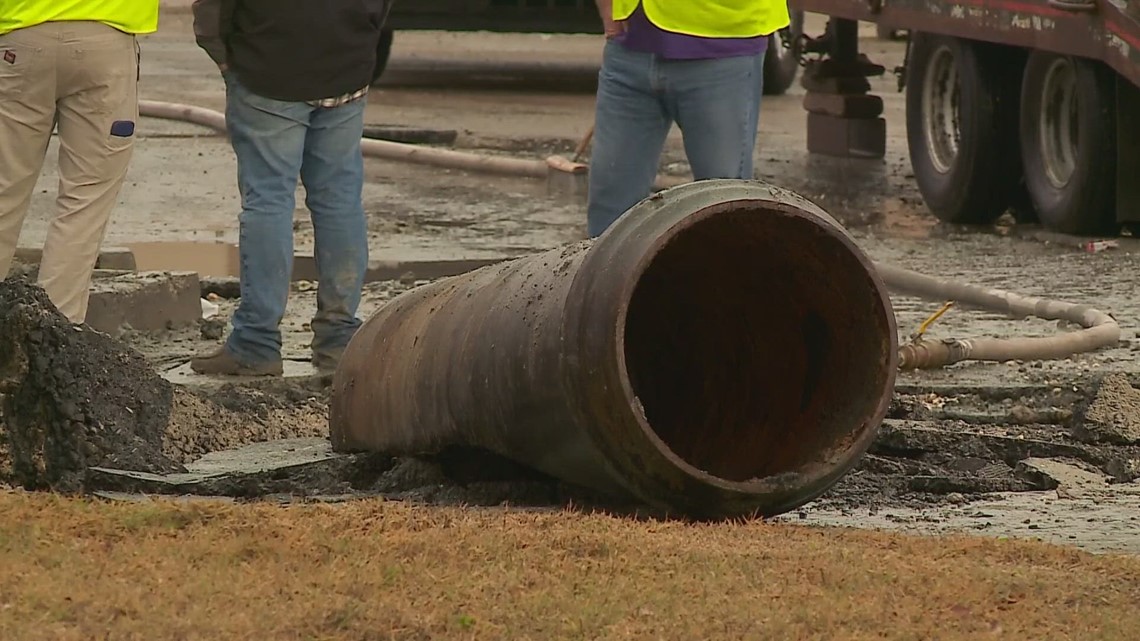
Last week, a massive main broke at South Claiborne Avenue, triggering boil-water advisories for Uptown, the CBD, the French Quarter, the 9th Ward, Mid-City, Gentilly, and large sections of New Orleans East. Council members stood before SWB Executive Director Randy Hayman and rattled off leaks that had been reported “over and over and over” — at Norman C. Francis Parkway, at Magazine Street, at Burgundy and Deslonde in Holy Cross — with no response, no timeline, and no plan. Hayman, to his credit, was direct: another break is not a possibility. It is a certainty. “One main break is one too many,” he said.
This is not a water emergency. This is a governance emergency. And it has been for decades.
SWBNO Crisis — By the Numbers
~70% Of treated drinking water estimated lost — engineers place the range at 50–76 percent
$2.8B Estimated pipe replacement cost in 2003 dollars — over $5B today
1,600+Miles of sewer infrastructure managed by SWBNO
150 Employees short of full staffing, per SWBNO’s own estimate
$87.5M Owed by SWB to the City of New Orleans for fronted road and water costs
3 Separate governmental entities governing SWB — a structure built to fail
“If we can’t flush the toilets in the French Quarter, the state of Louisiana is financially devastated. You cannot police your way out of a sewer collapse.”
Former New Orleans City Councilman Oliver Thomas
The Can Has Finally Hit the Bottom of the Road
Understand the full scope of this failure. A 2003 engineering master plan, commissioned by the SWB itself, concluded that replacing nearly all of the city’s water distribution mains would cost $2.8 billion in 2003 dollars. That plan was never finalized — shelved, at the direction of SWB leadership at the time. In the years since, the infrastructure aged another two decades in one of the most hostile soil environments on earth: subsiding, corrosive, saturated ground that is harder on buried pipe than almost anywhere else in the United States.
In 2026 dollars, engineering estimates for a complete water, sewer, drainage, and power infrastructure overhaul range from $5 billion to $7 billion or more over a 20-year rebuild cycle. And every year of delay makes it worse, and more expensive. We are not talking about a problem that can be patched. We are talking about a system that must be rebuilt — while people live in it, while business operates through it, and while the state’s largest economic engine depends on it.
The billing crisis, at least, appears to be on its way to correction. Smart meter installation is underway and expected to be complete by 2026. A new billing software system is in procurement. These are necessary and welcome improvements. But fixing a bill is not the same as fixing a pipe.

Under New Management
New SWB Executive Director Randy Hayman has just come back from Washington making the case for $20 million in federal funding to address 34 miles of transmission mains. That is a start. A real start. But 34 miles is a fraction of what must be done. The city has more than 1,600 miles of sewer infrastructure alone. New Orleans must come to the table with its own plan, its own funding, and its own political will. Without that, Washington doesn’t write checks — it sends its regrets.
Mayor Moreno: The Mandate Is Now, Not Later
Helena Moreno was elected mayor of New Orleans on October 11, 2025, with 55 percent of the vote — a first-ballot outright majority in a multi-candidate field. She did not stumble into office. She dominated. Moreno outran Oliver Thomas. She outran Royce Duplessis. Certainly she is, in the most meaningful sense of the word, a mandate mayor.
She was sworn in on January 12, 2026 — just 63 days ago. Her honeymoon is real. The people love her. The governor congratulated her. The business community is aligned. Even political opponents are watching with measured goodwill. Every new mayor has a window of public grace. For Moreno, given the scale of what she promised, it may be shorter than most.
She ran on a platform of Super Bowl-level city services — every single day, not just when the cameras are on. She told voters, “While some may see a broken city, I actually see so many solutions.” That was not campaign rhetoric. That was a covenant. The people of New Orleans did not vote for a study. They voted for a plan.
Show Us You Get It
Mayor Moreno: you must present that plan now. Not in six months. Not after a commission study. Now. Your political capital is burning whether you spend it or not. Spend it on something that matters.
New Orleanians understand the system is old. What they will not accept is being asked to pay more without a real plan attached to every dollar. Give them a plan with teeth, a timeline they can track, and equity protections that prove you are not asking the least fortunate to carry the heaviest load, and they will support you. That is not a political risk. That is a political opportunity.
“Her honeymoon is real. But honeymoons end. And the pipes break whether it’s politically convenient or not.”— Jeff Thomas, BackSource Media
Governor Landry: Police Can’t Protect a City With No Running Water
Governor Jeff Landry has deployed Louisiana State Police, requested National Guard troops to address the city’s crime crisis, and publicly committed to being a partner with City Hall. The goodwill between the governor’s office and the new mayor appears genuine.
But the SWBNO is a state agency. Not a city agency. Not a parish agency. A state-chartered, state-governed body. The Governor of Louisiana has direct authority and responsibility for this system in ways that no mayor ever will. The state sends police to New Orleans because New Orleans matters to the state. Good. It should. Now the state must recognize that crime is not the existential threat to Louisiana’s economy — infrastructure collapse is.
Louisiana benefits enormously from New Orleans’ economic activity. Tourism alone generates more than half a billion dollars annually in direct state and local tax revenue from Orleans Parish — more than any other parish in Louisiana by a significant margin. When New Orleans functions, Louisiana prospers. The investment runs both directions.
So here is the calculation that Baton Rouge must make: if the sewer system fails in the French Quarter, the hotels close. If the hotels close, the conventions cancel. If the conventions cancel, the restaurants shutter, the bars go dark, the musicians leave, and the tourists never come back. You cannot replace that with any combination of other parishes. There is no backup plan. New Orleans is the plan.
Governor Landry: the state must commit real money to SWB infrastructure. Not study money. Not task-force money. Capital investment money. The kind of investment the state has been making in stadiums, roads, and industrial tax exemptions for decades — but never adequately made in the pipes that keep the whole enterprise alive.
The Plan: A 20-Year, Phase-Funded Rebuild
The BackSource Model for SWBNO Reconstruction is built on four premises: urgency, equity, accountability, and financial reality. No plan that ignores the working poor survives politically. No plan that lacks hard numbers survives economically. And no plan that lacks public trust survives at all. Here is what a real plan looks like.
| Phase | Timeline | Priority | Est. Cost | Primary Funding |
|---|---|---|---|---|
| Phase 1 — Emergency Stabilization | 2026–2028 | Replace top 50 highest-risk transmission mains; power complex completion; lead pipe removal; smart meter buildout | $800M–$1.2B | Federal IIJA grants, state capital outlay, SWB revenue bonds |
| Phase 2 — Core Network Rebuild | 2028–2033 | Replace aging lines in CBD, French Quarter, 9th Ward, Gentilly, Mid-City; sewer rehabilitation; pump station upgrades | $1.5B–$2.0B | Revenue bonds, tiered rate increase, state capital commitment, federal SRF loans |
| Phase 3 — Residential Modernization | 2033–2040 | New Orleans East, Algiers, remaining residential distribution lines; drainage canal rehabilitation; green infrastructure | $1.5B–$2.0B | Rate revenues, federal grants, municipal bonds, state infrastructure bank |
| Phase 4 — Long-Term Resilience | 2040–2046 | Climate-adaptive upgrades; full system redundancy; technology modernization; final integration | $800M–$1.0B | System revenues, capital reserves, federal climate resilience funding |
| Total 20-Year Investment Estimate | $4.6B–$6.2B | Multi-source blended financing | ||
How New Orleanians Pay: A Just Financing Model
Here is the hardest truth: the people of New Orleans will have to pay more for water and sewer service. There is no version of this plan — no federal grant, no state commitment, no bond program — that fully shields ratepayers from rate increases. But the increases can be structured so that they fall heaviest on those most able to bear them, and lightest on those who cannot.
The BackSource Rate Equity Model creates a tiered system based on household income, property classification, water usage, and neighborhood infrastructure need. It is not a punishment for success. It is a recognition that a functional city is worth paying for — and that the weakest members of our community should not be the ones who pay for decades of political cowardice with their water bills.
Tier 1 — Protected
Income below $25,000
0–10% increase, capped
Subsidy program; fixed-income seniors auto-enrolled; income-verified annually; no service shutoffs
Tier 2 — Working Families
$25,000–$50,000
10–20% phased over 5 years
Conservation credits; flexible payment plans; no shutoffs during phase-in
Tier 3 — Middle Income
$50,000–$100,000
20–35% phased over 5 years
Smart meter data rewards low-usage households; increases tied to demonstrated system improvements
Tier 4 — High Income / Commercial
$100,000+ / Hotels / Restaurants
35–60% over 7 years
High-volume commercial users bear proportional burden; French Quarter tourism surcharge applied
New Orleans Utility Assistance Endowment — Proposed Structure
Seeded with $50 million from the State of Louisiana and $25 million from the City of New Orleans at program launch. Administered independently — not by the SWB.
Automatic enrollment for households at or below 200% of the federal poverty line, seniors on fixed incomes, and residents in historically underserved neighborhoods with documented histories of billing errors or service failures.
Refilled annually through a dedicated tourism infrastructure surcharge applied to hotel room sales in Orleans Parish — the people who profit most from a functioning French Quarter help fund the system that keeps it functioning.
For renters — who make up a large share of New Orleans’ population — the city enacts pass-through protections: landlords cannot pass the full rate increase to tenants without demonstrating equivalent capital improvement to the rental unit’s internal plumbing. This breaks the cycle where tenants pay more for worse service while landlords pocket the difference.
The Governance Fix That Has to Come With the Money
Money without accountability is a New Orleans tradition, and it has not served the city well. As of January 2025, the SWB assumed responsibility for the city’s 72,000 catch basins and small drain pipes — inheriting a backlog of over 5,000 work orders in the process. That is progress. But the deeper governance problem remains: fractured authority split among the mayor, the legislature, and the City Council produces an organization built for delay, not results. It must change.The next step is a unified governance structure with a single executive authority, a fully professional board, a public dashboard of real-time repair milestones, and annual independent audits published in plain language for every New Orleanian to read.
No more excuses from four different agencies. One system. One accountability structure. One throat to grab.
What Must Happen — Immediately
- Mayor Moreno must present a comprehensive 20-year SWB reconstruction plan within her first 100 days — with cost figures, phase timelines, rate tier structures, and equity protections built in from the start. Not a framework. A plan.
- Governor Landry must commit state capital investment in SWB infrastructure — no less than $500 million over 20 years. The state owns this system. The state must fund this system.
- SWB Executive Director Hayman must publish a 90-day emergency action plan identifying the top 25 highest-risk main segments in the city, with repair timelines and a weekly public dashboard.
- The City Council must authorize an independent infrastructure audit — a professional engineering firm with a published report due within 180 days, with findings binding on the SWB’s capital plan.
- Louisiana’s Congressional delegation must secure a minimum of $500 million in additional federal infrastructure allocations for New Orleans water and sewer over the next 5 years.
- A unified rate equity structure must be adopted before any rate increases take effect — no household below 200% of poverty level should see a net increase in their water bill without a corresponding subsidy in place.
The Stakes Are Not Abstract
This is not an op-ed about technical systems and engineering tolerances. This is an op-ed about whether New Orleans survives as a functioning city. The French Quarter generates more economic activity per square mile than almost any neighborhood in the American South. The hotels, the restaurants, the festivals, the port, the convention center — all of it depends on the basic civic infrastructure that New Orleanians have been promised and denied for three generations.
If the toilets stop flushing in the French Quarter — and they will, if this continues — the hotels close. If the hotels close, the conventions move. And if the conventions move, the restaurants close. If the restaurants close, the musicians go to Nashville and Austin, where the pipes work. And the more than half a billion dollars in annual tourism tax revenue that New Orleans pours into Louisiana’s treasury evaporates. Louisiana benefits enormously from what New Orleans produces. It will feel the loss in ways Baton Rouge is not prepared for.
This is not hyperbole. This is math.
Helena Moreno ran on the promise of making New Orleans work. Jeff Landry has made it clear that a functioning New Orleans matters to him as governor. This is the moment where that promise and that claim are tested in the most concrete way possible: not with speeches, not with studies — but with a plan, a number, a timeline, and a signature on a funding commitment.
The people of New Orleans have been patient. They have rebuilt after Katrina. They have absorbed every billing error, every boil-water advisory, every broken street, every collapsed pipe. Our people are still here. They are watching. And they are paying — for water that never reaches their taps, from a system that is crying out for someone to lead.
Mayor Moreno, your mandate is not just permission. It is a clock. Governor Landry, your partnership is not just political. It is a legal and fiscal obligation. The Sewerage and Water Board of New Orleans will not fix itself.
Fix it. Now. While there is still something left to fix.
Flush or Fall — The Complete Four-Part Series
This is the first in a four-part series on the New Orleans Sewerage and Water Board crisis. Over the next two weeks, BackSource Media will examine the full scope of the failure, present a real plan to fix it, lay out who should pay and how, and deliver a direct call to action to the people who have the power to act. The full reference article is below. The series begins Monday.
Part 1 — Monday, March 16
She Came Back After Katrina. The Water Board May Finally Break Her.
Doris Paige rebuilt after thirteen feet of floodwater. Now, at 72, she owes the SWB $3,000 for water she never used. Her story is the story of a system in collapse.
Part 2 — Thursday, March 19
No More Studies. Here’s What a Real 20-Year Plan Looks Like.
The plan to fix the SWB is not a mystery. Jeff Thomas presents the four-phase reconstruction model with real numbers and real timelines.
Part 3 — Monday, March 23
Who Pays — A Rate Model That Protects the Poor and Funds the Fix.
Yes, rates must rise. A tiered system can protect seniors, working families, and renters while placing the real burden on those who profit most.
Part 4 — Thursday, March 26
Mayor Moreno, Your Honeymoon Is a Clock. Governor Landry, Lead.
Moreno won 55% on a promise to make New Orleans work. Landry co-owns this state agency. Six specific demands. No more excuses.
Jeff Thomas is a contributor to BackSource Media covering New Orleans politics, civic affairs, and accountability journalism. This article incorporates data from the SWBNO Q2 2024 Operations Report, the Governor’s SWB Task Force Final Report (2024), the Louisiana Tourism Spending Report (2022), the Bureau of Governmental Research, and reporting by WWLTV, Fox 8 Live, The Times-Picayune / NOLA.com, and The Lens.
Corrections, data disputes, or official responses may be submitted to BackSource Media at jeff@think504.com. We will publish verified corrections promptly.
© 2026 BackSource Media. All rights reserved.