

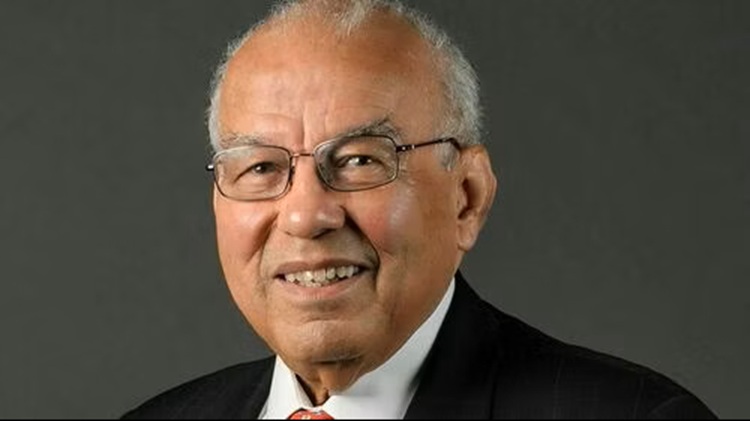
Dr. Norman C. Francis was not simply a university president.
He was an architect of Black excellence, an economic builder, a civic strategist, and arguably the most consequential figure in modern New Orleans history.
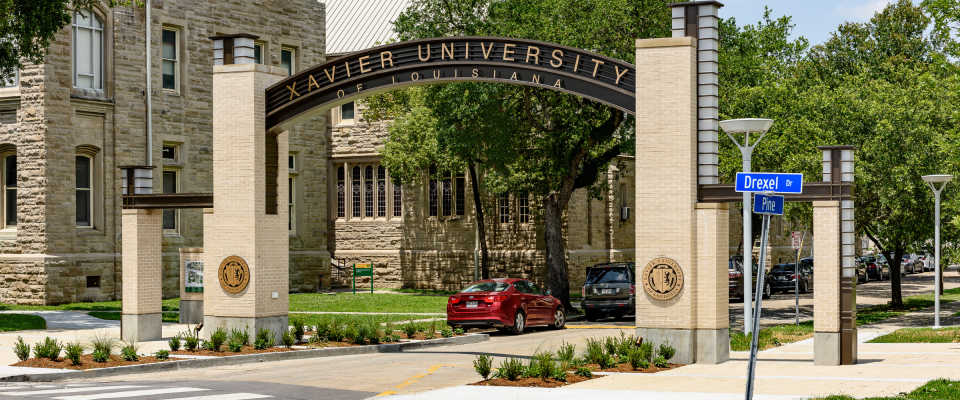
For nearly five decades, he led Xavier University of Louisiana and transformed it into a national powerhouse — not through inspiration alone, but through structural change that altered the professional trajectory of Black America.
The #1 Producer of Black Medical School Admits in America
Under his leadership, Xavier became — and remains — the number one college in the United States for placing African Americans into medical school.
Not number one among HBCUs.
Number one among all colleges and universities in America.
That distinction matters.
In a nation where African Americans remain severely underrepresented in medicine, Xavier created a pipeline that changed the demographics of healthcare. Doctors across Louisiana, Texas, California, New York, and beyond trace their path back to the systems Dr. Francis built.
He didn’t inspire excellence. He institutionalized it.
And he demanded rigor. He built advising structures that actually worked. He created expectation, not hope. Dr. Francis proved that Black achievement in the most competitive fields isn’t about talent — it’s about infrastructure.
That is structural change.
And it altered the professional class of Black America in ways that will compound for generations.
A Builder Beyond Campus Walls
Dr. Francis understood something most educators miss: academic excellence means nothing without economic power and political influence.
So he built across every sector:
• Co-founder of Liberty Bank and Trust, now one of the largest Black-owned banks in America • Among the original ownership group of the New Orleans Saints — not as a token, but as an investor who understood that Black wealth requires ownership • Advisor to U.S. presidents on education and civil rights • Chair of the Louisiana Recovery Authority after Hurricane Katrina — when the city needed strategic rebuilding, they turned to him • Counselor to governors, mayors, judges, legislators, and business leaders across Louisiana
There is a credible argument that no individual has shaped modern New Orleans more comprehensively — across education, finance, politics, civil rights, and disaster recovery.
He didn’t just participate in these spaces. He shaped them.
A Personal Reflection
My parents attended Xavier. I attended Xavier. We lived around the corner from Dr. Francis.
He would visit my parents while I was in college. And he did not engage me casually.
He knew my schedule. He asked about a new African American Studies class the university had just introduced. Dr. Francis explained the professor’s background and how the university structured the curriculum in this relatively new field in academia. He wanted me to make sure the course was relevant, informative, and worth building upon.
Then he asked for my assessment.
Not my opinion. My assessment.
That moment changed me.
It forced me to approach college with seriousness I hadn’t yet developed. It deepened my understanding of the African American experience as something to be studied, not just lived. But most of all, it made me see education not as attendance, but as responsibility — to myself, to my community, to the institution investing in me.
He likely did not know how profound that interaction was for me.
But that was his power. He invested personally while building institutionally. He made individual students feel seen while constructing systems that would outlive him.
Related: Xavier University to Open a Medical School
The Standard He Set
Dr. Francis proved something that cannot be disputed:
Black excellence is not accidental. It is built. It is organized. And it is disciplined. Black excellence is expected.
By making Xavier the nation’s leading producer of African Americans admitted to medical school — not just once, but consistently, year after year — he did not just elevate a university.
He elevated a people.
He created proof that when Black students are given rigorous preparation, high expectations, and institutional support, they don’t just compete — they dominate.
That evidence matters. Because it destroys every excuse about why Black achievement gaps exist.
What We Lost
New Orleans lost a giant.
But his work lives in every hospital wing staffed by a Xavier graduate, every courtroom led by a Xavier alum, every boardroom shaped by someone he mentored, every Black-owned business financed by Liberty Bank, every policy debate informed by the systems he built.
Dr. Norman C. Francis was not simply a leader of Xavier.
He was a builder of futures — institutional, economic, political, and personal.
And New Orleans may never see his equal again.
Not because we lack talent. But because we may lack the will to build with the same long-term vision, the same refusal to accept limitations, the same understanding that real change requires structures, not sentiment.
He showed us what is possible when one person commits to building power — not just for themselves, but for generations yet unborn.
That is legacy.
That is what greatness looks like.
This was an excellent read and article. Dr. Francis was and is a GIANT in all aspects of life. Thank you for sharing your experiences that you received from him. He will be greatly missed. R.I.H. Dr. Norman C. Francis 🙏🏾🙌🏾