

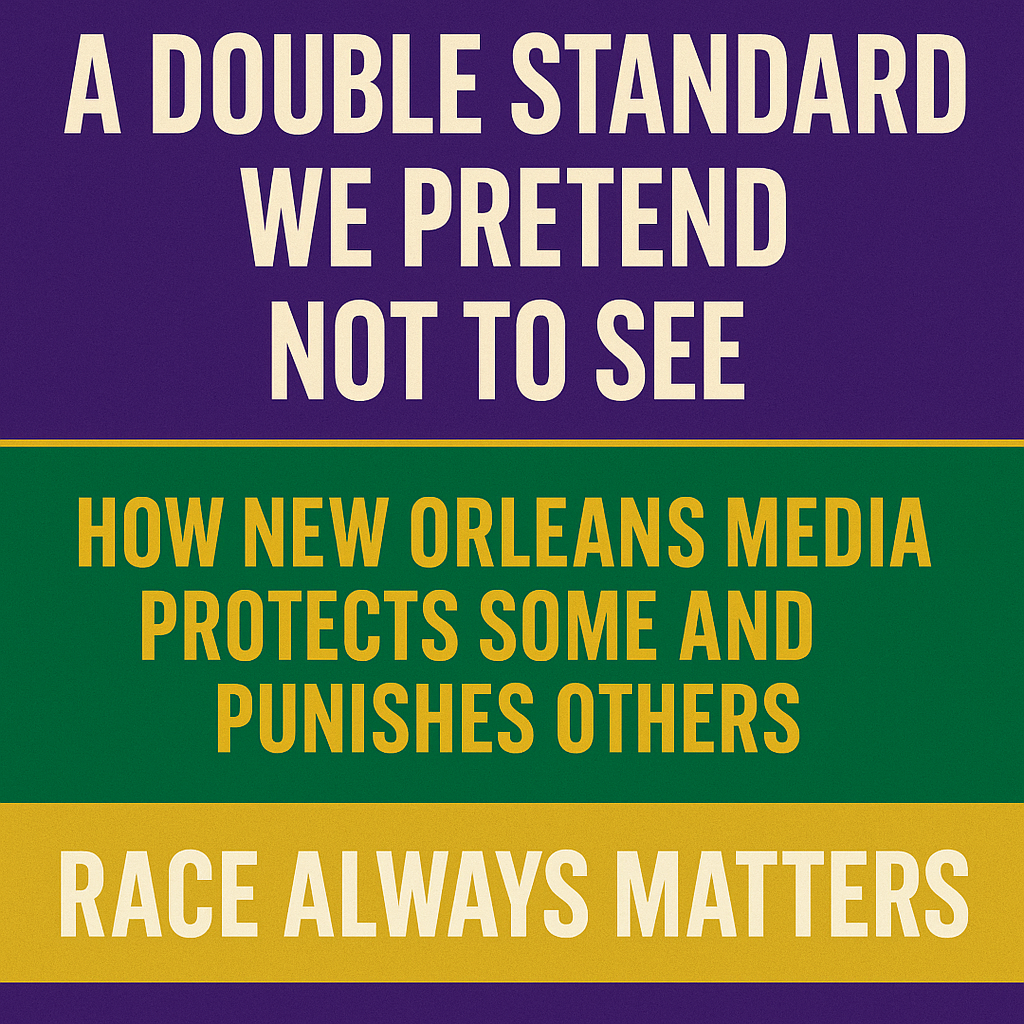
New Orleans claims that race doesn’t matter in politics or media coverage. But the truth is simple: when Black leadership faces scrutiny, local media unleashes full force. When non-Black officials fail, mismanage, or mislead the public, the same outlets soften the language, shift the blame, or skip the story entirely. This double standard has shaped political narratives for years — and the latest budget crisis proves it again.
How Black Leaders Get Punished While Others Get Protected
Local reporters and political commentators have long weaponized questionable Black associates against Black officials. Ike and Blair — these names were used to smear Desiree Charbonnet through association alone. Headlines amplified suspicion, not evidence.
Yet when the same types of figures orbit White or Hispanic politicians, the media applies a different rule. Their relationships become “strategic alliances,” “political necessities,” or simply not worth mentioning. The scrutiny disappears. Accountability evaporates.
That’s not fairness. It’s selective prosecution.
The Real Scandal: A Budget Crisis the Press Downplayed
While New Orleans fell into a historic financial crisis, the media focused on trivial controversies — plane-ticket upgrades, travel drama, and personal scandals.
Here’s what they should have covered with urgency:
- In April 2025, Chief Administrative Officer Gilbert Montaño publicly predicted a budget surplus.
- Months later, New Orleans faced a $160 million deficit — one of the worst fiscal shortfalls in modern city history.
- Budget Chair Joe Giarrusso and Councilmember Helena Moreno accepted those rosy projections without sufficient challenge.
- Finance Director , RomySamuel, reportedly raised concerns about the city’s finances, but her warnings carried less weight than Montaño’s assurances.
- Moreno missed 60% of budget meetings, yet media outlets completely ignored the negligence.
If these failures had come from Black councilmembers, New Orleans’ major news outlets would have launched week-long investigative series. Editorial boards would demand resignations. Every talk show would rehearse the same refrain: “Black leadership fails again.”
But this time? Silence. Deflection. Amnesia.
Related: Montaño’s Massive Misinformation Campaign
The Obsession With Scandal Over Substance
While services eroded and the city spiraled into financial instability, the press hyper-focused on salacious distractions:
- First-class plane tickets
- Personal disputes
- Character gossip
- Isolated staff issues
These topics generate clicks — but they don’t protect taxpayers, fix infrastructure, or improve public trust. New Orleans needed investigative reporting, not tabloid politics.
A real press would have demanded answers about:
- How Montaño’s projections went so wrong
- Why the Council failed to verify basic financial data
- Why warnings inside City Hall were ignored
- And why so few budget meetings were attended
- How a predicted surplus became a massive deficit
That should have been the front-page story every day.
The Standard New Orleans Needs — And the One We Aren’t Getting
A strong media ecosystem investigates power, regardless of who holds it. It questions assumptions, verifies facts, and applies equal scrutiny across race, class, and connections.
Instead, New Orleans sees:
- Over-coverage of Black missteps
- Under-coverage of White and Hispanic failures
- Selective outrage
- Narratives shaped by comfort, not truth
This harms democracy. It distorts public perception. And it protects those most responsible for the city’s most damaging failures.
Race Always Matters — Especially When Truth Is Inconvenient
Dr. Cornel West wrote that race always matters — especially when it shapes who gets uplifted and who gets torn down. New Orleans proves this daily. The narrative isn’t determined by performance or accountability — but by which leaders the press feels comfortable criticizing and which ones it prefers to protect.
New Orleans deserves a media that investigates real issues, not gossip. A media that covers the budget crisis with the same intensity it covers travel upgrades. A media that recognizes racial bias in coverage and corrects it.
Because the truth is clear:
Race always matters — but it’s the media that keeps making it matter.
And until that double standard ends, New Orleans will never get the honest, rigorous journalism it deserves.
Great editorial Mr. Price. It’s really sad how low the bar has been lowered. Low-hanging fruit is the norm now. Nobody wants to put in the work.
You see it in Entertainment, Law Enforcement and the Media. Really sad! We live in a world of short cuts. Awful!