
TL;DR
On Nov. 3, every Louisiana voter will see 10 proposed changes to the state constitution. Five of them deal with property taxes. The rest cover bail, how long a governor can serve, state pension debt and lead water pipes. Below, we explain each one in plain English, and you can build your own ballot cheat sheet to take with you.
Key Points
- Half of the 10 amendments deal with property taxes.
- Amendment 7 would help New Orleans replace lead water pipes at people’s homes.
- Under Amendment 9, more homeowners could qualify to keep their home’s taxable value from going up.
- Early voting is Oct. 20–27. Polls are closed Sunday, Oct. 25.
When you vote on Nov. 3, the end of your ballot will have 10 questions about changing the state constitution. These Louisiana constitutional amendments can be tough to read. Lawyers write the official wording, and it usually sounds like it.
So we wrote this guide in everyday language. You don’t need a law degree to follow it, and you shouldn’t need one to vote. Each amendment below gets its own box showing what a yes vote and a no vote would do.
To be clear, we aren’t telling you how to vote. That’s your call. Our information comes from the bills themselves, news reporting and the guide from the Public Affairs Research Council of Louisiana (PAR), a nonpartisan group that studies state government.
☑ Take your choices with you
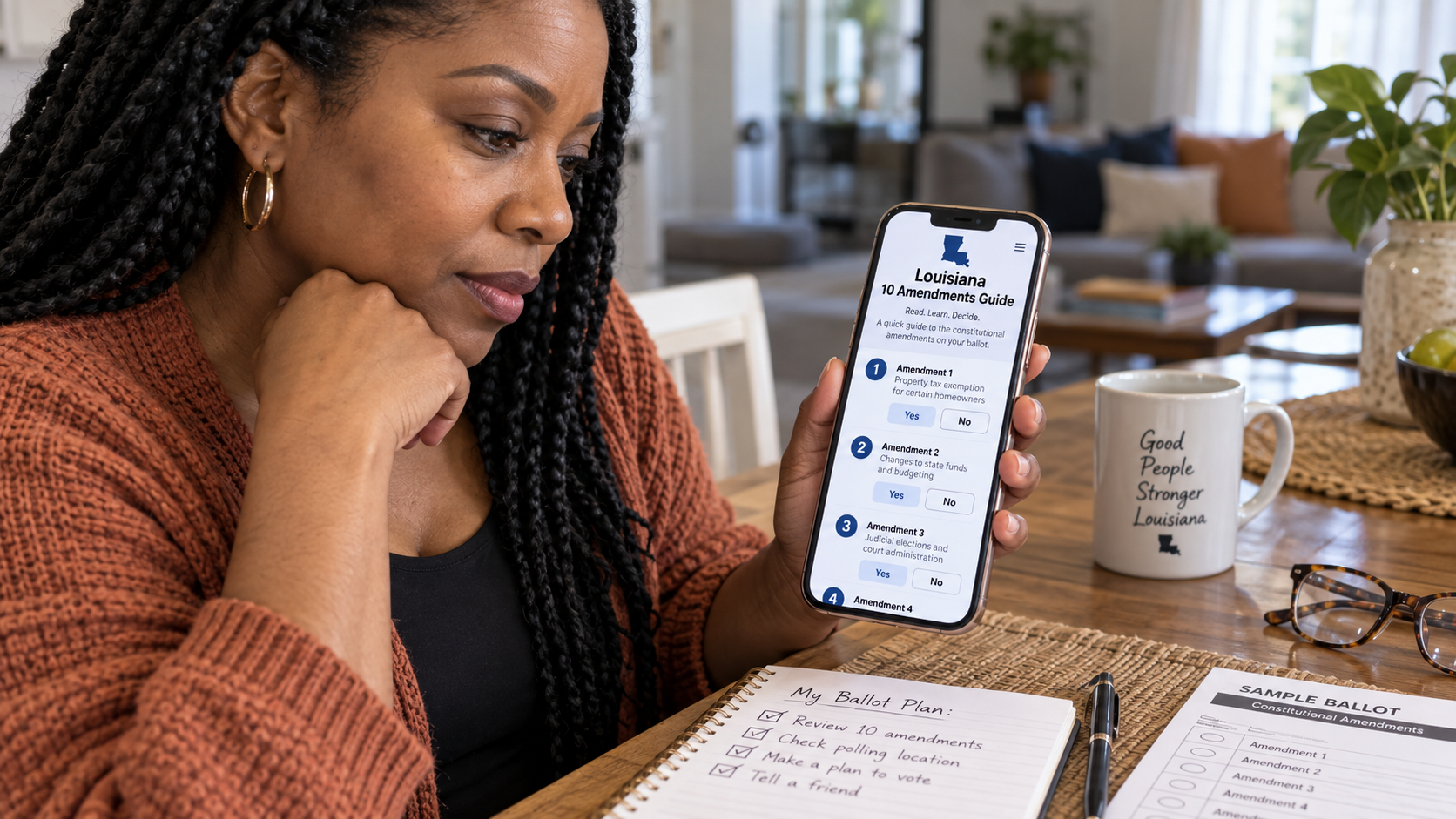
After you review the amendments, you’ll find something special at the bottom of this page. We built a Build Your Own Ballot tool just for you. Check yes or no on each amendment, and it creates a personal guide you can print or keep on your phone to take with you when you go to vote.
Louisiana Constitutional Amendments at a Glance
10
amendments on every ballot
5
deal with property taxes
Oct. 20–27
early voting
Nov. 3
Election Day
Three things to know first
☑ Each amendment needs more than half of the votes statewide to pass.
☑ You vote on each one separately. It’s fine to vote yes on some and no on others.
☑ A yes vote changes the constitution. Voting no leaves things the way they are now.
Tap a number to jump to that amendment:
What Each Amendment Would Do
Property tax
Amendment 1: Tax break for veterans’ surviving spouses
When a disabled veteran dies, their husband or wife can keep a special property tax break on the home. Right now, they lose it if they move.
☑ If you vote YES
The spouse could move the tax break to a new home one time.
☒ If you vote NO
The spouse keeps the break only by staying in the same house.
Something to think about: Sometimes a widow needs a smaller place or wants to live closer to her children. This would let her move without losing the break.
Property tax
Amendment 2: More time to raise a lowered tax rate back up
Your parish, school board and other local bodies can lower your property tax rate. If they do, they only have until the next time property values are reassessed to bring it back up to the highest rate voters already approved. After that, the higher rate is gone for good.
☑ If you vote YES
Local bodies would get more time. They could keep a rate low longer and still raise it back up later.
☒ If you vote NO
Today’s deadline stays in place.
Something to think about: This doesn’t raise your taxes today. It does make it easier for your rate to go back up down the road. On the other side, local governments might be more willing to cut rates if they know they won’t lose the option to raise them again.
Criminal justice
Amendment 3: No bail during appeal for certain crimes against children
After someone is found guilty, a judge can sometimes let them stay out of jail while they appeal, which means asking a higher court to review the case.
☑ If you vote YES
People convicted of certain serious crimes against children could not get out on bail while they appeal.
☒ If you vote NO
Current rules stay, and judges could still allow bail in some of these cases.
Something to think about: Supporters say this protects children who were harmed. Others are uneasy with any rule that takes the decision away from the judge who knows the case.
Government
Amendment 4: Two terms for governors, for life
Right now, a governor can serve two terms in a row. After sitting out a term, they can run again.
☑ If you vote YES
A person could only serve two terms as governor in their whole life. There’s also a rule for anyone who serves more than a term and a half, and PAR’s guide spells out exactly how that counts.
☒ If you vote NO
Today’s rule stays. A former governor could still come back after taking a break.
Something to think about: This would end comebacks by former governors. It would also give voters fewer choices in future races.
State budget
Amendment 5: How the state pays down retirement plan debt
Louisiana owes a lot of money to the retirement plans for teachers and other public workers. When the state has extra one-time money to put toward that debt, the constitution says the oldest debt gets paid first.
☑ If you vote YES
The state and the retirement plans could choose which debt to pay down.
☒ If you vote NO
The oldest debt still gets paid first.
Something to think about: Would having a choice save the state money? Or would it just make the money easier to move around?
Property tax
Amendment 6: Bigger property tax breaks for people 65 and older
Many older homeowners are stretched thin by insurance bills, repairs and property taxes. This amendment is about giving them more local help.
☑ If you vote YES
Your parish or city would be allowed to give homeowners 65 and older an extra property tax break. The break could grow as they get older.
☒ If you vote NO
Seniors keep the tax breaks they have now, with no new local option.
Something to think about: Nobody gets this break automatically. Your parish or city would have to decide to offer it. And when some people pay less, there’s less money for local services like fire protection and parks. Many seniors are already stretched thin by high insurance bills, something we’ve covered in our reporting on Louisiana’s insurance crisis and Black wealth.
Water
Amendment 7: Replacing lead water pipes at people’s homes
In many older homes, a lead pipe carries water from the main line to the house, and part of that pipe sits on the homeowner’s property. The state constitution says public money can’t be handed to private property owners. That rule could keep the Sewerage and Water Board from replacing the homeowner’s part of the line.
☑ If you vote YES
Local governments could use public money to find and replace lead water lines on private property.
☒ If you vote NO
The current limits stay.
Something to think about: The federal government has approved a $152 million loan to help the Sewerage and Water Board replace lead pipes. Federal rules say the pipe has to be replaced on both the city’s side and the homeowner’s side. A yes vote would let New Orleans start using that money right away. State Sen. Royce Duplessis of New Orleans wrote the amendment. This change would apply across the whole state. Even with the loan, the job is huge, since the S&WB says replacing every lead line in the city will cost more than $1 billion.
Property rights
Amendment 8: Keeping foreign enemies from taking Louisiana land
In some cases, the government can take private land for public use, like building a road, as long as it pays the owner. That power is called expropriation.
☑ If you vote YES
Groups the law labels as foreign adversaries, and anyone working for them, could never use that power in Louisiana.
☒ If you vote NO
The current rules stay.
Something to think about: How much this really changes depends on which countries and groups the law counts as foreign adversaries.
Property tax
Amendment 9: More homeowners can freeze their home’s taxable value
Some homeowners can freeze their home’s assessed value. That’s the number the assessor uses to figure your property tax. Once it’s frozen, it can’t go up as long as you qualify. Right now, your household has to make $100,000 a year or less.
☑ If you vote YES
The income limit would go up to $150,000.
☒ If you vote NO
The limit stays at $100,000.
Something to think about: More working families would qualify. Keep in mind that a frozen value doesn’t freeze your whole tax bill. Tax rates and other charges can still go up.
Property tax
Amendment 10: Tax breaks for fixing up rundown buildings
Empty, boarded-up buildings drag down a block. This amendment is about giving owners a reason to fix them.
☑ If you vote YES
Parishes could offer a property tax break on buildings that were blighted or abandoned and have since been fixed up.
☒ If you vote NO
No new tax break of this kind.
Something to think about: A tax break could help bring boarded-up houses back to life. If it isn’t set up well, though, it could reward projects that would have happened anyway and cost the parish money.
Why the Property Tax Amendments Deserve a Closer Look
Five of these amendments deal with property taxes: 1, 2, 6, 9 and 10. Property taxes pay for schools, fire stations, drainage and parks. A tax break puts money back in your pocket. Someone still has to pay for those services, though, so either other taxpayers pick up the cost or the services get cut. For a lot of Black families in Louisiana, the house is the most valuable thing they own. That’s reason enough to spend a few extra minutes on these questions.
Build Your Ballot Guide
Ready to decide? Pick yes, no or not sure on each amendment below. Your choice will show a short reminder of what it means. Then print your cheat sheet, save it as a picture or send it to your phone.
Build Your Own Ballot Guide
Tap Yes, No or Not sure on each amendment. We’ll show you what your choice means, then make a personal cheat sheet you can print or keep on your phone.
0 of 10 picked
My Ballot Picks
Louisiana Constitutional Amendments · Election Day: Tuesday, Nov. 3, 2026
- #1—Tax break for veterans’ surviving spouses
- #2—More time to raise a lowered tax rate back up
- #3—No bail during appeal for certain crimes against children
- #4—Two terms for governors, for life
- #5—How the state pays down retirement plan debt
- #6—Bigger property tax breaks for people 65 and older
- #7—Replacing lead water pipes at people’s homes
- #8—Keeping foreign enemies from taking Louisiana land
- #9—More homeowners can freeze their home’s taxable value
- #10—Tax breaks for fixing up rundown buildings
Made with the Black Source Media voter guide · blacksourcemedia.com
Your picks stay on your own phone or computer. Black Source Media does not see, collect or save them.
When and Where to Vote
Early voting
Oct. 20–27, 8:30 a.m. to 6 p.m. Closed Sunday, Oct. 25.
Mail ballot requests
Last day to ask for one is Oct. 30.
Election Day
Tuesday, Nov. 3.
Not sure if you’re registered or where you vote? Look it up on the Louisiana Voter Portal, where you can also see your sample ballot. PAR has a short two-page summary if you’d like something else to print.
The amendments come at the very end of the ballot, and plenty of people skip them. When that happens, the voters who finish make the decision for everyone else. We’ve reported on efforts to weaken the Black vote in Louisiana, and answering every question on your ballot is one way to push back.
The lawmakers who wrote these amendments won’t be in office forever. Whatever voters decide on Nov. 3 will stay in the constitution long after they’re gone. Take a few minutes, read through all 10 and vote on each one.

About the Author
This guide was written by the Black Source Media editorial board. We cover New Orleans and Louisiana politics, power and accountability, with a focus on what public decisions mean for Black communities.
Sources
- Public Affairs Research Council of Louisiana: Guide to the Fall 2026 Constitutional Amendments (Oct. 7, 2026)
- PAR: Two-page summary of the Fall 2026 amendments
- WAFB: Louisiana voters face 10 constitutional amendments in November (Oct. 14, 2026)
- Louisiana Illuminator: Amendment 7 would let New Orleans use federal money for private lead-pipe removal (Oct. 15, 2026)
- Louisiana Secretary of State: Election dates and early voting information
- KNOE: Louisiana election guide, including notes and phones at the polls (May 2026)
Don’t Miss the Next One
Black Source Media lands in your inbox every Sunday and Wednesday with the New Orleans and Louisiana stories other outlets won’t tell straight. Sign up free.
