
TL;DR
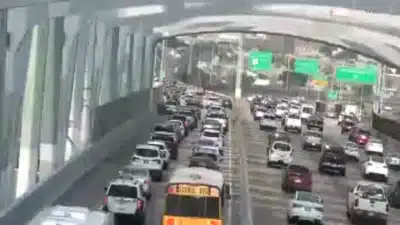
A two-truck crash closed eastbound U.S. 90 Business before the Crescent City Connection for nearly 12 hours on Saturday. The Huey P. Long Bridge was open the whole time, but most drivers never got word to use it until they were already stuck.
Key Points
- The eastbound approach to the Crescent City Connection was closed for nearly 12 hours after a two-truck crash.
- DOTD has used the Huey P. Long Bridge as the official detour during past bridge closures.
- The ferries help, but they cannot carry bridge-level traffic.
- The Regional Planning Commission is taking public comments on its long-range transportation plan through Oct. 12.
I was in that traffic for five hours. It was supposed to be a routine Saturday run to Costco for my weekly groceries and cheap gas, and I was already low on fuel when everything stopped. Eventually I had to turn off the motor to save what was left in the tank. It was raining, so I couldn’t roll the windows down. A weekly errand turned into a nightmare. Hot and stuck.
I scanned the radio and found nothing. Nothing on my phone, either. Only after I downloaded a traffic app did I learn that something bad had happened up ahead. I could have stayed home until it was clear to pass, but I had no way of knowing. That’s bad enough on a Saturday afternoon. On a weekday, it could have cost me hundreds of dollars.
Shortly after 3:30 p.m., two trucks (one of them an 18-wheeler) crashed on eastbound U.S. 90 Business before the Crescent City Connection. The lanes didn’t fully reopen until nearly 12 hours later, WDSU reported.
I don’t want to make this about the wreck itself; crashes happen on every bridge in America. What deserves a closer look is how this Crescent City Connection closure played out for the people stuck behind it, because most of them had no idea how long they’d be there or where else they could go.
There Was Another Way Across
The Huey P. Long Bridge was open all afternoon. That’s an important piece of information. DOTD has named it as the alternate route for Crescent City Connection closures for years, and during a partial closure in January 2025 the agency told drivers to use it by name.
So we already have the detour, and the state already knows it works. What broke down on Saturday was the part in between: getting that message to a driver in Harvey or Marrero while turning around was still possible. Once you’re on the elevated stretch near the bridge, a warning sign is just bad news you can’t act on.
What a Bridge Alert Could Look Like
I’d start with a simple trigger. If officials expect a closure on the bridge to last more than about 45 minutes, a single alert goes out across every channel at once: the overhead message boards, 511, Google Maps and Waze, local radio and TV, and the social media accounts of the city, the parishes and the state. RTA and the ferry operators should share it too.
The wording doesn’t need to be clever. Something like “Eastbound CCC closed, long delay, use the Huey P. Long” would have saved a lot of people a lot of time on Saturday. The goal is to reach drivers early, while they can still choose a different road, leave later or skip the trip.
None of this is futuristic. In these modern times, a delivery company can tell you to the minute when your next meal will arrive. The state can find a way to tell drivers that a bridge is closed and how long it will stay that way. We have to consider the options, and Louisiana needs a real road alert system.
Ferries and Buses Help, Up to a Point
The Algiers/Canal Street and Lower Algiers/Chalmette ferries are both running, according to DOTD, and they matter for people on foot or connecting to a bus. But the Chalmette ferry carries a small number of cars per trip, nowhere near what the bridge moves in an hour, so no one should pretend it can stand in for the bridge.
Transit has a bigger role to play than we usually give it. RTA says nearly 2,000 existing riders begin trips on the West Bank, and its planned Bus Rapid Transit line would connect them to downtown and New Orleans East. Every one of those riders is a car that isn’t on the approach when something goes wrong. That’s capacity, and we should plan for it like capacity.
The Cost Isn’t Spread Evenly
For some families, Saturday meant a missed dinner. For a home health aide who lost a shift, or a parent who couldn’t get to a child on time, it meant something heavier.
There’s a larger worry underneath all of this. If a single crash can strand the West Bank for half a day, what does an evacuation look like with the bridge out of service? The answer should be written down now, with the detour, the police posts at key intersections and the public messaging already decided. Too often in this region, those plans get invented on the fly, in front of everyone, after the damage is done.
Where to Push for It
There’s an opening right now. The New Orleans Regional Planning Commission is accepting public comments on its Metropolitan Transportation Plan 2056 until Oct. 12, and the plan explicitly covers bridges and regional resilience. If you were stuck in Saturday’s traffic, tell them. A short comment asking for a bridge closure alert protocol is exactly the kind of input that plan is supposed to collect.
For more on how state decisions shape life in New Orleans, read New Orleans Is Losing Louisiana. The 2026 Session Just Made It Official.
Nobody could have stopped Saturday’s crash. Twelve hours of drivers guessing, on the other hand, is a problem this region knows how to fix.

About the Author
Langston Price writes institutional and policy analysis for Black Source Media, with a focus on how public systems in New Orleans and Louisiana serve, or fail, the people who depend on them.
Sources
- WDSU: New Orleans US 90B reopens after massive crash delay
- Louisiana DOTD: US 90B Crescent City Connection closure announcement
- Louisiana DOTD: Crescent City Connection partial closure (January 2025)
- Louisiana DOTD: Ferry and moveable bridge status
- New Orleans RTA: Bus Rapid Transit
- New Orleans Regional Planning Commission: Metropolitan Transportation Plan 2056
Don’t Miss the Next One
Black Source Media lands in your inbox every Sunday and Wednesday with the New Orleans and Louisiana stories other outlets won’t tell straight. Sign up free.
