
Every Carnival season, this city gets the world’s attention. Every Ash Wednesday, it squanders it. Dr. Norman Francis spent 47 years proving there’s another way. The question is whether New Orleans is ready to follow his blueprint — or just hang his portrait.
Mardi Gras is over.
The floats are put away. The tourists have gone home. The neutral grounds have been swept. The garbage is in the landfill. The king cake is finished.
TL;DR — KEY POINTS
Mardi Gras Is Over. Black Culture Made It Possible. Now New Orleans Has Until Next Ash Wednesday to Decide What It Actually Builds.
- →Carnival generates nearly $900 million annually. Black culture is not the backdrop — it is the product. Yet when the money is counted, Black New Orleans takes home an hourly wage and someone else pockets the profit.
- →Dr. Norman Francis built Xavier into the #1 institution in America for placing Black students into medical school — with fewer resources than his peers. That is the institutional model New Orleans must follow.
- →New Orleans loses its most educated young Black professionals to Houston, Atlanta, and Washington because it has not built the infrastructure to retain them.
- →The Krewe of Tucks hate imagery incident reveals a governance failure — the city has not enforced consistent standards on racial content in parade permits.
- →A city generating nearly $900 million in Carnival revenue should have world-class schools. That is a resource allocation choice, not an impossibility.
- →The parade was beautiful. The question is what gets built on Ash Wednesday — and every day after.
And New Orleans is left, as it always is on the morning after, with everything it had the morning before.
The same underfunded schools. The same unequal infrastructure. Yes the same working-class Black neighborhoods that served as the backdrop for the party but haven’t seen meaningful economic investment in decades. The same brain drain that pulls the city’s most educated young people toward Houston and Atlanta because New Orleans can’t give them a reason to stay.
Every year, Mardi Gras gives this city a global platform. This year over 2.2 million people visited the city. International television coverage. Economic activity that generates almost $1 billion in a two-week window.
And every year, New Orleans treats that platform as an endpoint rather than a launchpad.
It doesn’t have to be this way.
We know it doesn’t, because one man spent 47 years showing us exactly what’s possible when an institution in this city decides to build instead of perform.
The Norman Francis Standard
Dr. Norman C. Francis became president of Xavier University of Louisiana in 1968.
At the time, Xavier was a small Catholic HBCU on a modest campus in Mid-City. It had a mission. It had a committed faculty. And it had essentially no resources compared to the white institutions that were the default for serious academic investment in the city.
Dr. Francis did not wait for New Orleans to hand him what he needed.
He built it.
Over 47 years — the longest tenure of any university president in American history — he transformed Xavier into the number one institution in the United States for placing African Americans into medical school. Not the top HBCU. The top institution in America, full stop.
He built a pharmacy college that consistently ranks among the strongest in the nation, Black or white. Dr. Francis built a health sciences pipeline that changed the demographic composition of medicine in the Gulf South. He built research partnerships, capital campaigns, and civic relationships that gave Xavier resources and standing that far exceeded what anyone in 1968 would have predicted possible.
And he did not do this by making New Orleans notice him.
He did it by building something New Orleans couldn’t ignore.
That is the standard.
And right now, the city that claims his legacy is not meeting it.
What the Spotlight Costs — and What It Could Buy
The economics of Mardi Gras are not mysterious.
Over one million visitors spend money in this city every Carnival season. Hotels fill. Restaurants book weeks in advance. The service industry runs at maximum capacity. Transportation, retail, entertainment — all of it surges.
Black New Orleanians make that possible.
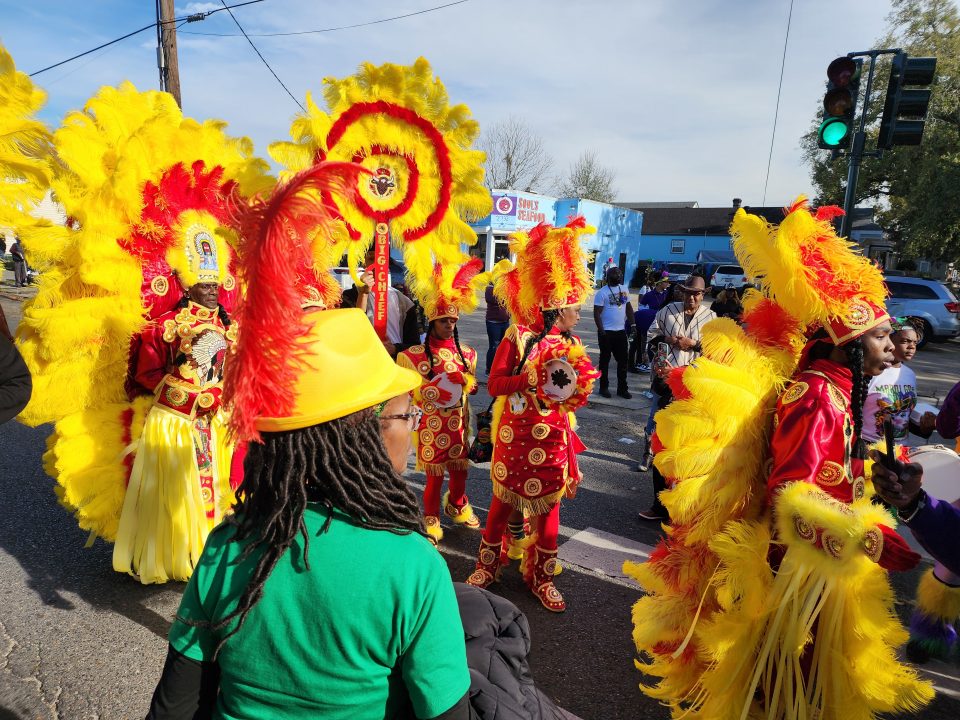
The Indians who have sewn their suits for months. The second line clubs who organize and fund their own productions. The Zulu Social Aid and Pleasure Club, one of the oldest and most beloved krewes in the city’s history. The musicians, the chefs, the bartenders, the hospitality workers, the service sector employees who make the tourism infrastructure run.
Black culture is not the backdrop of Mardi Gras.
Black culture is an integral part of Mardi Gras.
Yet when the money is counted, Black New Orleans takes home an hourly wage and someone else pockets the profit.
The hotels are not predominantly Black-owned. The large restaurant groups are not predominantly Black-owned. The tour operators, the event companies, the media rights holders — these are not predominantly Black-owned enterprises.
Black people create the value. Other people capture it.
That is not an accident. It is a structural outcome. The city built the structure. So the city must tear it down.
What the Post-Mardi Gras Moment Actually Is
Here is what most people miss about Mardi Gras.
The real asset is not the two weeks of carnival. The real asset is the 11 months that follow.
After Mardi Gras, New Orleans has name recognition that most American cities cannot buy. It has a tourism infrastructure that is among the most developed in the country. It has a culinary identity that generates international media coverage year-round. And it has a music tradition that produces artists, producers, and cultural exports that shape American sound.
These are competitive advantages.
Cities build economies on far less.
What New Orleans lacks is not assets. It lacks the institutional will to convert those assets into durable, broad-based economic opportunity — particularly for the Black residents whose culture is the primary source of the city’s global identity.
The School Problem
New Orleans’ post-Katrina school reform experiment was one of the most radical restructurings of a public school system in American history.
The results are complicated. Some charter schools have produced genuine excellence. The Recovery School District model has had real successes. But the overall system still fails too many Black children, particularly those from the lowest-income households.
A city that generates over a billion dollars annually in tourism revenue should have world-class schools.
That is not idealism. That is a resource allocation choice.
Dr. Francis understood this. Xavier University’s pre-med pipeline works in part because Xavier students arrive at college having already been prepared. The city’s failure to produce that preparation at the K-12 level is a civic failure, not an educational mystery.
The Wealth Gap Problem
New Orleans is one of the most economically unequal cities in the United States.
The racial wealth gap in this city is not a historical legacy that will close on its own. It is an active, ongoing disparity reproduced by property ownership patterns, business capital access, contract allocation, and income inequality in the service industries that dominate the local economy.
The city’s tourism dollars flow through a system that was built to extract labor from Black residents while concentrating ownership and profit elsewhere. Changing that requires policy: minority contracting requirements with actual enforcement, capital access programs for Black entrepreneurs, land use and development policies that prevent displacement without economic reciprocity.
None of this happens without intentional, sustained political will.
And political will requires political pressure.
The Brain Drain Problem
The most educated young Black people who grow up in New Orleans leave.
They leave because the jobs are in Houston. Because the income is in Atlanta. Because the professional networks are in Washington. And don’t forget they have student loans that require salaries that New Orleans, for most professions, does not offer.
Xavier University produces physicians and pharmacists who practice across the country. Southern University Law Center produces attorneys who litigate in federal courts nationally. Dillard and Xavier and Southern produce educators, engineers, and civic leaders who build other cities because New Orleans didn’t build the infrastructure to retain them.
That is a failure. Not theirs. The city’s.
Dr. Francis didn’t build Xavier so its graduates would leave Louisiana and never return. He built it to produce people capable of transforming wherever they went.
New Orleans should want those people to come home.
Right now, it isn’t offering them a reason.
The Krewe of Tucks Moment and What It Revealed
This Mardi Gras, a Krewe of Tucks member displayed a Black girl doll hanging by beads from a float.
It was not subtle. It was not ambiguous. Yes it was a public display of racial hatred during the city’s signature cultural event — in a city where Black culture is the foundation of that event.
The outrage was real and it was warranted.
But the outrage also needs to be converted into something more durable than a news cycle.
New Orleans has protocols for float content. Those protocols are not enforced consistently. The question of who has the right to parade in this city, under what conditions, and accountable to whom — these are civic governance questions that the city has refused to answer with the clarity they require.
If you want the culture, you follow the community’s rules.
Not the other way around.
The city’s failure to enforce clear, consistent standards around racial hate imagery at Mardi Gras is connected to the same failure to enforce economic equity in Mardi Gras revenue. Both are expressions of a civic culture that takes Black contribution for granted while protecting white prerogative.
That has to change.
And it won’t change through outrage.
It will change through governance.
What Building Actually Looks Like
The Francis model is not complicated to understand.
Identify a need. Build an institution to meet it. Run that institution with standards, accountability, and mission clarity. Measure outcomes in decades, not election cycles. Refuse to accept symbolic progress in place of structural progress.
Applied to New Orleans in 2026, that looks like this:
Black entrepreneurs need capital. The city should require that a percentage of Mardi Gras-related licensing revenue fund a revolving loan fund for Black-owned hospitality businesses. Measure outcomes annually. Publish the data. Hold elected officials accountable to the numbers.
Black students need prepared schools. The city and state should fund K-12 education at levels commensurate with its tourism revenue. The schools in the Lower Ninth Ward should be as well-resourced as the schools in Metairie. That is a policy choice, not an impossibility.
Black professionals need reasons to stay. Economic development investment — city contracts, infrastructure spending, anchor institution partnerships — should be tracked by who benefits. If the pattern shows that investment consistently flows to non-Black firms while Black residents provide the labor, that pattern requires a policy response.
And Black culture needs institutional protection. The tradition of the Mardi Gras Indians, the second line clubs, the jazz musicians, the chefs who define New Orleans cuisine — these are not tourist attractions. They are living cultural institutions. They deserve funding, legal protection, and civic recognition commensurate with the economic value they generate.
The City This Could Be
Dr. Norman Francis built something in New Orleans that the whole world now points to as a model.
He did it with less money than his peers, less support from the government than he deserved, and more obstacles than anyone should have had to overcome.
He did it because he decided that the institution in his care was going to build — not perform, not protest, not wait — but build.
New Orleans is full of people with that same capacity.
The musicians who have defined American music for generations. The chefs who have shaped how the world eats. The educators, the community organizers, the small business owners, the civic leaders who have kept this city alive through floods, through neglect, through every form of catastrophe the environment and the government have thrown at it.
These people don’t need inspiration.
They need infrastructure.
They need a city government that treats their contributions as assets to be invested in, not labor to be exploited. And they need an economic system that lets them own what they build. They need schools that prepare the next generation. They need a political class that measures success by outcomes, not announcements.
Mardi Gras is over.
The world watched for two weeks.
Now New Orleans has 11 months to decide what it’s actually building.
The parade was beautiful.
It always is.
The question is what comes next.
Jeff Thomas is a columnist and publisher of Black Source Media. He covers civic institutions, education, and community development in New Orleans and the Gulf South.
