
By Jeff Thomas
Monday means something different this year in New Orleans.
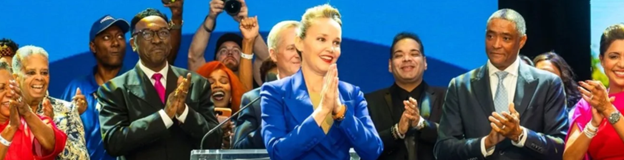
January 12, 2026 will mark the official inauguration of Helena Moreno as the 63rd mayor of New Orleans. Truth told, though, she’s been functioning as mayor since October 12—less than 24 hours after winning the election. That’s when reality hit. Not the glory. Not the celebration. The crisis.
The city was broke. Employees might not get paid. Someone had cooked the books. Moreover, a deficit so massive that even veteran politicians struggled to explain it stared back at her from spreadsheets that should’ve never looked that bad.
So let’s be clear from the jump: this isn’t a normal inauguration. Instead, it’s a rescue mission.
The Numbers Don’t Lie—But City Hall Did
Moreno inherited a $222 million budget deficit from LaToya Cantrell’s administration. Let that number sit with you. In a city with a general fund of roughly $725 million, New Orleans was spending nearly $948 million—money it did not have.
How does this happen? Mismanagement doesn’t begin to cover it. According to Moreno and Council President JP Morrell, the previous administration’s Chief Administrative Officer Gilbert Montano and Chief Financial Officer Romy Samuel weren’t “painting an accurate picture” of the city’s finances. That’s political-speak for lying.
The dysfunction ran deep. The city now must work through a budgetary crisis. Now Moreno must clean up a mess she didn’t start—but one she watched grow from her seat on the City Council—while taking heat for every cut, furlough, and painful decision required to stabilize the city. Accountability doesn’t begin with the oath of office.
Already, she’s announced job cuts—36 unclassified positions, 62 probationary employees gone, and a hiring freeze on 134 vacant positions. Additionally, she’s slashing travel budgets by 75 percent, consolidating departments, and eliminating programs like the Youth Internship Program. Under normal circumstances, nobody would dare touch that program. But these aren’t normal circumstances.
The Transition That Wasn’t
Most mayors-elect receive a transition. This moment shoved Helena Moreno into the deep end with concrete shoes.
Normally, a mayor-elect spends those weeks between election and inauguration building their team. They set priorities. They prepare policy rollouts. Moreno spent that time scrambling to Baton Rouge begging the Louisiana Bond Commission for $125 million just to make payroll. Furthermore, she spent it negotiating with the Sewerage and Water Board to kick $32 million into the general fund. On top of that, she fought with a lame-duck mayor who vetoed a spending freeze designed to protect revenue for the 2026 budget.
“Not 24 hours after I got elected, I was pretty much thrown into being de facto mayor,” Moreno told Newell Normand. “Plus, also be a city council member. Plus, also deal with everything happening in Baton Rouge.”
That’s not governance. That’s triage.
Yet despite all this, she’s hosting an inauguration designed around community this weekend. A day of service. A cultural festival at Lafayette Square. An interfaith mass at St. Louis Cathedral. All of it free. All of it funded without city dollars. Because even in crisis, Moreno understands optics. She knows New Orleans needs to see hope alongside accountability.
But make no mistake—the real work starts Monday. And it’s going to be brutal.
The Four Priorities That Will Define Her
Moreno has been clear about her core focus: public safety, infrastructure, economic development, and fixing the basic functions of government that Cantrell’s administration allowed to rot.
She’s promised to revamp Safety and Permits so thoroughly that residents will be shocked by how easy the department becomes to navigate. She’s committed to transforming New Orleans East—unlocking opportunities tied to the port, recruiting new businesses, and breathing life into Lake Forest Plaza. Meanwhile, she’s vowed to make the city feel “open for business” again.
These aren’t small promises. They’re existential. Because New Orleans has been bleeding residents for years. People leave because they don’t feel safe. They leave because infrastructure fails. They leave because opportunity feels like it exists everywhere except here.
Moreno gets it. “I want to be judged by the fact that people stop leaving New Orleans,” she said. That’s the bar. Not flashy projects. Not ribbon-cutting ceremonies. But whether people stay.
Related: Who’s the Mayor? Cantrell or Moreno?
The Tightrope She Must Walk
Here’s the harder truth: Moreno is a Democrat governing a blue city in the middle of an increasingly red, hostile state. Governor Jeff Landry and Attorney General Liz Murrill are Republican power players who have already shown they’re willing to intervene aggressively in New Orleans affairs. The National Guard deployed here. ICE raids intensified. State oversight expanded.
Consequently, Moreno will have to navigate that relationship with surgical precision. Too much compromise, and her base revolts. Too much confrontation, and the state chokes off funding and support the city desperately needs.
This is the tightrope every New Orleans mayor has walked since Reconstruction. Moreno walks it with the backing of a City Council that holds a working majority ready to govern. Close allies like JP Morrell—her friend and strongest champion—anchor that support, while newer members grow into their roles. Over time, dynamics will shift and alliances will be tested, but Moreno begins with a council positioned to help her execute her agenda, not obstruct it.
And all of it happens under the weight of that $222 million deficit.
What Success Looks Like
If Moreno survives her first term—and that’s the right word, survives—here’s what success looks like:
People stop leaving. Crime stays manageable without militarized state intervention. Infrastructure projects that have been delayed for years finally move forward. The budget stabilizes without gutting essential services. New Orleans East experiences the transformation. And maybe, just maybe, residents start believing their city government actually works for them again.
That’s a tall order. Some would say impossible given what she’s inheriting. But Moreno isn’t walking into this blind. She knows the dysfunction. She’s seen it from the City Council. She fought it. Now she owns the responsibility to fix it.
Monday isn’t just an inauguration. It’s a test—for Moreno, for New Orleans, and for whether real governance can replace years of chaos driven by performative politics that Moreno did not create, but did not challenge while it served her political rise.
New Orleans has been here before—on the edge, desperate, needing someone to step up. Sometimes the city rises. Sometimes it doesn’t. Helena Moreno gets this shot to prove which path this moment takes.
The whole city is watching. And for the first time in years, many New Orleanians are cautiously hopeful that someone who actually says the understand the job is finally doing it.
Let’s see if Monday delivers on that promise.
